

Strengthening ‘the safety net downtown’
Security cameras added to Beacon program bolster will boost business confidence

Advertisement
Read this article for free:
or
Already have an account? Log in here »
To continue reading, please subscribe:

Digital Subscription
One year of digital access for only $205*
- Enjoy unlimited reading on winnipegfreepress.com
- Read the E-Edition, our digital replica newspaper
- Access News Break, our award-winning app
- Play interactive puzzles
*First annual payment billed as $205.00 + GST for one year. This annual subscription will automatically renew at $233.00 + GST every 52 weeks (10% off the regular annual price of $259.35). Offer available to new and qualified returning subscribers only. Cancel any time.
To continue reading, please subscribe:
Add Free Press access to your Brandon Sun subscription for only an additional
$1 for the first 4 weeks*
- Enjoy unlimited reading on winnipegfreepress.com
- Read the E-Edition, our digital replica newspaper
- Access News Break, our award-winning app
- Play interactive puzzles
*Your next Brandon Sun subscription payment will increase by $1.00 and you will be charged $17.95 plus GST for four weeks. After four weeks, your payment will increase to $24.95 plus GST every four weeks.
Read unlimited articles for free today:
or
Already have an account? Log in here »
Hey there, time traveller!
This article was published 22/03/2026 (207 days ago), so information in it may no longer be current.
Snapshots of downtown Winnipeg cover a wall.
They aren’t pictures — they are screens of security footage down Portage Avenue, by True North Square, off Smith Street.
Nearby, a Downtown Community Safety Partnership staffer takes calls. They might change the view on the mounted screens, flipping between 49 security cameras.
Downtown organizations and private businesses are increasingly linking their exterior security camera feeds to a central hub in the DCSP office. It has been using the footage to track issues such as opioid poisonings, and keep an eye on people who may need a mental health check, over the past couple years.
MIKAELA MACKENZIE / FREE PRESS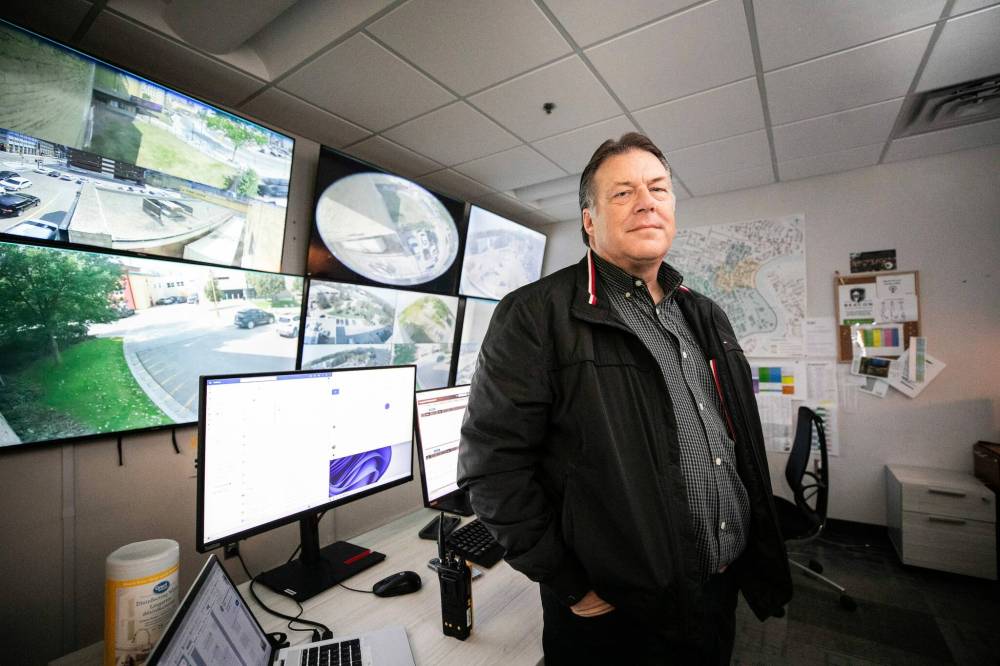
Now the program, titled Beacon, is ready to level up: both the City of Winnipeg and Winnipeg Police Service are preparing to add cameras. Those, in addition to more users, could bring the total camera count above 100.
“We believe that it really strengthens the safety net downtown,” said Brian Scharfstein, owner of Canadian Footwear, at 128 Adelaide St.
He was one of the first on board: the feed from upwards of four cameras at the company’s location are shared with the DCSP. Canadian Footwear spends around $120 to $140 per month on the monitoring program, Scharfstein said.
“To be quite honest, it’s one of my better investments,” he said.
In one instance, his staff needed someone removed from the store parking lot. They called the downtown patrol; a DCSP employee reviewed the relevant tape, saw what was occurring and dispatched someone who knew what to expect. Sometimes, they arrive in five minutes, Scharfstein said.
“There’s a real level of confidence, trust and comfort knowing that somebody’s watching,”
“There’s a real level of confidence, trust and comfort knowing that somebody’s watching,” he said.
The safety partnership isn’t interested in policing, executive director Greg Burnett emphasized. It’ll sometimes flag incidents of crime caught on camera, such as a break-in, to police, but it’s largely focused on community well-being, Burnett said.
The DCSP has hired a new staff member dedicated to Beacon in anticipation of the program expanding. It has largely relied on alerts from security cameras to see relevant activity. Artificial intelligence isn’t used for facial recognition or other tracking, Burnett said.
“(This is) very basic. It looks like (someone) may need help, we can dispatch somebody to help them,” he said.
The DCSP might call the Winnipeg Fire Paramedic Service about cases and meet them on site to assist. In other instances, the non-profit’s workers attend solo to de-escalate difficult situations or check on people, Burnett explained.
The video surveillance system has grown in tandem with the demand for safety partnership crews. It might field 300 to 350 calls weekly — double the 150 to 200 calls it received when it started in 2020, Burnett said.
“We’re not going to get everybody on every street corner… it’s just fiscally impossible,” he said. “So how do we leverage different ways to increase safety in our downtown?”
“I always worry and (am) concerned, ‘Oh, Big Brother is watching over surveillance.’ … That’s not what this is.
Upon launching, the DCSP was tasked with integrating CCTV camera operations. It connected with Solink, an Ottawa-based company, about bringing different organizations’ feeds into one dispatch location, according to a 2024 Solink article.
The different systems — and all the moving pieces — have been a challenge to merge, Burnett noted. The feeds are cloud-based; some companies use QNAP, which adds a layer of protection between their surveillance systems and the DCSP, Burnett said.
The DCSP keeps footage for a maximum two weeks, said Joe Macdonald, the lead on the Beacon program.
“I always worry and (am) concerned, ‘Oh, Big Brother is watching over surveillance,’” Burnett said about people’s perception. “That’s not what this is. I think that’s why people are buying into it and seeing what it is about.”
Participating organizations don’t have access to others’ footage, he said.
The City of Winnipeg plans to add 10 cameras to the program over the coming month. Locations haven’t been determined, city spokesman Adam Campbell wrote in a statement.
“I believe the camera program will be a very important component of enhancing safety in Winnipeg’s downtown,” said Mayor Scott Gillingham.
“This Beacon program is going to enhance the delivery of public safety and social services for our city.”
The Winnipeg Police Service will share camera feeds with the Beacon program in “the near future,” spokesman Const. Claude Chancy confirmed.
Those cameras are positioned over intersections, according to Burnett. The police won’t have access to the Beacon network and others’ security feeds, he said.
It’s something Kevin Walby, a University of Winnipeg criminal justice professor, worried about. He cited a 2019 case in Detroit in which police used a similar security camera system; the program ultimately focused on criminalization.
“This Beacon program is going to enhance the delivery of public safety and social services for our city.”
“When you start creating networks of cameras, centralizing access in public-private partnerships and police tapping into that, I think it starts to get extreme,” Walby said. “The (DCSP) is all about meeting people’s needs, but police are about security.”
Beacon will not be like the Detroit case, Burnett stressed.
Kate Fenske, chief executive of the Downtown Winnipeg BIZ, applauded the local program: “It’s bringing folks together.”
“When we’re looking at how DCSP approaches its work on the street, it is being as proactive as possible.”
The Beacon project hasn’t yet been a line item in the DCSP’s budget. Burnett estimated the total cost has ranged from $50,000 to $100,000 so far; the non-profit is figuring out a financial structure with private partners, he said.
The DCSP has been funded by both the City of Winnipeg and Manitoba government.
gabrielle.piche@winnipegfreepress.com
Gabrielle Piché reports on business for the Free Press. She interned at the Free Press and worked for its sister outlet, Canstar Community News, before entering the business beat in 2021. Read more about Gabrielle.
Every piece of reporting Gabrielle produces is reviewed by an editing team before it is posted online or published in print — part of the Free Press‘s tradition, since 1872, of producing reliable independent journalism. Read more about Free Press’s history and mandate, and learn how our newsroom operates.
Our newsroom depends on a growing audience of readers to power our journalism. If you are not a paid reader, please consider becoming a subscriber.
Our newsroom depends on its audience of readers to power our journalism. Thank you for your support.
Gabrielle Piché reports on business for the Free Press. She interned at the Free Press and worked for its sister outlet, Canstar Community News, before entering the business beat in 2021. Read more about Gabrielle.
Every piece of reporting Gabrielle produces is reviewed by an editing team before it is posted online or published in print — part of the Free Press‘s tradition, since 1872, of producing reliable independent journalism. Read more about Free Press’s history and mandate, and learn how our newsroom operates.
Our newsroom depends on a growing audience of readers to power our journalism. If you are not a paid reader, please consider becoming a subscriber.
Our newsroom depends on its audience of readers to power our journalism. Thank you for your support.
Related Articles
Downtown non-profit open to partnering with newly formed coalition to improve safety










Advertisement Advertise With Us
Advertisement Advertise With Us