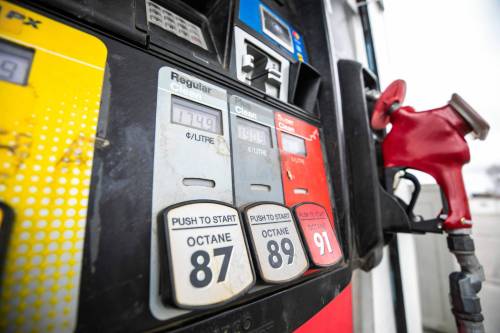
War fuels inflation, robs Manitobans’ purchasing power Province records highest monthly inflation rate since spring 2023
Read this article for free:
or
Already have an account? Log in here »
To continue reading, please subscribe:

Digital Subscription
One year of digital access for only $205*
- Enjoy unlimited reading on winnipegfreepress.com
- Read the E-Edition, our digital replica newspaper
- Access News Break, our award-winning app
- Play interactive puzzles
*First annual payment billed as $205.00 + GST for one year. This annual subscription will automatically renew at $233.00 + GST every 52 weeks (10% off the regular annual price of $259.35). Offer available to new and qualified returning subscribers only. Cancel any time.
To continue reading, please subscribe:
Add Free Press access to your Brandon Sun subscription for only an additional
$1 for the first 4 weeks*
- Enjoy unlimited reading on winnipegfreepress.com
- Read the E-Edition, our digital replica newspaper
- Access News Break, our award-winning app
- Play interactive puzzles
*Your next Brandon Sun subscription payment will increase by $1.00 and you will be charged $17.95 plus GST for four weeks. After four weeks, your payment will increase to $24.95 plus GST every four weeks.
Read unlimited articles for free today:
or
Already have an account? Log in here »
Manitoba’s inflation rate in April climbed to its highest level since 2023 — topping all provinces alongside Nova Scotia — as the war in oil-rich Iran caused gasoline prices to soar.
The rate of inflation in both provinces climbed to 4.3 per cent from three per cent in March, tying New Brunswick for the biggest month-to-month increase, Statistics Canada said Tuesday.
“If you’re hoping for a quick reduction in expenses and inflation, it’s going to be a bit of awhile,” said Shiu-Yik Au, an associate professor of finance at the University of Manitoba’s Asper School of Business.
The conflict in the Middle East has disrupted oil production, damaged refineries and choked off the Strait of Hormuz, a vital shipping lane for oil supplies, he noted.
“Even if we were to get boats shipping out of there today, it would take two to three weeks for them to reach refinery destinations across Asia and Europe,” Au said.
“What that means is we can expect bad things in next month’s inflation report and in the next few months’ inflation reports. The worst part is this is going to feed into things like food (prices).”
The U.S. and Israel started the war by launching air strikes against Iran on Feb. 28.
Winnipeg resident Jack Jansen, 82, who was filling his car’s gas tank Tuesday, said he would welcome additional financial relief from governments.
“Anything that’s going to make (gas prices) a little bit lower,” he said at a Petro-Canada station at Route 90 and Ellice Avenue.
Higher prices put pressure on Jansen’s budget for other expenses. He said he tries to wait for gas prices to dip before filling up.
“But if you’ve got somewhere to go, you’ve got to get gas,” Jansen said.

Emma Zhu filled up a rental car while visiting from Mississauga, Ont., where she drives a Tesla electric car.
“Every time I see the price jump, I’m grateful we have an electric car that doesn’t use gasoline,” she said, noting she pays high insurance premiums for her Tesla.
Zhu compared prices between stations while driving a gas-powered car in Winnipeg.
“It still surprises me,” she said about the 174.9 cents per litre that she paid Tuesday.
Logistics companies are also feeling the effects of inflation. When prices rise at the pumps, fuel surcharges for customers often do as well.
“For us, it’s unfortunate that we do have to adjust our fuel-surcharge price,” said Jerrold Gabb, a part-owner and customs broker with Runnin’ Red Transport, which has offices in Winnipeg and Letellier.
MIKAELA MACKENZIE / FREE PRESS Higher prices for energy, including gasoline, pushed the national inflation rate to 2.8 per cent in April.
The company uses a fleet of vans to collect and ship parcels from or to the U.S. via Pembina, N.D. Runnin’ Red also makes deliveries to parts of southern Manitoba.
Gabb said he hopes there will be “cost certainty” for fuel prices soon, after recent fluctuations.
“It’s just a burden on that internal combustion market. It’s definitely going to send ripples through the industry,” he said.
Manitoba’s inflation rate for April was its highest since 5.5 per cent in April 2023. The rate was 9.4 per cent in June 2022, a near 40-year high, as the world emerged from the COVID-19 pandemic.
The Manitoba Bureau of Statistics’ most recent analysis, published April 20, said the province’s relatively higher inflation in March was primarily due to property taxes and other special charges (including higher sewer and garbage fees imposed by the City of Winnipeg) increasing by 19.5 per cent compared with March 2025.
“Given that property taxes and other special charges are assessed on an annual basis, their impact will persist in year-over-year comparisons until October 2026,” the analysis said.
The bureau is expected to publish a new report this week that reflects April’s inflation rate.
April inflation rates for Canadian provinces
OTTAWA – Canada’s annual inflation rate was 2.8 per cent in April, Statistics Canada says. Here’s what happened in the provinces (previous month in brackets):
• Newfoundland and Labrador: 3.6 per cent (2.6)
• Prince Edward Island: 3.4 per cent (2.3)
• Nova Scotia: 4.3 per cent (3.0)
• New Brunswick: 4.2 per cent (2.9)
• Quebec: 3.0 per cent (2.9)
• Ontario: 2.4 per cent (1.9)
• Manitoba: 4.3 per cent (3.0)
• Saskatchewan: 3.8 per cent (2.9)
• Alberta: 3.2 per cent (2.3)
• British Columbia: 2.5 per cent (2.5)
— The Canadian Press
StatCan said Ontario (2.4 per cent) and B.C. (2.5 per cent) had the lowest rates among provinces last month. The national rate was 2.8 per cent, up from 2.4 per cent in March.
The increase was driven by higher energy costs, most notably gas prices, which were pushed higher by supply uncertainty amid the conflict in the Middle East, StatCan said.
Gas prices were 28.6 per cent higher in April than they were in the same month a year ago, when the removal of the consumer carbon levy caused prices to drop, the study found.
The switch to a more expensive summer blend of gasoline contributed to the rise in gas prices, StatCan said.
Ottawa’s temporary suspension of the fuel excise tax, from April 20 until Labour Day, moderated the increase. Normally, the tax is 10 cents a litre for gasoline and four cents per litre for diesel.
StatCan said in Winnipeg, the average monthly price for a litre of regular unleaded gasoline at self-service stations was 171.2 cents, which was among the lowest of major Canadian cities.
Premier Wab Kinew has said his government is considering additional relief for Manitobans.
While it had pondered another temporary suspension of the provincial gas tax, Kinew said April 30 that giving Manitobans a subsidy, geared to income, to buy healthy food “might be the more effective intervention.”
Manitoba had the lowest inflation rate among provinces in 2024, to which the NDP government credited a year-long 14-cents per litre provincial gas tax holiday and other affordability measures.
Finance Minister Adrien Sala wouldn’t say Tuesday whether new measures are coming. He spoke to reporters after the NDP government and Opposition Tories sparred over affordability in question period.
Tory finance critic Lauren Stone said Manitoba’s food inflation was the country’s highest, at 4.9 per cent.
“Manitoba is trending in the wrong direction as the cost of living is getting increasingly worse under the NDP,” she told the house, while repeating a call for the government to increase the basic personal exemption on income tax to $30,000 annually.

Sala said additional relief for Manitobans will be delayed if the Tories stall a vote on the budget implementation and tax statutes amendment law before MLAs break for the summer.
The proposed budget contains a temporary PST cut on grocery items not already exempt, including rotisserie chickens, prepared salads and soft drinks, starting July 1.
“If they want to help Manitobans, get out of the way and pass the BITSA bill. Do it today,” Sala said of the Tories in question period.
Tory Leader Obby Khan said the PST cut will save only “pennies” for Manitobans.
— With files from Carol Sanders
chris.kitching@freepress.mb.ca

Chris Kitching is a general assignment reporter at the Free Press. He began his newspaper career in 2001, with stops in Winnipeg, Toronto and London, England, along the way. After returning to Winnipeg, he joined the Free Press in 2021, and now covers a little bit of everything for the newspaper. Read more about Chris.
Every piece of reporting Chris produces is reviewed by an editing team before it is posted online or published in print — part of the Free Press‘s tradition, since 1872, of producing reliable independent journalism. Read more about Free Press’s history and mandate, and learn how our newsroom operates.
Our newsroom depends on a growing audience of readers to power our journalism. If you are not a paid reader, please consider becoming a subscriber.
Our newsroom depends on its audience of readers to power our journalism. Thank you for your support.
Related Articles
Inflation rises to 2.8% in April but Iran war impact limited to gas pumps for now


History
Updated on Tuesday, May 19, 2026 4:38 PM CDT: Adds details, comments, new photos.