

Carbon capture project gains support
Deep Sky seeks to build on Alberta success as it pitches province on ‘economic opportunity for Manitoba on a global scale’

Advertisement
Read this article for free:
or
Already have an account? Log in here »
To continue reading, please subscribe:

Digital Subscription
One year of digital access for only $205*
- Enjoy unlimited reading on winnipegfreepress.com
- Read the E-Edition, our digital replica newspaper
- Access News Break, our award-winning app
- Play interactive puzzles
*First annual payment billed as $205.00 + GST for one year. This annual subscription will automatically renew at $233.00 + GST every 52 weeks (10% off the regular annual price of $259.35). Offer available to new and qualified returning subscribers only. Cancel any time.
To continue reading, please subscribe:
Add Free Press access to your Brandon Sun subscription for only an additional
$1 for the first 4 weeks*
- Enjoy unlimited reading on winnipegfreepress.com
- Read the E-Edition, our digital replica newspaper
- Access News Break, our award-winning app
- Play interactive puzzles
*Your next Brandon Sun subscription payment will increase by $1.00 and you will be charged $17.95 plus GST for four weeks. After four weeks, your payment will increase to $24.95 plus GST every four weeks.
Read unlimited articles for free today:
or
Already have an account? Log in here »
A direct air carbon capture facility proposed for southwestern Manitoba has been shoring up allies in local and Indigenous governments and large corporations, as Montreal-based Deep Sky aims to convince the province its project is ready to launch.
The venture capital-backed tech firm sent the province a package of support letters late last year, encouraging the government to provide the regulatory support and electric power supply needed for the facility to move forward, according to documents obtained by the Free Press/The Narwhal.
“Deep Sky Manitoba is not a speculative concept,” the company wrote in a December letter. “It is a commercially viable infrastructure project that is backed by real market demand and presents an economic opportunity for Manitoba on a global scale.”
Deep Sky / Facebook
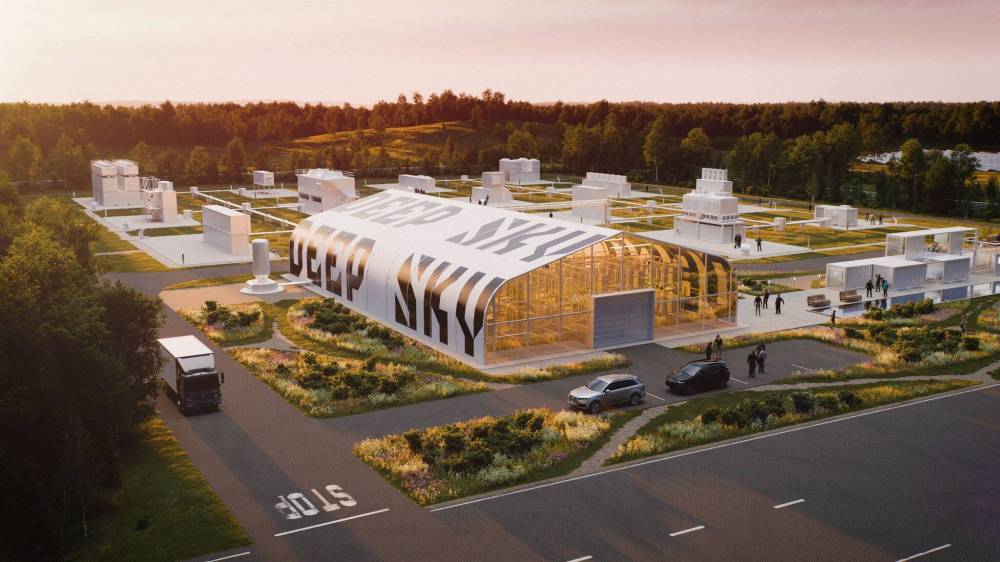
A rendering of what the proposed Westman site may look like, where Deep Sky plans to pull carbon out of the air and store it underground.
Deep Sky is proposing a 145-acre facility in the agriculture and oil-dominant southwestern region that will scrub 30,000 tonnes of carbon dioxide directly from the atmosphere each year and inject it into porous rock formations 1,000 metres below ground. The company says it will use technology first tested at its existing accelerator in Innisfail, Alta., and will finance the $200-million Manitoba project by selling carbon credits.
The package included term sheets and letters of intent from five customers and investors, as well as support from local communities.
While some of the documents are redacted under a section of the freedom of information act that protects corporate privacy, the Free Press/The Narwhal obtained copies of letters from the Dakota Grand Council, the rural municipalities of Pipestone and Two Borders, Frontier and the Bank of Montreal.
“These documents illustrate that this project is ready to break ground,” the company wrote.
“We have the customers and the support to bring this investment to the province. We are simply waiting for the final regulatory framework and the confirmation of power supply to unlock this investment.” (See the package of letters online at wfp.to/deepsky.)
Deep Sky will need up to 15 megawatts of power — roughly the power draw of 10,000 homes — for the first stage of the project, CEO Alex Petre told the Free Press/The Narwhal in December.
The proposal has been met with skepticism from area residents and climate action groups, who have posed questions about the safety, affordability and long-term impacts of direct air carbon capture.
While oil and gas companies and some climate experts view the technology as a useful tool to help achieve global net-zero targets, critics say it is prohibitively expensive and not guaranteed to work.
Despite energy agencies, including the Canada Energy Regulator and Manitoba Hydro, predicting direct air capture will sequester millions of tonnes of emissions annually by 2050, facilities aren’t yet keeping pace. The two dozen facilities currently operating worldwide capture less than 10,000 tonnes per year.
But Deep Sky maintains its project will be able to succeed given Manitoba’s “natural advantages,” including suitable geologic conditions, a low-cost hydroelectric grid and local workforce familiar with oil and gas operations.
The company recently sold North America’s first verified carbon removal credits after successfully storing carbon at its Innisfail facility, according to a news release Monday.
According to the December letter, it has now also secured “strong local buy-in” after hosting information sessions through the fall and winter.
“Over the past year, we’ve engaged with Indigenous communities, municipalities, provincial partners and regional stakeholders across Manitoba to better understand local priorities and explore how this industry can create lasting economic opportunities for Manitoba,” Jason Vanderheyden, Deep Sky’s vice-president of government affairs and public policy, said in an emailed statement.
“All of these conversations continue to inform our approach as the project advances.”
Vanderheyden noted the company’s partnership with the Dakota Grand Council, a collaborative organization representing Manitoba’s Dakota Nations.
In a letter to the province dated Dec. 5, 2025, Dakota Chiefs Dennis Pashe and Raymond Brown expressed “strong support for the Deep Sky Manitoba project,” noting it presents an opportunity to reverse “decades of economic exclusion in the region.”
The project is anticipated to create between 750 and 1,000 jobs during construction, with around 100 permanent positions during operation. The Dakota council said it is working with Deep Sky to ensure its members are prioritized for these roles, and will explore equity opportunities through the relationship agreement.
“Deep Sky’s Manitoba executive team engaged with us early, right from the start of the project and we found them to be extremely transparent,” Pashe said in an emailed statement.
“They were also very informative when explaining the project and carbon removal technology, which is important when communities consider something new.”
The company will still need to complete impact and benefit agreements to receive consent from the Dakota Nation, he added.
The package also included resolutions passed by the RMs of Pipestone and Two Borders in early 2025 declaring support for carbon capture and storage projects, including the Deep Sky initiative, and urging Manitoba to amend its carbon storage rules in collaboration with the company.
Manitoba passed the Captured Carbon Storage Act in May 2024. The accompanying regulations, which will outline the finer details of a company’s responsibilities when storing captured carbon, were initially expected this spring. It’s not yet clear when the regulations will be finalized.
In response to questions regarding the province’s support for Deep Sky’s proposal, progress on carbon storage regulations and the company’s power supply request, Business, Mining, Trade and Economic Development Minister Jamie Moses’ office said: “Any decisions regarding that project will be communicated in the coming months” and consultation will continue to take place with affected communities.
Alongside local support, Deep Sky has the backing of several large corporations in the technology and finance sectors.
Frontier is an advanced market commitment group representing some of the world’s largest tech and financial companies — including Stripe, Google, Shopify and Anthropic — in an effort to stimulate the carbon storage industry.
The company is “actively evaluating Deep Sky for future offtake agreements and are encouraged by the pace of their technical progress,” according to a letter included in the package.
“However, to unlock this global market demand for Manitoba,” the company states, “two critical enablers are required: the allocation of hydroelectric power and a finalized regulatory framework.”

BMO executive Grégoire Baillargeon, who serves as a board member for Carbon Removal Canada, wrote a similar letter of support urging the province to “grant the project a high-priority hydro allocation so that construction can begin and Manitoba can secure a leadership position in this emerging market.”
Neither company responded to follow-up questions.
Any facility needing to draw more than five MW must submit a large power supply application. In an email, Manitoba Hydro media relations officer Peter Chura explained the Crown utility reviews applications to determine feasibility, then forwards requests to the province for review and prioritization.
Chura said Hydro could not confirm whether it had received a request for power from Deep Sky, as it does not publicly discuss customers, applications or proposed developments. He confirmed Hydro has not received any directives from the Manitoba government regarding the Deep Sky proposal.
julia-simone.rutgers@freepress.mb.ca
Julia-Simone Rutgers is an investigative reporter who joined the Free Press in 2020. Read more about Julia-Simone.
Every piece of reporting Julia-Simone produces is reviewed by an editing team before it is posted online or published in print — part of the Free Press‘s tradition, since 1872, of producing reliable independent journalism. Read more about Free Press’s history and mandate, and learn how our newsroom operates.
Our newsroom depends on a growing audience of readers to power our journalism. If you are not a paid reader, please consider becoming a subscriber.
Our newsroom depends on its audience of readers to power our journalism. Thank you for your support.
Julia-Simone Rutgers is an investigative reporter who joined the Free Press in 2020. Read more about Julia-Simone.
Every piece of reporting Julia-Simone produces is reviewed by an editing team before it is posted online or published in print — part of the Free Press‘s tradition, since 1872, of producing reliable independent journalism. Read more about Free Press’s history and mandate, and learn how our newsroom operates.
Our newsroom depends on a growing audience of readers to power our journalism. If you are not a paid reader, please consider becoming a subscriber.
Our newsroom depends on its audience of readers to power our journalism. Thank you for your support.
Related Articles
What can you do with $200 million?
Advertisement Advertise With Us
Advertisement Advertise With Us