

Herbicide drama a nightmare for farmers, investors and government

Advertisement
Read this article for free:
or
Already have an account? Log in here »
To continue reading, please subscribe:
Monthly Digital Subscription
$1 per week for 24 weeks*
- Enjoy unlimited reading on winnipegfreepress.com
- Read the E-Edition, our digital replica newspaper
- Access News Break, our award-winning app
- Play interactive puzzles
*Billed as $4.00 plus GST every four weeks. After 24 weeks, price increases to the regular rate of $19.95 plus GST every four weeks. Offer available to new and qualified returning subscribers only. Cancel any time.
Monthly Digital Subscription
$4.99/week*
- Enjoy unlimited reading on winnipegfreepress.com
- Read the E-Edition, our digital replica newspaper
- Access News Break, our award-winning app
- Play interactive puzzles
*Billed as $19.95 plus GST every four weeks. Cancel any time.
To continue reading, please subscribe:
Add Free Press access to your Brandon Sun subscription for only an additional
$1 for the first 4 weeks*
*Your next subscription payment will increase by $1.00 and you will be charged $16.99 plus GST for four weeks. After four weeks, your payment will increase to $23.99 plus GST every four weeks.
Read unlimited articles for free today:
or
Already have an account? Log in here »
Glyphosate, arguably farmers’ favourite herbicide and the central character in a high-stakes drama now spanning decades, was back in the news this week.
Just as Bayer rolled out a new plan to settle thousands of lawsuits claiming the active ingredient in Roundup causes cancer, U.S. President Donald Trump was declaring the product critical to the nation’s food security.
These are just the latest twists in a plotline that has embroiled regulatory agencies in controversy, and which has now jumped out of courtrooms and investor calls to the highest political level.
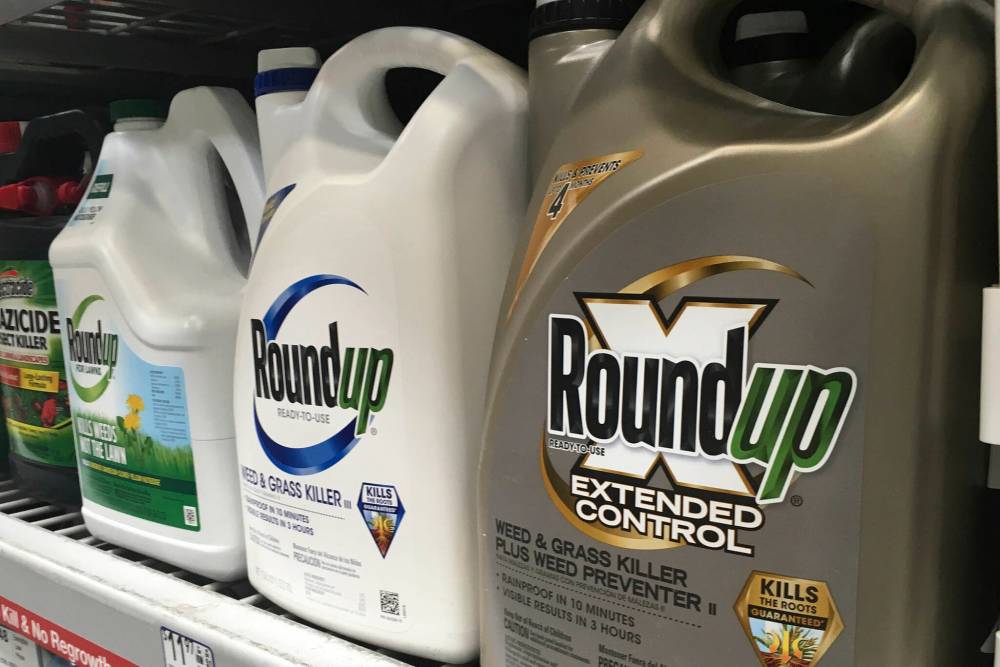
Just as Bayer rolled out a new plan to settle once and for all thousands of lawsuits claiming the active ingredient in Roundup causes cancer, U.S. President Donald Trump was declaring the product critical to the nation’s food security. (Haven Daley / The Associated Press files)
Bayer shares jumped and then slumped midweek as the market debated whether the company’s proposed US$7.25-billion settlement plan would end the legal nightmare it inherited with its purchase of Monsanto in 2018. It has reportedly already paid out more than $10 billion to settle claims glyphosate exposure is connected to non-Hodgkin’s lymphoma.
It’s a costly remedy to a problem Bayer says shouldn’t exist. Of the cases that have gone to trial, the company has won more than it has lost, but it’s desperate to cap its exposure.
Bayer has warned that if it can’t find a way out of the legal morass, it will have no option but to quit making and selling glyphosate. That would leave it to generic manufacturers — mostly located in China — to supply the North American market.
Not happening, says Trump. He invoked the Defense Production Act this week to ensure domestic production of glyphosate and phosphorus, deeming them critical to national and food security.
The move angered the Make American Healthy Again movement (MAHA) and forced Secretary of Health Robert F. Kennedy to choose between his own track record of condemning the herbicide and his loyalty to Trump. He chose Trump.
The Supreme Court of the United States is also expected to weigh in this year on a critical legal question underpinning the outstanding legal claims, which are based on the premise that Roundup’s product labels failed to warn users that glyphosate may cause cancer.
However, the U.S. Environmental Protection Agency has consistently ruled that the herbicide is not a carcinogen, and it has approved the Roundup label without such a warning.
Bayer’s position is that federal labelling laws pre-empt the failure-to-warn claims made under state laws. If a product doesn’t cause cancer, how can the company put a warning on the label saying it does?
Adding more confusion to the hullabaloo, the scientific journal Regulatory and Toxicology Pharmacology, one of the leading peer-reviewed resources on product safety, announced late last year that it was taking the rare step of retracting a 25-year-old study “widely regarded as the hallmark paper” used by regulators to conclude glyphosate is safe.
The journal’s editor said in a statement that three academics whose names appear on the study Safety Evaluation and Risk Assessment of the Herbicide Roundup and Its Active Ingredient, Glyphosate, for Humans cherry-picked the data, may have accepted payments from Monsanto and had help from Monsanto writing the report.
This disclosure in no way proves that glyphosate poses undue risk to human health. However, it makes it harder to support claims that it is unequivocally safe, and it further erodes public trust.
Canada’s own Pest Management Regulatory Agency had one of its approvals for products containing glyphosate thrown out by the Federal Court of Canada last year because it failed to conduct a thorough enough assessment.

Farmers, who are more exposed than anyone to whatever risk there is, are pragmatic about the product’s safety relative to the other perils of their job. They, like the rest of us, are surrounded by known carcinogens ranging from exhaust fumes, to processed meats, alcohol or too much sun.
Farmers are more worried about losing the herbicide that has played a pivotal role in conservation agriculture and the chill this saga puts on new product investment.
Weeds are continuously evolving; there is a growing list of plants that are resistant to herbicides such as glyphosate, yet there are few new modes of action coming to market.
The glyphosate story might make good television drama someday, but it’s a horror flick for investors.
Laura Rance is executive editor, production content lead for Glacier FarmMedia. She can be reached at lrance@farmmedia.com
Laura Rance is editorial director at Farm Business Communications.
Our newsroom depends on a growing audience of readers to power our journalism. If you are not a paid reader, please consider becoming a subscriber.
Our newsroom depends on its audience of readers to power our journalism. Thank you for your support.
Laura Rance is editorial director at Farm Business Communications.
Our newsroom depends on a growing audience of readers to power our journalism. If you are not a paid reader, please consider becoming a subscriber.
Our newsroom depends on its audience of readers to power our journalism. Thank you for your support.
Advertisement Advertise With Us
Advertisement Advertise With Us