

‘Ducks and cows have a lot in common’
Ducks Unlimited provides $1-M pasture for farming research

Advertisement
Read this article for free:
or
Already have an account? Log in here »
To continue reading, please subscribe:

Digital Subscription
One year of digital access for only $205*
- Enjoy unlimited reading on winnipegfreepress.com
- Read the E-Edition, our digital replica newspaper
- Access News Break, our award-winning app
- Play interactive puzzles
*First annual payment billed as $205.00 + GST for one year. This annual subscription will automatically renew at $233.00 + GST every 52 weeks (10% off the regular annual price of $259.35). Offer available to new and qualified returning subscribers only. Cancel any time.
To continue reading, please subscribe:
Add Free Press access to your Brandon Sun subscription for only an additional
$1 for the first 4 weeks*
- Enjoy unlimited reading on winnipegfreepress.com
- Read the E-Edition, our digital replica newspaper
- Access News Break, our award-winning app
- Play interactive puzzles
*Your next Brandon Sun subscription payment will increase by $1.00 and you will be charged $17.95 plus GST for four weeks. After four weeks, your payment will increase to $24.95 plus GST every four weeks.
Read unlimited articles for free today:
or
Already have an account? Log in here »
Hey there, time traveller!
This article was published 16/03/2026 (186 days ago), so information in it may no longer be current.
A Manitoba farming research non-profit will have more space to let cattle roam and graze on prairie grasslands — and study how that foraging affects biodiversity — through a partnership with Ducks Unlimited Canada.
On Monday, the conservation organization announced it is providing $1 million worth of land to nearly double the size of the Brookdale Research Farm north of Brandon.
“This expansion of land is going to be an opportunity to do commercial-scale case studies and data collection… and then share it back to producers in a real-world setting,” said Mary-Jane Orr, general manager of Manitoba Beef and Forage Initiatives.
MIKAELA MACKENZIE / FREE PRESS
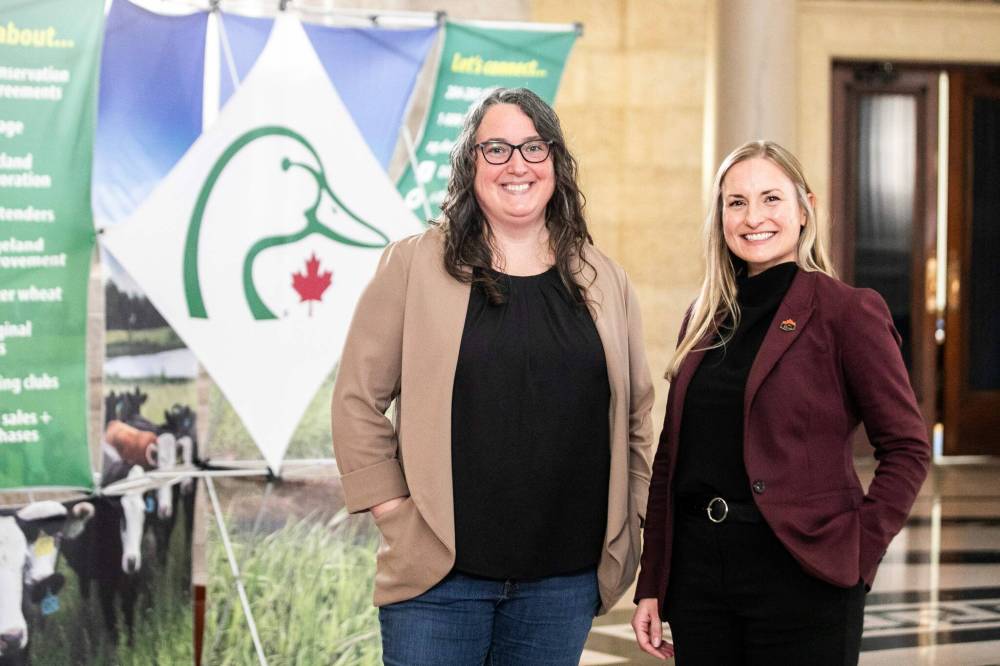
Mary-Jane Orr, general manager of Manitoba Beef & Forage Initiatives (left), and Karli Reimer, manager of outreach at Ducks Unlimited Canada
Brookdale Farm — one of two farm stations managed by Beef and Forage Initiatives — typically tested new technology, land-management practices and other farming innovations on a smaller footprint, less than 20 acres at a time. With the addition of the 467-acre Odanah Pasture, the organization will be able to work with farmers at a more true-to-life scale, helping to ease the risk for producers looking to implement new practices with their herds.
“Oftentimes when you’re doing research at a small scale, the question is: ‘Will this work on a larger farm?’ So this is actually putting that application into practice and showing that, actually, yes, this is going to work for larger farms here in Manitoba,” Karli Reimer, head of communications and outreach for Ducks Unlimited, said.
The new parcel is an opportunity to showcase the impact of restoring cropland to its natural state, Orr added.
Ducks Unlimited purchased the land in 2020 with funds from “conservation-minded government agencies in Canada and the United States, including Manitoba’s conservation trust,” a news release said. The parcel had been used for crop production, and its wetlands and uplands had been drained. Over five years, Ducks Unlimited restored the land to its natural state: a rich grassland with more than 100 wetland basins.
Healthy wetlands and grasslands are a win-win for cattle farmers and conservationists alike.
“More productive grasslands make for more productive cattle. But those more productive grasslands are also making more productive ecological areas,” said Melissa Atchison, a southwest Manitoba cattle producer and the research and extension specialist for Manitoba Beef Producers.
“Being able to get good production out of our cattle while also providing great benefits from a biodiversity standpoint, from a habitat standpoint, from an ecological goods and services standpoint, is just a really cool win for everybody involved.”
Historically, bison roamed the wetland-dotted prairie, Orr said. As they grazed, they helped diversify the grasslands and created a canopy structure for wildlife and waterfowl. Today’s cattle farms effectively mimic that process.
“It’s creating this beautiful net win: keeping cattle on the landscape is maintaining habitat for untold numbers of species, from pollinators all the way up to mallards,” she said.
Orr said Beef and Forage Initiatives is in the process of landing a collaborator who will raise cattle on Odanah Pasture and share data about their decision-making process, economics and marketing decisions. The research will be shared with other farmers, helping to demonstrate what processes, technology and land-management decisions are most effective for the cattle, the business and the land.

“We need to be profitable, and environmental sustainability is a big piece of that profitability,” Orr said.
Manitoba’s billion-dollar beef sector, comprised of more than 6,500 cattle farms, plays a key role in conservation, Reimer said.
Monday’s announcement marks the third annual Ducks Unlimited Day in Manitoba, honouring the organization’s 90-year history to support conservation in the province, as well as Manitoba Agricultural Awareness Day.
“Ducks and cows have a lot in common,” Reimer said. “We really care about habitats for waterfowl, wildlife and people — grasslands and wetlands — and that is exactly what the beef sector needs to be profitable and productive.”
julia-simone.rutgers@freepress.mb.ca
Julia-Simone Rutgers is an investigative reporter who joined the Free Press in 2020. Read more about Julia-Simone.
Every piece of reporting Julia-Simone produces is reviewed by an editing team before it is posted online or published in print — part of the Free Press‘s tradition, since 1872, of producing reliable independent journalism. Read more about Free Press’s history and mandate, and learn how our newsroom operates.
Our newsroom depends on a growing audience of readers to power our journalism. If you are not a paid reader, please consider becoming a subscriber.
Our newsroom depends on its audience of readers to power our journalism. Thank you for your support.
Julia-Simone Rutgers is an investigative reporter who joined the Free Press in 2020. Read more about Julia-Simone.
Every piece of reporting Julia-Simone produces is reviewed by an editing team before it is posted online or published in print — part of the Free Press‘s tradition, since 1872, of producing reliable independent journalism. Read more about Free Press’s history and mandate, and learn how our newsroom operates.
Our newsroom depends on a growing audience of readers to power our journalism. If you are not a paid reader, please consider becoming a subscriber.
Our newsroom depends on its audience of readers to power our journalism. Thank you for your support.
Advertisement Advertise With Us
Advertisement Advertise With Us