

Farmers won’t receive carbon tax compensation for drying grain: Ottawa
Advertisement
Read this article for free:
or
Already have an account? Log in here »
To continue reading, please subscribe:

Digital Subscription
One year of digital access for only $205*
- Enjoy unlimited reading on winnipegfreepress.com
- Read the E-Edition, our digital replica newspaper
- Access News Break, our award-winning app
- Play interactive puzzles
*First annual payment billed as $205.00 + GST for one year. This annual subscription will automatically renew at $233.00 + GST every 52 weeks (10% off the regular annual price of $259.35). Offer available to new and qualified returning subscribers only. Cancel any time.
To continue reading, please subscribe:
Add Free Press access to your Brandon Sun subscription for only an additional
$1 for the first 4 weeks*
- Enjoy unlimited reading on winnipegfreepress.com
- Read the E-Edition, our digital replica newspaper
- Access News Break, our award-winning app
- Play interactive puzzles
*Your next Brandon Sun subscription payment will increase by $1.00 and you will be charged $17.95 plus GST for four weeks. After four weeks, your payment will increase to $24.95 plus GST every four weeks.
Read unlimited articles for free today:
or
Already have an account? Log in here »
Hey there, time traveller!
This article was published 10/06/2020 (2265 days ago), so information in it may no longer be current.
OTTAWA — The federal Liberals will not be compensating farmers in Western Canada over a part of the carbon tax that has fuelled months of criticism across the Prairies.
Fuel used to dry grain is one of the few agricultural tasks that isn’t exempted under the carbon levy, which has multiple carve-outs in order to avoid advantaging American farmers.
“The impact is a very small percentage of (farm) operation costs, so this is why we are not moving forward with more specific relief,” Agriculture Minister Marie-Claude Bibeau told the Free Press Tuesday.
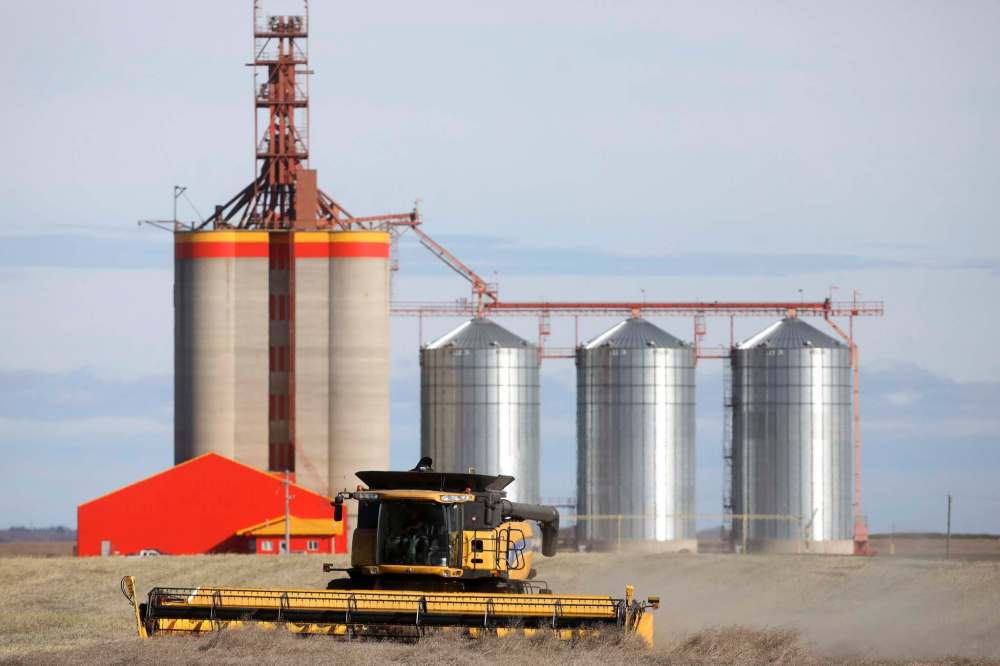
Fuel used for agriculture is generally exempt from the carbon tax, because there are few environmentally friendly alternatives.
Officials decided it would be counterproductive to apply the levy in cases where customers would likely shift to cheaper foreign products, resulting in a minimal reduction of carbon emissions.
The 2019 harvest was already troubled by a CN Rail strike and China’s canola boycott when a wet autumn required farmers to use fuel to dry out their grain, just as the carbon tax took effect.
Back in December, agriculture ministers from the Prairie provinces agreed to tally and send Ottawa data on how much the federal carbon tax added to farmers’ costs that year, specifically for drying grain.
Alberta published its $2.7-million estimate in February; it’s unclear whether the Manitoba or Saskatchewan governments ever submitted their own estimates.
Bibeau said Monday her department instead analyzed filings to the federal Agricultural Tax Data Program, and found the average farm paid $210 to $819 last year, amounting to between 0.05 and 0.42 per cent of total operating expenses.
Her office also provided Tuesday a 2018 analysis — from before the tax came into effect — which projected a 0.2 per cent drop in Manitoba farms’ operating incomes.
The head of Keystone Agricultural Producers, which represents Manitoba farmers, dismissed both as creative mathematics.
“For her to suggest that that this is an insignificant cost is extremely frustrating,” said KAP President Bill Campbell. “It’s become apparent that this is a political position taken by the federal government.”
His group estimates Manitoba corn farmers paid roughly $1.7 million in carbon tax for grain-drying in 2019, but doesn’t have data on other crops.
“It does put us at a competitive disadvantage,” Campbell said, though he wasn’t sure if it will mean more expensive food at the grocery store.
Last December, Manitoba Agriculture Minister Blaine Pedersen pledged the province would tabulate the cost per bushel, which could be used to tally the cost of the carbon tax for drying grains.
Pedersen was unavailable Tuesday for an interview. His office did not say whether it had followed through on tallying the data.
Instead, his staff provided a statement attributed to Pedersen saying he was “disappointed” in Ottawa’s decision.
The Pallister government has tried to put the province back onto its own carbon levy, which exempts more agricultural tasks, but those talks have slowed as officials focus on the COVID-19 pandemic.
Bibeau noted Monday that the carbon tax doesn’t apply to activities such as greenhouse heating, where it would raise costs by as much a seven per cent, or cardlock gas.
“Where the impact is significant, exemptions have been given,” she said. “This pollution-pricing policy is an important part for a greener economy, and for more sustainable development.”
Conservative MP Dan Mazier, who represents the Dauphin area, disagrees.
“That somewhat misses the whole premise of why we dry grain,” said Mazier.

Changing weather patterns make it more likely that grain will need to be dried, and it has to be the right moisture to stay in bins during rail disruptions and ice storms, Mazier said.
Technology to dry grain using electricity is costly and hard to procure, said Mazier, who used to lead KAP. “I don’t understand that policy at all.”
He noted that farm groups have tallied much higher cumulative costs when accounting for the added costs for transportation. He questioned why Ottawa had asked provinces to tally costs in the first place.
“Farmers knew exactly what they were paying for a carbon tax,” said Mazier. “There was no need to re-invent the wheel there.”
dylan.robertson@freepress.mb.ca