Dry winter drains reservoirs, ruins crops in Spain, Portugal

Advertisement

Advertise with us

ACEREDO, Spain (AP) — Roofs peeking out of the water have become a common sight every summer at the Lindoso reservoir in northwestern Spain. In especially dry years, parts would appear of the old village of Aceredo, submerged three decades ago when a hydropower dam flooded the valley.

Read this article for free:


or

Already have an account? Log in here »

To continue reading, please subscribe:

Subscribe and receive a limited-edition Free Press branded hat or tote.

Digital Subscription

One year of digital access for only $205*

  • Enjoy unlimited reading on winnipegfreepress.com
  • Read the E-Edition, our digital replica newspaper
  • Access News Break, our award-winning app
  • Play interactive puzzles

*First annual payment billed as $205.00 + GST for one year. This annual subscription will automatically renew at $233.00 + GST every 52 weeks (10% off the regular annual price of $259.35). Offer available to new and qualified returning subscribers only. Cancel any time.

To continue reading, please subscribe:

Add Free Press access to your Brandon Sun subscription for only an additional

$1 for the first 4 weeks*

  • Enjoy unlimited reading on winnipegfreepress.com
  • Read the E-Edition, our digital replica newspaper
  • Access News Break, our award-winning app
  • Play interactive puzzles
Start now

*Your next Brandon Sun subscription payment will increase by $1.00 and you will be charged $17.95 plus GST for four weeks. After four weeks, your payment will increase to $24.95 plus GST every four weeks.

Hey there, time traveller!
This article was published 13/02/2022 (1672 days ago), so information in it may no longer be current.

ACEREDO, Spain (AP) — Roofs peeking out of the water have become a common sight every summer at the Lindoso reservoir in northwestern Spain. In especially dry years, parts would appear of the old village of Aceredo, submerged three decades ago when a hydropower dam flooded the valley.

But never before has the skeleton of the village emerged in its entirety in the middle of the usually wet winter season.

With almost no rain for two months and not much expected any time soon, the ruins of Aceredo are dredging up a mix of emotions for locals as they see the rusted carcass of a car, a stone fountain with water still spouting and the old road leading to what used to be the local bar.
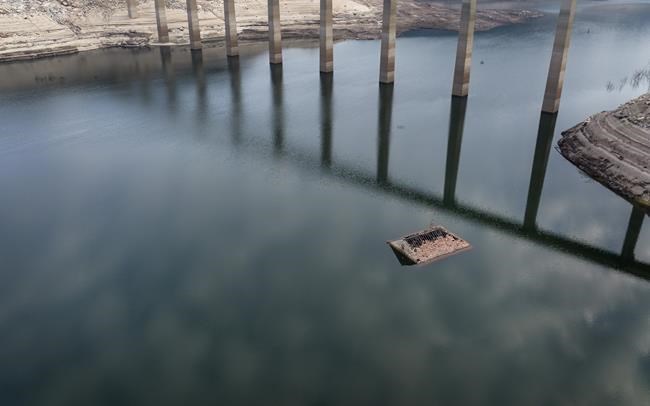
The roof of an old house, submerged three decades ago when a hydropower dam flooded the valley, is photographed emerged due to drought at the Lindoso reservoir, in northwestern Spain, Saturday, Feb. 12, 2022. Large sections of Spain are experiencing extreme or prolonged drought, with rainfall this winter at only one-third of the average in recent years. The situation is similar in neighboring Portugal, where 45% of the country is now enduring “severe” or “extreme” drought. (AP Photo/Emilio Morenatti)

“The whole place used to be all vineyards, orange trees. It was all green. It was beautiful,” said 72-year-old José Luis Penín, who used to stop at the bar with pals at the end of a day’s fishing.

“Look at it now,” said Penín, who lives in the same county, pointing at the cracked, yellow bed of the reservoir. ”It’s so sad.”

While the arid zones of the Iberian Peninsula have historically experienced periods of drought, experts say climate change has exacerbated the problem. This year, amid record levels of low or no rainfall at all, farmers in both Portugal and Spain, who are growing produce for all of Europe, are worried that their crops for this season will be ruined.

In the last three months of 2021, Spain recorded just 35% of the average rainfall it had seen during the same period from 1981 to 2010. But there has been almost no rain since then.

According to the national weather agency AEMET, in this century, only in 2005 has there been a January with almost no rain. If clouds don’t unleash in the next two weeks, emergency subsidies for farmers will be needed, authorities said.

But Rubén del Campo, a spokesman for the weather service, said the below-average rainfall over the last six months is likely to continue for several more weeks, with hopes that spring will bring much-needed relief.

While only 10% of Spain has officially been declared under a “prolonged drought,” there are large areas, particularly in the south, which are facing extreme shortages that could impact the irrigation of crops.

The valley around the Guadalquivir River in Spain’s southwest was declared under prolonged drought in November. It is now the focus of a fierce environmental dispute over water rights near Doñana National Park, a World Heritage wetland site. The government of the Andalusia region wants to grant water rights to farmers on land near the park, but critics say the move will further endanger a major wildlife refuge that is already drying up.

“The past two, three years have been dry, with the tendency toward less and less rain,” said Andrés Góngora, a 46-year-old tomato farmer in southern Almería.

Góngora, who expects the water he uses from a desalinating plant to be rationed, is still better off than other farmers who specialize in wheat and grains for livestock feed.

“The cereal crops for this year have been lost,” Góngora said.

Other areas in central and northeast Spain are also feeling the burn.

The leading association of farmers and livestock breeders in Spain, COAG, warns that half of Spain’s farms are threatened by drought this year. It says if it does not rain heavily in the coming month, rain-fed crops including cereals, olives, nuts and vineyards could lose 60% to 80% of their production.

But the association is also worried about crops that depend on irrigation, with reservoirs under 40% of capacity in most of the south.

Spain’s left-wing government plans to dedicate over 570 million euros ($647 million) from the European Union’s pandemic recovery fund to make its irrigation systems more efficient, including incorporating renewable energy systems.

Spanish Agriculture Minister Luis Planas said this week the government will take emergency measures if it doesn’t rain in two weeks. Those would likely be limited to economic benefits to palliate the loss of crops and revenues for farmers.

Neighboring Portugal has also seen little rain since last October. By the end of January, 45% of the country was enduring “severe” or “extreme” drought conditions, according to the national weather agency IPMA.

Rainfall from Oct. 1 through January was less than half the annual average for that four-month period, alarming farmers who are short of grass for their livestock.

Unusually, even the north of Portugal is dry and forest fires have broken out there this winter. In the south, crickets are already singing at night and mosquitoes have appeared — traditional signs of summer.

The IPMA doesn’t forecast any relief before the end of the month.

Portugal has witnessed an increase in the frequency of droughts over the past 20-30 years, according to IPMA climatologist Vanda Pires, with lower rainfall and higher temperatures.

“It’s part of the context of climate change,” Pires told The Associated Press.

And the outlook is bleak: Scientists estimate that Portugal will see a drop in average annual rainfall of 20% to 40% by the end of the century.

___

Joseph Wilson in Barcelona, Spain, Barry Hatton in Lisbon and Aritz Parra in Madrid contributed to this report.

___

Follow all AP stories on climate change at https://apnews.com/hub/climate

Report Error Submit a Tip

More Stories

Downtown no place to be after dark, huge majority of Winnipeggers say in survey

Joyanne Pursaga 8 minute read Preview

Downtown no place to be after dark, huge majority of Winnipeggers say in survey

Joyanne Pursaga 8 minute read Updated: Yesterday at 7:22 PM CDT

Most Winnipeggers are afraid to walk alone downtown and believe the city needs more police officers, a new survey finds.

Winnipeg Police Service released its 2026 citizen survey Friday.

Downtown safety appears to remain a major concern, with just 44 per cent saying they feel very or reasonably safe walking alone in the area during the day. The number plummets to eight per cent overall at night, down from nine per cent in 2024, the last time the survey was conducted.

This year, 14 per cent of men felt very or reasonably safe walking alone downtown at night, compared to just three per cent of women.

Read
Updated: Yesterday at 7:22 PM CDT

Artist’s inspired work brings Red River Métis story back to Portage and Main

Conrad Sweatman 8 minute read Preview

Artist’s inspired work brings Red River Métis story back to Portage and Main

Conrad Sweatman 8 minute read Updated: Yesterday at 2:47 PM CDT

Jennine Krauchi calls them the “grandmothers.” “They speak to you very silently. You never hear a word, but they speak,” Krauchi says, referring to the antique pieces of Métis needlework she’s carefully studied for years. But there are few precedents for her latest art project: a 85-foot-wide by 32-foot-high chain curtain of Métis needlework that drapes over the historic Bank of Montreal’s neoclassical facade.

Read
Updated: Yesterday at 2:47 PM CDT

Chrétien says Canada bows to no one in fiery address at 9/11 commemoration

Sarah Smellie, The Canadian Press 6 minute read Preview

Chrétien says Canada bows to no one in fiery address at 9/11 commemoration

Sarah Smellie, The Canadian Press 6 minute read Updated: Yesterday at 8:15 PM CDT

GANDER - Former prime minister Jean Chrétien drew a standing ovation inside a Gander, N.L., hockey arena on Friday as he delivered a pointed message to American leaders during a ceremony marking the 9/11 terrorist attacks in the United States, 25 years ago.

The 92-year-old warned Americans never to mistake Canadian generosity for weakness, nor its kindness for softness.

U.S. Ambassador Pete Hoekstra looked on as Chrétien insisted his pointed words were a sign of friendship. Friends tell each other the truth, he said.

“We embraced our friends and we helped them in their moment of need, but we bow to no one,” Chretien said, as the crowd erupted again.

Read
Updated: Yesterday at 8:15 PM CDT

Highway-safety upgrades in progress after tragic Interlake crash

Chris Kitching 5 minute read Preview

Highway-safety upgrades in progress after tragic Interlake crash

Chris Kitching 5 minute read Updated: Yesterday at 6:25 PM CDT

Provincial workers have started to update or install safety measures at a rural Interlake intersection where four teenage friends died in a crash on Labour Day weekend.

Pavement markings were repainted at Highway 8 and Provincial Road 229, just west of Winnipeg Beach, ahead of work to refresh worn-down rumble strips, starting Monday, and install flashing lights atop two stop signs, following an assessment earlier this week.

“They will also need to incorporate any information from the RCMP report that might be helpful if we were to consider any additional safety measures at this intersection,” Transportation and Infrastructure Minister Lisa Naylor said of department staff.

“The most important thing is safety, and any kinds of changes we make at any intersection actually have to make it safer.”

Read
Updated: Yesterday at 6:25 PM CDT

Letters, Sept. 12

7 minute read 2:00 AM CDT

An overreactionRe: Winnipeg teacher disciplined for ‘liking’ student’s post, Sept. 1.

I’ve been stewing about the article for a few days and trying to decide what’s been bothering me.

I feel that the school division overreacted with its disciplinary measures, and that a public servant has been publicly shamed on the front page for what I can only describe as a questionable act.

The named teacher seems to be a responsible and law-abiding person who has committed no crime whatsoever.

Retired sportscaster Scott Oake determined as fundraising for women's addictions treatment facility enters home stretch

Melissa Martin 4 minute read Preview

Retired sportscaster Scott Oake determined as fundraising for women's addictions treatment facility enters home stretch

Melissa Martin 4 minute read Thursday, Sep. 10, 2026

For now, the patch of land just east of the Victoria Hospital doesn’t look like much: just a field of rocks, mounded dirt, and concrete piles driven into the earth. Yet when Scott Oake looks over the site, he can already imagine how it will look in just over a year’s time, when the new Anne Oake Family Recovery Centre is expected to open.

It’s easier to picture this time around. In 2020, when the recently-retired CBC sportscaster and his late wife, Anne, were building their first labour of intermingled grief and love, the Bruce Oake Recovery Centre for men, it was hard for him to wrap his mind around how a raw construction site could transform into a welcoming addictions treatment facility.

When that centre opened in 2021, Oake found it looked “almost identical” to the architect’s renderings. So it’s easy to hope the Anne Oake Centre will be the same. It will be the first facility of its kind, its founders believe, not only in Canada but in North America: a place where 50 to 70 women can pursue sobriety while staying with their children.

“At Bruce Oake there’s a culture of love, and most of all a culture of hope,” Oake said, speaking at the site Thursday after a media conference to announce the final push of the centre’s fundraising campaign. “I can feel it every time I walk into that building. And I know it will be the same here.”

Read
Thursday, Sep. 10, 2026