Indigenous leaders say safe drinking water settlement with federal gov’t is unfair

Advertisement

Advertise with us

OTTAWA - The federal government has set aside about $1.5 billion to compensate Indigenous people who have been without clean drinking water, the result of a class-action lawsuit initiated by First Nations communities.

Read this article for free:


or

Already have an account? Log in here »

To continue reading, please subscribe:

Subscribe and receive a limited-edition Free Press branded hat or tote.

Digital Subscription

One year of digital access for only $205*

  • Enjoy unlimited reading on winnipegfreepress.com
  • Read the E-Edition, our digital replica newspaper
  • Access News Break, our award-winning app
  • Play interactive puzzles

*First annual payment billed as $205.00 + GST for one year. This annual subscription will automatically renew at $233.00 + GST every 52 weeks (10% off the regular annual price of $259.35). Offer available to new and qualified returning subscribers only. Cancel any time.

To continue reading, please subscribe:

Add Free Press access to your Brandon Sun subscription for only an additional

$1 for the first 4 weeks*

  • Enjoy unlimited reading on winnipegfreepress.com
  • Read the E-Edition, our digital replica newspaper
  • Access News Break, our award-winning app
  • Play interactive puzzles
Start now

*Your next Brandon Sun subscription payment will increase by $1.00 and you will be charged $17.95 plus GST for four weeks. After four weeks, your payment will increase to $24.95 plus GST every four weeks.

Hey there, time traveller!
This article was published 28/04/2022 (1602 days ago), so information in it may no longer be current.

OTTAWA – The federal government has set aside about $1.5 billion to compensate Indigenous people who have been without clean drinking water, the result of a class-action lawsuit initiated by First Nations communities.

But while the government called the settlement “historic,” people living under the country’s longest boil-water advisory called it unfair and frustrating at a news conference Thursday.

Chief Wayne Moonias of Neskantaga First Nation in Ontario said the 27-year-long advisory is “heartbreaking,” particularly for children who’ve never known clean water.
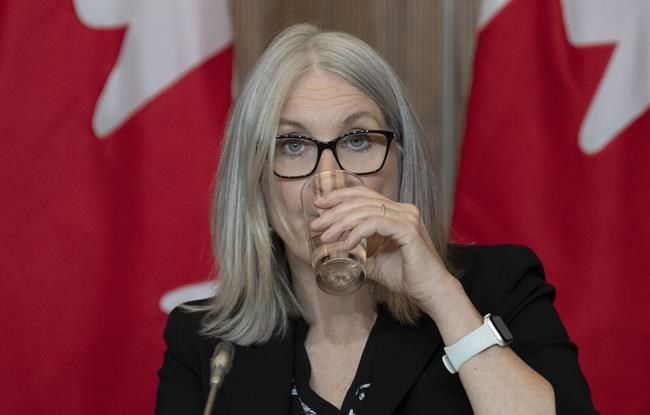
Indigenous Services Minister Patty Hajdu drinks water from a glass as she listens to speakers appearing virtually during a news conference, Thursday, April 28, 2022 in Ottawa. The federal government has set aside about $1.5 billion to compensate Indigenous people who have been without clean drinking water, the result of a class-action lawsuit initiated by First Nations communities. THE CANADIAN PRESS/Adrian Wyld

Community member Roy Moonias said he’s only entitled to claim six years of compensation even though he’s lived under the advisory since 1995.

“That is B.S.,” Moonias said. “Who made that call?”

He said the water treatment plant in Neskantaga is still incomplete, “and our people have lost hope in this project.”

“The government of Canada should be accountable for the wrongdoing of this community,” he said.

The settlement will compensate people living in communities that were subject to a drinking water advisory of at least one year between November 1995 and June 20, 2021.

Tataskweyak Chief Doreen Spence said the class-action lawsuit was intended to make the federal government aware of the injustice faced by Indigenous people.

The lawsuit was initiated by Neskantaga First Nation, Curve Lake First Nation and Tataskweyak Cree Nation in 2019. The court approved a settlement agreement on Dec. 22, 2021.

But representatives from those communities who were invited to speak at Thursday’s news conference said people are still suffering.

Sharon Sakanee, health director for Neskantaga, said people have come to the nursing station with skin rashes caused by the water.

“We are asked to use bottled water to bathe, to cook, to clean, and that’s not acceptable,” she said.

Sakanee’s son was born a month after the water advisory came into effect in 1995. She said he died by suicide in 2012 — shortly before the community declared a state of emergency over suicides — and “he never got to drink clean drinking water since the day he was born, and that’s what all our children today are facing.”

“It’s just another form of genocide,” she said.

Indigenous Services Minister Patty Hajdu said individual compensation will never make up for the harm to people’s lives, but added the government’s commitment of at least $6 billion through the settlement is meant to end all boil-water advisories “once and for all.”

“I agree, nobody should have to fight so hard for basic human rights,” she said.

Spence invited Hajdu to visit her community in Manitoba, which has been under an advisory for five years, to get a better understanding of the living conditions.

In a news release, the government said it “acknowledges the past harms caused to First Nations by a lack of safe drinking water and is firmly committed to supporting these communities by addressing systemic barriers and developing sustainable solutions.”

The settlement also includes a $400 million First Nation Economic and Cultural Restoration Fund, and a promise of “making all reasonable efforts” to repeal the Safe Drinking Water for First Nations Act and introduce a replacement law by the end of the year.

“If we want to build reconciliation, a path to healing, we have to address these basic fundamental rights of individuals,” Chief Moonias said.

The Trudeau government promised to end all long-term boil water advisories when it was first elected in 2015. So far 132 advisories have ended but there are still 33 active in 28 communities.

Tataskweyak elder Eunice Beardy said the prime minister “makes promises but doesn’t keep them.”

“I’m hoping that someday before it’s my time to leave this earth I see that clean water for our young people,” she said.

The settlement claims period is open and people can apply for compensation until next March.

This report by The Canadian Press was first published April 28, 2022.
Report Error Submit a Tip

More Stories

Manitoba mineral production set to triple, premier says

Carol Sanders 5 minute read Preview

Manitoba mineral production set to triple, premier says

Carol Sanders 5 minute read Updated: Yesterday at 5:19 PM CDT

Premier Wab Kinew said Tuesday Manitoba plans to triple mineral production in the next five years “to unlock a new era of wealth creation and growth.”

“We’re going to make sure that opportunity is spread throughout the province,” he told a news conference at the Canada investment summit in Toronto.

The province is working with industry and Indigenous governments to send a message to investors that “we’re going to do mining right in Manitoba,” the premier said.

For too long, Manitoba has lagged behind neighbouring provinces, Kinew said.

Read
Updated: Yesterday at 5:19 PM CDT

Defenceman Morrissey focused on season ahead

Ken Wiebe 8 minute read Preview

Defenceman Morrissey focused on season ahead

Ken Wiebe 8 minute read Monday, Sep. 14, 2026

Josh Morrissey insists that a trade request from the franchise goalie doesn’t change his desire to be a lifelong Winnipeg Jet.

The top-pairing defenceman and alternate captain reinforced that view on Monday morning when speaking to a group of reporters prior to the Winnipeg Jets Golf Classic at St. Charles Country Club.

“At the end of the day, I love being here and I love being a Jet. That’s how I’ve always felt,” said Morrissey, who spoke for just over nine minutes on a variety of topics. “That doesn’t change because of somebody else’s decision. Nothing is finalized, so who knows, he could be back. My position doesn’t change.”

Morrissey has two years left on a contract that pays him US$6.25 million and he’s only eligible to sign an extension on July 1, but the future of the franchise pillar will be a topic of discussion as the Jets work to sort through the situation with franchise goaltender Connor Hellebuyck, which remains unresolved.

Read
Monday, Sep. 14, 2026

Federal Court awards OCN $27M, 62 years after construction of hydro dam

Nicole Buffie 5 minute read Preview

Federal Court awards OCN $27M, 62 years after construction of hydro dam

Nicole Buffie 5 minute read Yesterday at 6:34 PM CDT

The Federal Court has ordered Ottawa pay Opaskwayak Cree Nation $27 million over damages suffered due to the construction of the Grand Rapids hydro dam in the 1960s.

In a decision dated Sept. 3, Federal Court Justice Sébastien Grammond says the federal government had a fiduciary duty to protect the community from the impacts of the dam.

“When the Crown exercises a discretionary power over an Indigenous interest, it has a fiduciary duty and it must exercise the discretion in the best interests of the Indigenous group,” the ruling said. “Canada breached its fiduciary duty to OCN because it approved the (project) without ensuring that the impacts of the Grand Rapids dam on OCN’s traditional way of life were mitigated or compensated.”

The First Nation took the federal government to court in February over impacts on the community after the dam, located about 145 kilometres southeast of Opaskwayak Cree Nation, was installed on the Saskatchewan River in 1964. The case was heard over 14 days in a judge-alone trial in Winnipeg.

Read
Yesterday at 6:34 PM CDT

Nothing wrong with planting trees, but it won’t get province very far on path to net zero

Dan Lett 5 minute read Preview

Nothing wrong with planting trees, but it won’t get province very far on path to net zero

Dan Lett 5 minute read Monday, Sep. 14, 2026

Manitoba’s new plan to achieve net zero carbon emissions by 2050 is a lot of things. It’s detailed. It’s certainly comprehensive in scope. But when it is all said and done, it is still very much a work in progress.

Read
Monday, Sep. 14, 2026

Puzzles Palace

1 minute read Monday, Jul. 27, 2026

To solve our puzzles, please subscribe with this special offer: |

Rogers, Telus deny blame for June twister alert barrage

Malak Abas 3 minute read Preview

Rogers, Telus deny blame for June twister alert barrage

Malak Abas 3 minute read Updated: Yesterday at 7:21 AM CDT

Telecom companies say they aren’t to blame for the barrage of tornado alerts Manitobans received during severe thunderstorms in early June.

The Canadian Radio-television and Telecommunications Commission announced in August it would investigate the unusually high number of alerts, and called on the Pelmorex Corp., which operates the national Alert Ready system, along with telecom companies Bell, Rogers and Telus to respond to a number of questions.

They were given until last Friday to describe their possible roles in the creation, receipt, processing or distribution of alerts issued from Environment and Climate Change Canada in the midst of the June 9 storm.

Telus said in its response that it received 133 alert requests targeted to Manitoba created by Environment Canada and forwarded by Pelmorex between 2:35 p.m. June 9 and 3:29 a.m. the following day. While the majority of those messages contained identical information and were automatically suppressed, 17 were ultimately sent out as alerts in Winnipeg.

Read
Updated: Yesterday at 7:21 AM CDT