Nova Scotia Power CEO says proposed new solar fee about ‘fairness for all customers’
Advertisement
Read this article for free:
or
Already have an account? Log in here »
To continue reading, please subscribe:

Digital Subscription
One year of digital access for only $205*
- Enjoy unlimited reading on winnipegfreepress.com
- Read the E-Edition, our digital replica newspaper
- Access News Break, our award-winning app
- Play interactive puzzles
*First annual payment billed as $205.00 + GST for one year. This annual subscription will automatically renew at $233.00 + GST every 52 weeks (10% off the regular annual price of $259.35). Offer available to new and qualified returning subscribers only. Cancel any time.
To continue reading, please subscribe:
Add Free Press access to your Brandon Sun subscription for only an additional
$1 for the first 4 weeks*
- Enjoy unlimited reading on winnipegfreepress.com
- Read the E-Edition, our digital replica newspaper
- Access News Break, our award-winning app
- Play interactive puzzles
*Your next Brandon Sun subscription payment will increase by $1.00 and you will be charged $17.95 plus GST for four weeks. After four weeks, your payment will increase to $24.95 plus GST every four weeks.
Read unlimited articles for free today:
or
Already have an account? Log in here »
Hey there, time traveller!
This article was published 30/01/2022 (1702 days ago), so information in it may no longer be current.
HALIFAX – The head of Nova Scotia’s electrical utility is defending a proposal to charge fees to customers who sell renewable power back to the grid, a plan critics say will gut the province’s burgeoning solar industry.
Nova Scotia Power president and CEO Peter Gregg says without the fee, homeowners who generate their own electricity using solar panels are currently being subsidized by other customers.
He says the monthly fee for people who sell excess power back to the system will ensure fairness for all customers.
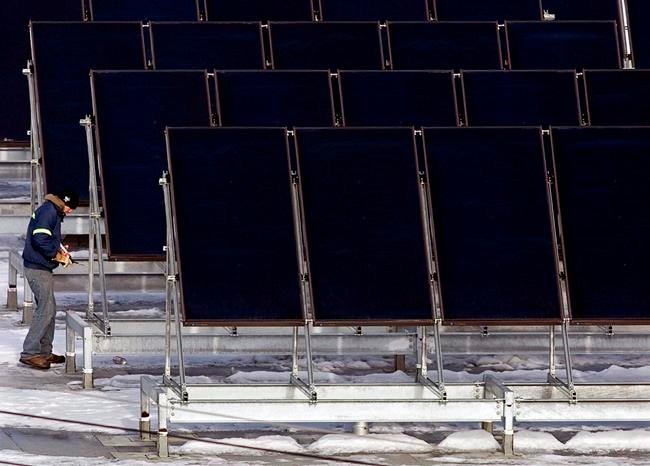
Nova Scotia Power, a subsidiary of Emera Inc., applied to the provincial regulator last week to charge solar customers about $8 per kilowatt of electricity.
It amounts to roughly $960 a year for a typical 10-kilowatt photovoltaic solar installation, which generates about $1,800 in annual revenue — doubling the time needed to earn back the cost of installing the system.
Critics say the proposed fee could wipe out the province’s emerging solar industry.
It’s also renewed enduring concerns about the 30-year old privatization of the utility and its allowed return on equity of about nine per cent, a situation that appears to be contributing to some of the rancour surrounding the proposed fee.
Opponents have even gone so far as to accuse the private company of using its monopoly on electricity distribution to oust competition from small-scale renewable systems.
But Gregg says the proposed new system access charge would contribute to a strong and fair “net metering program” and is a critical part of getting Nova Scotia off coal by 2030.
“These are customers who generate their own electricity at their home or business and use (Nova Scotia Power’s) power lines and infrastructure to put their excess energy on the grid or use power from the grid when they don’t produce enough,” he said in a statement on Saturday.
“Today, the energy and service provided by (Nova Scotia Power) to solar customers is being subsidized by all of (Nova Scotia Power’s) other customers. Our intent in the general rate application is to address this fact and find a solution with the regulator that is fair for all customers.”
Gregg says he understands the concerns raised by the solar industry and some customers, and plans to meet with industry leadership early next week.
“We will continue to support the development of more renewables in Nova Scotia while maintaining our commitment to ensuring fairness for all customers,” he said.
David Brushett, the chairman of Solar Nova Scotia, said in a recent interview that the fee would make solar “not feasible for just about everybody.”
Nova Scotia Power’s proposal is already creating uncertainty in the industry as nervous consumers reconsider solar installations scheduled for this spring, Brushett said.
“Even if the regulator ultimately rejects it, there’s going to be uncertainty over the next months and nobody will install solar.”
The Nova Scotia Power monthly fee, if approved as proposed, would apply retroactively to people who install solar systems beginning next month.
The regulator is expected to hear the rate application, which has over 3,000 pages of documentation, this fall, and normally requires up to 90 days to make decisions.
This report by The Canadian Press was first published Jan. 30, 2022.