Once a powerful symbol in Russia, McDonald’s withdraws

Advertisement

Advertise with us

Two months after the Berlin Wall fell, another powerful symbol opened its doors in the middle of Moscow: a gleaming new McDonald’s.

Read this article for free:


or

Already have an account? Log in here »

To continue reading, please subscribe:

Subscribe and receive a limited-edition Free Press branded hat or tote.

Digital Subscription

One year of digital access for only $205*

  • Enjoy unlimited reading on winnipegfreepress.com
  • Read the E-Edition, our digital replica newspaper
  • Access News Break, our award-winning app
  • Play interactive puzzles

*First annual payment billed as $205.00 + GST for one year. This annual subscription will automatically renew at $233.00 + GST every 52 weeks (10% off the regular annual price of $259.35). Offer available to new and qualified returning subscribers only. Cancel any time.

To continue reading, please subscribe:

Add Free Press access to your Brandon Sun subscription for only an additional

$1 for the first 4 weeks*

  • Enjoy unlimited reading on winnipegfreepress.com
  • Read the E-Edition, our digital replica newspaper
  • Access News Break, our award-winning app
  • Play interactive puzzles
Start now

*Your next Brandon Sun subscription payment will increase by $1.00 and you will be charged $17.95 plus GST for four weeks. After four weeks, your payment will increase to $24.95 plus GST every four weeks.

Hey there, time traveller!
This article was published 14/03/2022 (1671 days ago), so information in it may no longer be current.

Two months after the Berlin Wall fell, another powerful symbol opened its doors in the middle of Moscow: a gleaming new McDonald’s.

It was the first American fast-food restaurant to enter the Soviet Union, reflecting the new political openness of the era. For Vlad Vexler, who as a 9-year-old waited in a two-hour line to enter the restaurant near Moscow’s Pushkin Square on its opening day in January 1990, it was a gateway to the utopia he imagined the West to be.

“We thought that life there was magical and there were no problems,” Vexler said.
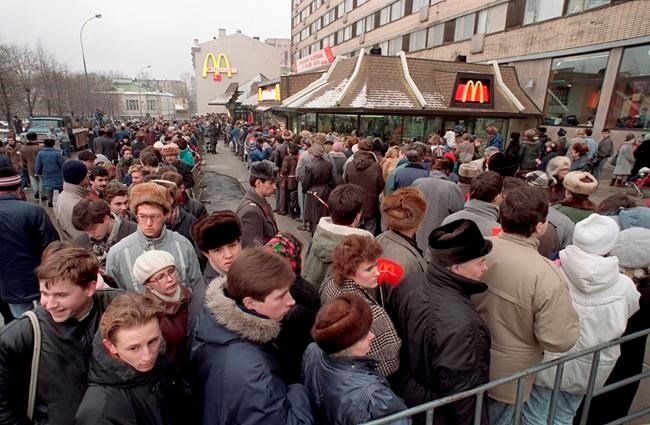
FILE - Hundreds of Muscovites line up outside the first McDonald's restaurant in the Soviet Union on its opening day, in Moscow, Wednesday, Jan. 31, 1990. Two months after the Berlin Wall fell, another powerful symbol opened its doors in the middle of Moscow: a gleaming new McDonald’s. It was the first American fast-food restaurant to enter the Soviet Union. But now, McDonald's is temporarily closing its 850 restaurants in Russia in response to the Ukraine invasion. (AP Photo, File)

So it was all the more poignant for Vexler when McDonald’s announced it would temporarily close that store and nearly 850 others in response to Russia’s invasion of Ukraine. McDonald’s Russian website on Monday read: “Due to operational, technical and logistical difficulties, McDonald’s will temporarily suspend service at its network enterprises from March 14.”

“That McDonald’s is a sign of optimism that in the end didn’t materialize,” said Vexler, a political philosopher and author who now lives in London. “Now that Russia is entering the period of contraction, isolation and impoverishment, you look back at these openings and think about what might have been.”

McDonald’s said in a statement that “at this juncture, it’s impossible to predict when we might be able to reopen our restaurants in Russia.” But it is continuing to pay its 62,500 Russian employees. The company said this week that it expects the closure to cost around $50 million per month.

Outside a McDonald’s in Moscow last week, student Lev Shalpo bemoaned the closure.

“It’s wrong because it was the only affordable place for me where I could eat,” he said.

Just as McDonald’s paved the way for other brands to enter the Soviet market, its exit led to a cascade of similar announcements from other U.S. brands. Starbucks closed its 130 outlets in Russia. Yum Brands closed its 70 company-owned KFC restaurants and was negotiating the closure of 50 Pizza Huts that are owned by franchisees.

McDonald’s entry into the Soviet Union began with a chance meeting. In 1976, McDonald’s loaned some buses to organizers of the 1980 Moscow Olympics who were touring Olympic venues in Montreal, Canada. George Cohon, then the head of McDonald’s in Canada, took the visitors to McDonald’s as part of the tour. That same night, the group began discussing ways to open a McDonald’s in the Soviet Union.

Fourteen years later, after Soviet laws loosened and McDonald’s built relationships with local farmers, the first McDonald’s opened in downtown Moscow. It was a sensation.

On its opening day, the restaurant’s 27 cash registers rang up 30,000 meals. Vexler and his grandmother waited in a line with thousands of others to enter the 700-seat store, entertained by traditional Russian musicians and costumed characters like Mickey Mouse.

“The feeling was, ‘Let’s go and see how Westerners do things better. Let’s go and see what a healthy society has to offer,’” Vexler said.

Vexler saved money for weeks to buy his first McDonald’s meal: a cheeseburger, fries and a Coca-Cola. The food had a “plasticky goodness” he had never experienced before, he said.

Eileen Kane visited the original McDonald’s often in 1991 and 1992 when she was an exchange student at Moscow State University. She found it a striking contrast from the rest of the country, which was suffering frequent food shortages as the Soviet Union collapsed.

“McDonald’s was bright and colorful and they never ran out of anything. It was like a party atmosphere,” said Kane, who is now a history professor at Connecticut College in New London, Connecticut.
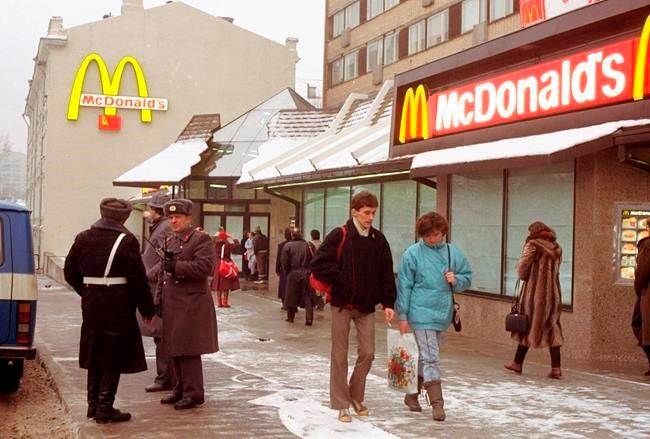
FILE - People walk past Moscow's first McDonalds a day before its opening, in Moscow's Pushkin Square, Jan. 30, 1990. Two months after the Berlin Wall fell, McDonald’s opened its doors in the middle of Moscow. It was the first American fast-food restaurant to enter the Soviet Union. But now, McDonald's is temporarily closing its 850 restaurants in Russia in response to the Ukraine invasion. (AP Photo/Vicktor Yurchenko, File)

McDonald’s entry into the Soviet Union was so groundbreaking it gave rise to a political theory. The Golden Arches Theory holds that two countries that both have McDonald’s in them won’t go to war, because the presence of a McDonald’s is an indicator of the countries’ level of inter-dependence and their alignment with U.S. laws, said Bernd Kaussler, a political science professor at James Madison University in Harrisonburg, Virginia.

That theory held until 2014, when Russia annexed Crimea, Kaussler said.

Kaussler said the number of countries now withdrawing from Russia, and the speed with which they acted, is unprecedented. He thinks some __ including McDonald’s __ might calculate that it’s unwise to reopen, which would leave Russia more isolated and the world less secure.

“As the Russian economy is becoming less inter-dependent with the U.S. and Europe, we basically have fewer domestic economic factors that could mitigate current aggressive policies,” Kaussler said.

Vexler said the admiration for the West that caused Russians to embrace McDonald’s three decades ago has also shifted. Russians now tend to be more anti-Western, he said.

Anastasia Chubina visited a McDonald’s in Moscow last week because her child wanted one last meal there. But she was indifferent about its closure, suggesting Russians will get healthier if they stop eating fast food.

“I think we lived without it before and will live further,” she said.

Entrepreneur Yekaterina Kochergina said the closure could be a good opportunity for Russian fast-food brands to enter the market.

“It is sad, but it’s not a big deal. We’ll survive without McDonald’s,” she said.
Report Error Submit a Tip

More Stories

Protein crests current appetite wave

Laura Rance-Unger 4 minute read Preview

Protein crests current appetite wave

Laura Rance-Unger 4 minute read 2:01 AM CDT

Holiday feasts often reflect the latest fads and trends influencing how we eat.

This Thanksgiving’s table is likely to feature more Canadian content than it might otherwise as a point of national pride.

In the recent past, the carb-free craze has made cauliflower a substitute for the mashed potatoes on some family spreads. Some have gone meatless, while others have added more. Still others offer gluten-free, dairy-free or fat-free alternatives.

Nowadays, it seems consumers can’t get enough protein. Desmond Sobool, deputy chief economist Farm Credit Canada, told a recent economic update for the agri-food sector there are two converging influences in play.

Read
2:01 AM CDT

Puzzles Palace

1 minute read Monday, Jul. 27, 2026

To solve our puzzles, please subscribe with this special offer: |

A Life's Story: Writer built bridges with genuine curiosity, compassion for diversity of religious practices

Janine LeGal 6 minute read Preview

A Life's Story: Writer built bridges with genuine curiosity, compassion for diversity of religious practices

Janine LeGal 6 minute read 6:00 AM CDT

Brenda Suderman knew how to make people feel comfortable. For a journalist, that character trait is a real strength, and it made people trust and appreciate her.

Whether covering musicals, worship spaces, the effects of pandemic shutdowns, death rituals and practices of different traditions, the discovery of the burial of 2,284 infants in unmarked graves, or any other of the countless topics she wrote about in her four- decade career, Suderman did it with genuine interest and care.

Born and raised in Winkler, Suderman grew up on a farm. Much of her childhood was spent in gardens and sugar beet fields.

Baptized at 16, she became a member of the Winkler Bergthaler Mennonite Church. The restrictions against women at the time contributed to planting the seeds of Suderman’s feminist perspective.

Read
6:00 AM CDT

Nurses disciplined for botched IV infusion

Nicole Buffie 3 minute read Preview

Nurses disciplined for botched IV infusion

Nicole Buffie 3 minute read Thursday, Oct. 8, 2026

Two nurses working at the Grace Hospital have been reprimanded and fined $2,500 each for an IV infusion gone bad and an attempted coverup.

The incident happened on November 23, 2023 when a nurse asked a colleague to set up an IV infusion on him in an unused operating room.

During the attempted IV start, the nurse lost consciousness. The nurse who attempted the IV drip and another who was in the room called for help and several staff responded.

The nurse regained consciousness and vomited, but recovered and continued to work his shift, a March 18 decision by the College of Registered Nurses of Manitoba says.

Read
Thursday, Oct. 8, 2026

Police on scene at Fairmont hotel construction site

1 minute read Updated: Yesterday at 12:19 AM CDT

At least three police cars were present at the under-construction Fairmont Winnipeg Thursday evening.

The nature of the response was unclear, but officers were guiding traffic outside of the construction zone at 2 Lombard Place while the response was underway. At 6:50 p.m., traffic was flowing normally.

Security on site provided no information on the response, but an individual working behind site fencing told the Free Press there’d be no comment from anyone on site as to why police were on scene at this time.

An SUV with a Government of Manitoba logo on its side was also present alongside personnel from Manitoba Workplace Safety and Health. However, it’s unknown if it’s connected to the police response.

Phoneless concert a beautiful chance to bask in moment

Jen Zoratti 5 minute read Preview

Phoneless concert a beautiful chance to bask in moment

Jen Zoratti 5 minute read 2:01 AM CDT

Outside the Scotiabank Arena in Toronto, digital billboards flashed fans their singular photo op for the night: “I took this photo before I saw Phoebe Bridgers: The Lost Tour 2026.”

It is, as it is for so many other people, my only documentation of a concert by one of my favourite artists. The American singer-songwriter — who I discovered at the Winnipeg Folk Festival in 2018 — has had a meteoric rise in the past few years, winning three Grammys in 2024 as one third of Boygenius, the indie-rock supergroup rounded out by Lucy Dacus and Julien Baker, and opening for Taylor Swift on select dates of her titanic Eras Tour.

Now, Bridgers is touring in support of Lost Weekend, her third album and first since 2020’s Punisher. It’s a feat of a record, a richly textured meditation on loss and grief, written in the aftermath of the death of her dad, with whom she had a complicated relationship.

So she is in a position to not only play multiple sold-out arena shows, but also insist that those shows be phone-free.

Read
2:01 AM CDT