Scotiabank’s climate plan and fossil fuel financing key focus at AGM
Advertisement
Read this article for free:
or
Already have an account? Log in here »
To continue reading, please subscribe:

Digital Subscription
One year of digital access for only $205*
- Enjoy unlimited reading on winnipegfreepress.com
- Read the E-Edition, our digital replica newspaper
- Access News Break, our award-winning app
- Play interactive puzzles
*First annual payment billed as $205.00 + GST for one year. This annual subscription will automatically renew at $233.00 + GST every 52 weeks (10% off the regular annual price of $259.35). Offer available to new and qualified returning subscribers only. Cancel any time.
To continue reading, please subscribe:
Add Free Press access to your Brandon Sun subscription for only an additional
$1 for the first 4 weeks*
- Enjoy unlimited reading on winnipegfreepress.com
- Read the E-Edition, our digital replica newspaper
- Access News Break, our award-winning app
- Play interactive puzzles
*Your next Brandon Sun subscription payment will increase by $1.00 and you will be charged $17.95 plus GST for four weeks. After four weeks, your payment will increase to $24.95 plus GST every four weeks.
Read unlimited articles for free today:
or
Already have an account? Log in here »
Hey there, time traveller!
This article was published 05/04/2022 (1639 days ago), so information in it may no longer be current.
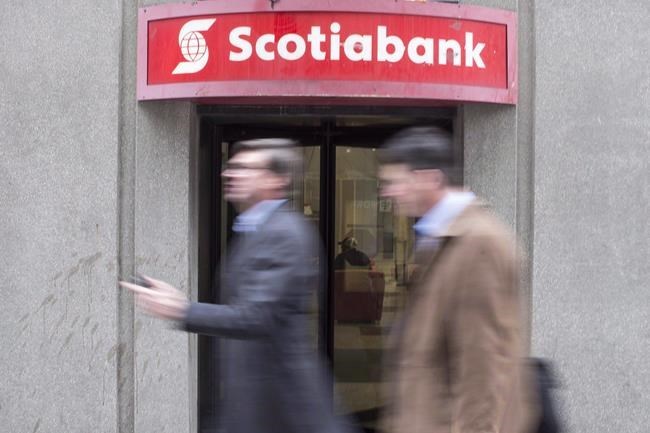
TORONTO – Scotiabank faced criticism for not moving fast enough on climate change at the bank’s annual general meeting, while prepared remarks for chief executive Brian Porter, who missed the meeting due to COVID-19, focused especially on the economic challenges faced by Canadians.
Speaking at the bank’s 190th AGM Tuesday at the Scotiabank Centre, the Trottier Family Foundation, a Scotiabank shareholder, commended the bank for acknowledging climate change as a top risk, but said it was not acting with enough urgency.
“Last year, Scotia’s financing of fossil fuels increased by 87 per cent or $14 billion in absolute numbers to a staggering $30 billion,” Eric St. Pierre, executive director of the Trottier Family Foundation, said in the meeting. “While on paper commitments are being made, the reality is, fossil fuels are being financed massively.”
Following this, a proxy holder brought up the bank’s approach to Scope three greenhouse-gas emissions and what they believe is a lack of reduction targets in the bank’s net-zero plan for this emissions group across all sectors, but especially for the oil and gas sector. Scope three emissions cover indirect emissions outside the direct control of a company.
Meanwhile, Greenpeace activists attempted to disrupt the meeting, criticizing Scotiabank for their approach to fossil fuels and membership in the Canadian Association of Petroleum Producers (CAPP), an oil lobby group. The bank and lobby group held an oil and gas conference together in Calgary on Tuesday.
The company has however made numerous climate change commitments. In March, Scotiabank released its initial targets for achieving net-zero emissions, which includes reducing the emissions intensity, but not absolute emissions, of its oil and gas and its power and utilities portfolios.
The bank also highlighted in its annual ESG report that it had achieved a 25 per cent reduction of its scope one and two greenhouse-gas emissions, which measure emissions companies have more direct control over, four years ahead of the bank’s 2025 target.
“ESG is built into our business strategy…and how we operate as a bank,” said chief financial officer Raj Viswanathan.
Because Porter was absent after testing positive for COVID-19, Viswanathan delivered a condensed version of his prepared remarks which covered inflation pressures on Canadians, growing the economy and labour shortages, as well as criticizing the proposed federal bank tax expected as part of Thursday’s federal budget, calling it “a knee-jerk reaction that sends the wrong message to the global investment community.”
On boosting the Canadian economy and improving living standards, Porter suggested in his prepared remarks that Canada should strike a modern version of the Macdonald Commission, which he explains opened up new trade and export markets, stimulated new businesses and industries and ushered in “a new era of growth and prosperity for Canadians.”
Porter had also planned to talk about Scotiabank’s confidence in its investments in digital, intentions to fund organic growth and the improvement in the company’s market valuation.
Aside from Scotiabank’s carbon footprint, shareholders also raised the issues of fees tied to discount brokerage Scotia iTrade, the bank’s Chilean operations and Russia’s invasion of Ukraine.
This report by The Canadian Press was first published April 5, 2022.
Companies in this story: (TSX:BNS)
Note to readers: This is a corrected story. A previous version had the incorrect first name for Scotiabank’s board chair.