Study: Gas stoves worse for climate than previously thought

Advertisement

Advertise with us

Gas stoves are contributing more to global warming than previously thought because of constant tiny methane leaks while they’re off, a new study found.

Read this article for free:


or

Already have an account? Log in here »

To continue reading, please subscribe:

Subscribe and receive a limited-edition Free Press branded hat or tote.

Digital Subscription

One year of digital access for only $205*

  • Enjoy unlimited reading on winnipegfreepress.com
  • Read the E-Edition, our digital replica newspaper
  • Access News Break, our award-winning app
  • Play interactive puzzles

*First annual payment billed as $205.00 + GST for one year. This annual subscription will automatically renew at $233.00 + GST every 52 weeks (10% off the regular annual price of $259.35). Offer available to new and qualified returning subscribers only. Cancel any time.

To continue reading, please subscribe:

Add Free Press access to your Brandon Sun subscription for only an additional

$1 for the first 4 weeks*

  • Enjoy unlimited reading on winnipegfreepress.com
  • Read the E-Edition, our digital replica newspaper
  • Access News Break, our award-winning app
  • Play interactive puzzles
Start now

*Your next Brandon Sun subscription payment will increase by $1.00 and you will be charged $17.95 plus GST for four weeks. After four weeks, your payment will increase to $24.95 plus GST every four weeks.

Hey there, time traveller!
This article was published 27/01/2022 (1719 days ago), so information in it may no longer be current.

Gas stoves are contributing more to global warming than previously thought because of constant tiny methane leaks while they’re off, a new study found.

The same study that tested emissions around stoves in homes raised new concerns about indoor air quality and health because of levels of nitrogen oxides measured.

Even when they are not running, U.S. gas stoves are putting 2.6 million tons (2.4 million metric tons) of methane — in carbon dioxide equivalent units — into the air each year, a team of California researchers found in a study published in Thursday’s journal Environmental Science & Technology. That’s equivalent to the annual amount of greenhouse gases from 500,000 cars or what the United States puts into the air every three-and-a-half hours.
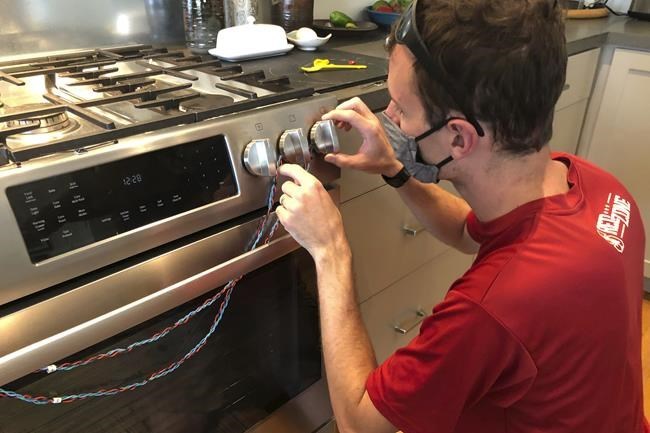
In this photo provided by climate scientist Rob Jackson, researcher Eric Lebel attaches sensors to a stove to measure how often it is used in Stanford, Calif., in 2020. According to a study published Thursday, Jan. 27, 2022, in the journal Environmental Science & Technology, gas stoves are worse for the climate than previously thought because of constant tiny methane leaks even while they’re off. (Rob Jackson via AP)

“They’re constantly bleeding a little bit of methane into the atmosphere all the time,” said the study’s co-author Rob Jackson, a Stanford University climate scientist.

That methane is on top of the 6.8 million tons (6.2 million metric tons) of carbon dioxide that gas stoves emit into the air when they are in use and the gas is burned, the study said. Methane is a greenhouse gas that is dozens of times more potent than carbon dioxide but doesn’t stay in the atmosphere nearly as long and isn’t as plentiful in the air.

The researchers examined 53 home kitchens in California — many in bed and breakfasts they rented. They sealed most of the rooms in plastic tarps and then measured emissions when the stoves were working and when they were not. And what was surprising was that three-quarters of the methane released happened while the stoves were off, Jackson said. Those are emissions releases that the government doesn’t account for, he said.

“That’s a big deal because we’re trying to really reduce our carbon footprint and we claim that gas is cleaner than coal, which it is,” said study lead author Eric Lebel, a scientist at PSE Healthy Energy, an Oakland nonprofit. But he said much of the benefit disappears when leaks are taken into account.

Many communities have bans on gas stove use in future new construction that will take effect in future years, including New York City and the Bay Area cities of San Francisco, Oakland, San Jose, and Berkeley, Jackson said.

“People can already choose electric appliances if they want,” said Frank Maisano, a Washington policy and public relations expert who represents gas and appliance interests. “People just like gas appliances because they perform better, especially in colder climates.”

“Natural gas appliances are generally more energy- and cost-effective than their electric counterparts,” Maisano said.

Jackson estimated that when all natural gas use and extraction is taken into account, about 100 million tons (91 million metric tons) of gas leaks into the atmosphere. And the couple million tons from gas stoves “is meaningful. That’s a substantial part and it’s a part that we haven’t included accurately in the past.”

The leakage finding is “a very important takeaway” and fits with other work that found there are often big leaks that account for much of the emissions, said Zachary Merrin, a research engineer with the Illinois Applied Research Institute’s Indoor Climate Research & Training group.

Merrin, who wasn’t part of the study, said the emission of un-combusted methane is “clearly bad. From an emissions standpoint, cooking directly with gas is better than using a fossil fuel powered electric stove but worse than using a solar powered electric stove.”

The methane leak isn’t dangerous to human health or as a possible explosive, Jackson said. But when conducting the tests, researchers found high levels of nitrogen oxides, greater than 100 parts per billion. Jackson said the U.S. Environmental Protection Agency doesn’t have indoor air quality standards for that gas, but the measurements they took exceed its outdoor air quality standards. While methane doesn’t include nitrogen, the nitrogen oxides are byproducts of the combustion in natural gas ovens, he said.

Maisano said people should always use hood ranges and make sure they have proper ventilation. Jackson, who has a gas stove that he plans to replace, said he never used ventilation before this study, but that he now does so every time.

___

Follow AP’s climate coverage at https://apnews.com/hub/climate and follow Seth Borenstein on Twitter at https://twitter.com/borenbears.

___

The Associated Press Health and Science Department receives support from the Howard Hughes Medical Institute’s Department of Science Education. The AP is solely responsible for all content.

Report Error Submit a Tip

More Stories

Puzzles Palace

1 minute read Monday, Jul. 27, 2026

To solve our puzzles, please subscribe with this special offer: |

Protein crests current appetite wave

Laura Rance-Unger 4 minute read Preview

Protein crests current appetite wave

Laura Rance-Unger 4 minute read Saturday, Oct. 10, 2026

Holiday feasts often reflect the latest fads and trends influencing how we eat.

This Thanksgiving’s table is likely to feature more Canadian content than it might otherwise as a point of national pride.

In the recent past, the carb-free craze has made cauliflower a substitute for the mashed potatoes on some family spreads. Some have gone meatless, while others have added more. Still others offer gluten-free, dairy-free or fat-free alternatives.

Nowadays, it seems consumers can’t get enough protein. Desmond Sobool, deputy chief economist Farm Credit Canada, told a recent economic update for the agri-food sector there are two converging influences in play.

Read
Saturday, Oct. 10, 2026

Chopped trees will leave a ‘blight’ on Windsor Park

Kelly-Anne Riess 3 minute read Preview

Chopped trees will leave a ‘blight’ on Windsor Park

Kelly-Anne Riess 3 minute read Friday, Oct. 9, 2026

Robert Gordon has watched the trees grow along a popular Windsor Park walking path for nearly six decades.

Now, as Manitoba Hydro cuts them down to protect nearby power lines, he says a familiar part of his childhood neighbourhood is disappearing.

Although he no longer lives in the area, Gordon regularly returns to walk or cycle along the tree-lined path, which runs parallel to Archibald Street.

He was concerned when he recently spotted crews clearing vegetation near the entrance to the path, but initially assumed they were removing brush. When he returned, he discovered the clearing had extended farther along the corridor.

Read
Friday, Oct. 9, 2026

Towing company hands stolen car back, but not to owner

By Matthew Frank 4 minute read Preview

Towing company hands stolen car back, but not to owner

By Matthew Frank 4 minute read Friday, Oct. 9, 2026

A Manitoba man says he is dumbfounded after his car was stolen, impounded by a Winnipeg towing company and given back — to someone that wasn’t him.

Cody Lamb lives in the western Manitoba community of Douglas, about 18 kilometres east of Brandon, but spends weeks away from home working on oil rigs in Alberta.

The 24-year-old says on Sept. 11, while away for work, he heard from his girlfriend who told him his car wasn’t in their driveway. Lamb reported the car stolen to Brandon RCMP the same day.

After filing the report, he heard from Steinbach RCMP on Oct. 1 that his car was recovered that day in the community of Mitchell, roughly five km west of Steinbach.

Read
Friday, Oct. 9, 2026

Manitoba e-scooter legislation changes set to impose speed limit, age restrictions, sidewalk ban

Matthew Frank 5 minute read Preview

Manitoba e-scooter legislation changes set to impose speed limit, age restrictions, sidewalk ban

Matthew Frank 5 minute read Updated: Yesterday at 5:14 PM CDT

People riding e-scooters and other personal electric vehicles in Manitoba will have to strap on a helmet, stay off sidewalks and follow new age limits once new provincial rules for the devices take effect next year.

The vehicles, which also include electric skateboards, hoverboards and unicycles, will fall under The Highway Traffic Act starting in 2027, according to the province’s website. E-bikes are excluded from the new rules, according to the province’s frequently-asked-questions page.

All riders must be at least 16 years old and wear properly fitting helmets — that goes for passengers, too, the province said.

The proposed new legislation sets a speed limit of 25 km/h and would prohibit personal electric vehicles from sidewalks unless signs specifically allow sidewalk use. Riders would be using shared paths or roads with speed limits of 50 km/hr or less. They won’t be allowed to operate the vehicles under the influence of alcohol or drugs and they must use hand signals and obey traffic signs.

Read
Updated: Yesterday at 5:14 PM CDT

Carney: Trump’s ‘energy ceasefire’ could ‘de-escalate’ war in Ukraine

Kyle Duggan, The Canadian Press 4 minute read Preview

Carney: Trump’s ‘energy ceasefire’ could ‘de-escalate’ war in Ukraine

Kyle Duggan, The Canadian Press 4 minute read Updated: Yesterday at 5:18 PM CDT

OTTAWA - Mark Carney thanked U.S. President Donald Trump for “his leadership toward securing an energy ceasefire" between Ukraine and Russia, the Prime Minister's Office said on Sunday.

But on the same day, Carney also expressed to Ukraine's leader that Trump's new diesel supply agreement with Russia undermines Canada's efforts to end the war in Europe.

Trump posted on his Truth Social account on Sunday that Ukraine and Russia have agreed to an "energy ceasefire," but did not immediately offer any details.

Carney expressed “strong support for this agreement," according to a readout from the PMO that followed a conversation between the two leaders. And on his own social media account, Carney offered that Trump’s newly announced “energy ceasefire” could help wind down Russia’s war against Ukraine.

Read
Updated: Yesterday at 5:18 PM CDT