Toronto committee pushes to ban robots from sidewalks, bike paths
Advertisement
Read this article for free:
or
Already have an account? Log in here »
To continue reading, please subscribe:
Digital Subscription
One year of digital access for only $1.44 a week*
- Enjoy unlimited reading on winnipegfreepress.com
- Read the E-Edition, our digital replica newspaper
- Access News Break, our award-winning app
- Play interactive puzzles
*Billed as $5.77 plus GST every four weeks. After 52 weeks, price increases to the regular rate of $19.95 plus GST every four weeks. Offer available to new and qualified returning subscribers only. Cancel any time.
To continue reading, please subscribe:
Add Free Press access to your Brandon Sun subscription for only an additional
$1 for the first 4 weeks*
- Enjoy unlimited reading on winnipegfreepress.com
- Read the E-Edition, our digital replica newspaper
- Access News Break, our award-winning app
- Play interactive puzzles
*Your next Brandon Sun subscription payment will increase by $1.00 and you will be charged $17.95 plus GST for four weeks. After four weeks, your payment will increase to $24.95 plus GST every four weeks.
Read unlimited articles for free today:
or
Already have an account? Log in here »
Hey there, time traveller!
This article was published 06/12/2021 (1777 days ago), so information in it may no longer be current.
TORONTO – A Toronto committee is pushing for the city to ban some robots and other automated or remote controlled devices from sidewalks, bike paths and pedestrian ways.
The Toronto Accessibility Advisory Committee is asking city councillors to vote next Wednesday in favour of prohibiting devices from these spaces that run on anything but muscle power.
The committee’s recommendation is aimed at reducing hazards for people with low mobility or vision, as well as seniors and other children, who may be impeded by stopped or stalled devices or unable to quickly detect their presence and manoeuvre around them.
The recommendation permits mobility devices like scooters used by people with disabilities, but would ban food delivery robots like Tiny Mile’s pink, heart-eyed ones named Geoffrey, which some Toronto restaurants have used to courier orders.
Tiny Mile did not respond to requests for comment, but circulated a petition on social media, which calls for a stop to the “illogical” ban accused of hurting innovation.
However, the committee’s chair insists the proposed ban is not about stifling innovation, but rather encouraging accessibility.
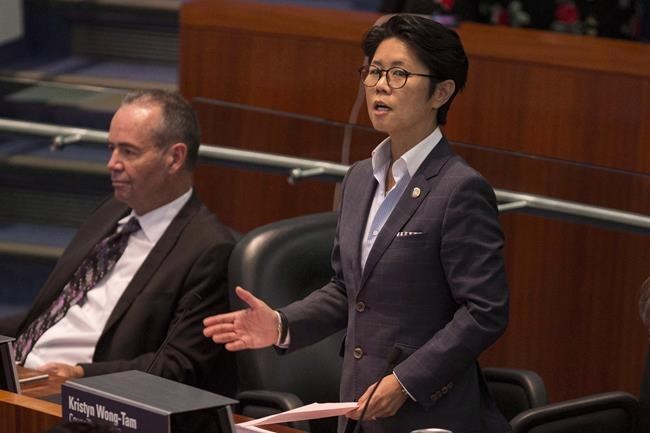
“We want to remove external barriers so that people can participate in public life,” said Kristyn Wong-Tam, a city councillor, who represents the Toronto-Centre area and recently put forward a motion calling for the ban.
“With people who are facing barriers, with disabilities, our job is to make sure that that community has a voice to city council.”
Wong Tam’s motion was prompted by discussions the committee and city staff had after Ontario’s Ministry of Transportation solicited feedback on a pilot allowing micro-utility devices, including automated personal delivery devices, for off-road use in places such as sidewalks in September.
The 10-year pilot proposal suggested such devices travel at no more than 10 km/hr on sidewalks, be marked with an operator’s name and contact details, and have mandatory audible signals, reflectors with lights, brakes, insurance and a requirement to yield to pedestrians.
These measures are not enough, said David Lepofsky, chairman of the Accessibility for Ontarians with Disabilities Act Alliance and a visiting professor at the Osgoode Hall Law School.
He worries about all the dangerous situations that could arise for people with disabilities and even those without.
“It’s everything from a robot, which could be in your path or travelling becoming a tripping hazard, to a robot that’s fallen over or…could be in motion and could injure you,” he said.
“If you have a guide dog or you have got a kid with you, they could also be injured.”
Wong-Tam has similar concerns and feels if they aren’t addressed early, tech companies may continue to push limits and the devices could become even more dangerous.
“Will (the devices) become taller and larger?” she said.
“Unless there are regulations that tell us how fast they can operate or how large they can be, how tall they can be, how wide they can be, they’ll just keep on going.”
While the province is mulling collision reporting for the pilot, Lepofsky feels there will be little recourse for pedestrians.
“You can’t arrest a robot and prosecute them,” he said.

And worse, he says the province’s plan to allow municipalities to opt into the pilot could put the onus on Canadians with disabilities to repeatedly defend their rights and ensure they can safely use sidewalks.
“We don’t want to have to fight robots one city after the next all the way across Ontario,” he said. “That is totally dumping an unfair burden on people with disabilities.”
If Wong-Tam’s motion succeeds at city council on Dec. 16, accessibility advocates like Lepofsky will have one less battle to fight and an example of a region that took a hard stand to use elsewhere.
The motion was already approved by the city’s Infrastructure and Environment Committee last week.
This report by The Canadian Press was first published Dec. 6, 2021.