

Did theatrics inspire Discovery’s mutiny?
Author links play to Henry Hudson's demise
Advertisement
Read this article for free:
or
Already have an account? Log in here »
To continue reading, please subscribe:
Digital Subscription
One year of digital access for only $1.44 a week*
- Enjoy unlimited reading on winnipegfreepress.com
- Read the E-Edition, our digital replica newspaper
- Access News Break, our award-winning app
- Play interactive puzzles
*Billed as $5.77 plus GST every four weeks. After 52 weeks, price increases to the regular rate of $19.95 plus GST every four weeks. Offer available to new and qualified returning subscribers only. Cancel any time.
To continue reading, please subscribe:
Add Free Press access to your Brandon Sun subscription for only an additional
$1 for the first 4 weeks*
- Enjoy unlimited reading on winnipegfreepress.com
- Read the E-Edition, our digital replica newspaper
- Access News Break, our award-winning app
- Play interactive puzzles
*Your next Brandon Sun subscription payment will increase by $1.00 and you will be charged $17.95 plus GST for four weeks. After four weeks, your payment will increase to $24.95 plus GST every four weeks.
Read unlimited articles for free today:
or
Already have an account? Log in here »
Hey there, time traveller!
This article was published 09/06/2009 (6208 days ago), so information in it may no longer be current.
A play performed in Shakespeare’s London in the early 1600s may have “inspired” the man who led a famous mutiny against British explorer Henry Hudson, claims a new book probing the 400-year-old cold case.
In Fatal Journey: The Final Expedition of Henry Hudson, U.S. historian Peter Mancall highlights a potential link between Hudson’s demise in northern Canada in 1611 while searching for the Northwest Passage and a 1609 theatrical production in England that gave sympathetic treatment to a band of pirates that takes over a ship but is eventually hanged for the crime.
The play, Fortune By Land and Sea, was written by Thomas Heywood and William Rowley. Contemporaries of William Shakespeare, the two based their tragicomedy on the true story of three Englishmen executed for piracy in 1583.
The condemned men — a Thomas Walton and fellow pirates named Clinton and Arnold — are known to have made stirring speeches at the gallows defending their harassment of the Spanish armada and lamenting the loss of courage and sailing skill that their deaths would mean for England.
A pamphlet was published capturing the trio’s final words in verse, and that prompted Heywood and Rowley to write and stage their play in London between 1607 and 1609.
It was 1609 when Hudson made the first of his two voyages of discovery to the New World. He reached the mouth of the Hudson River at present-day New York City in September 1609, the quadricentennial of which is the focus of major events this summer in the U.S.
He soon returned to the New World but much farther north. Hudson, whose chief discovery was the Arctic bay that bears his name, was forced to lock his ship in ice during the harsh winter of 1610-11.
He then quarrelled with his crew in June 1611 when he resisted returning to England before the next freeze-up.
Mutineers led by Henry Greene suspected their captain of hoarding food and dooming the ship to destruction.
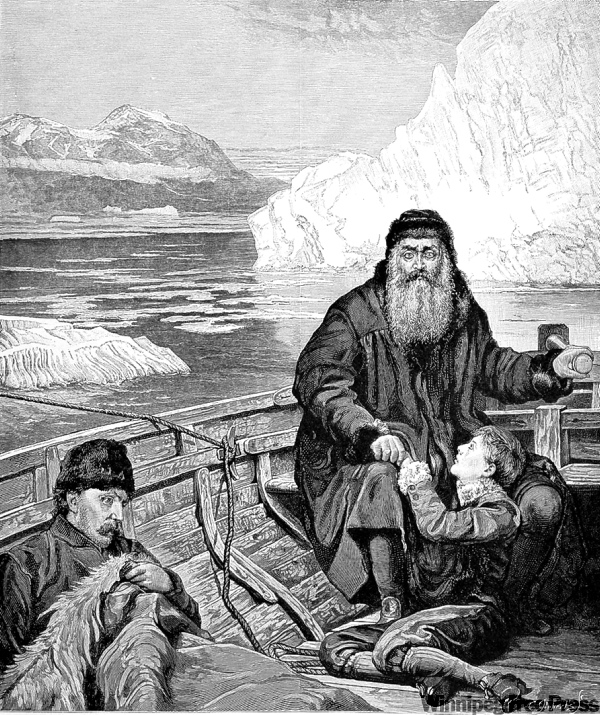
Hudson, his son and a handful of loyalists were set adrift in a lifeboat in James Bay. They were never seen again.
Greene and several other mutineers died during the voyage home in Hudson’s ship, Discovery, which eventually reached the Irish coast thanks to the expert piloting of Robert Bylot.
Although tried for murder, the survivors of Hudson’s ill-fated final expedition were exonerated — largely, historians believe, because of the valuable experience the accused could provide in future searches for the Northwest Passage.
Bylot later played a key role in the English discovery of Smith, Jones and Lancaster sounds in Canada’s eastern Arctic Ocean.
Noting that Fortune By Land and Sea was performed in London “just preceding” the 1610 voyage of Hudson’s ship to Canada, Mancall asks: “Is it possible that Greene had seen it and been inspired by it to believe that perhaps the circumstances on board the Discovery would be serious enough to justify clemency from the king?”
The “crucial detail,” Mancall said, “was that the play was on a stage in London in the years just before Hudson’s final journey… I cannot prove that (Greene) or others saw the play (or read the pamphlets about pirates), but the timing is suggestive.”
— Canwest News Service