

Thatcher uses book to lay blame
Convicted killer says he was framed for ex-wife's murder
Advertisement
Read this article for free:
or
Already have an account? Log in here »
To continue reading, please subscribe:

Digital Subscription
One year of digital access for only $205*
- Enjoy unlimited reading on winnipegfreepress.com
- Read the E-Edition, our digital replica newspaper
- Access News Break, our award-winning app
- Play interactive puzzles
*First annual payment billed as $205.00 + GST for one year. This annual subscription will automatically renew at $233.00 + GST every 52 weeks (10% off the regular annual price of $259.35). Offer available to new and qualified returning subscribers only. Cancel any time.
To continue reading, please subscribe:
Add Free Press access to your Brandon Sun subscription for only an additional
$1 for the first 4 weeks*
- Enjoy unlimited reading on winnipegfreepress.com
- Read the E-Edition, our digital replica newspaper
- Access News Break, our award-winning app
- Play interactive puzzles
*Your next Brandon Sun subscription payment will increase by $1.00 and you will be charged $17.95 plus GST for four weeks. After four weeks, your payment will increase to $24.95 plus GST every four weeks.
Read unlimited articles for free today:
or
Already have an account? Log in here »
Hey there, time traveller!
This article was published 29/08/2009 (6204 days ago), so information in it may no longer be current.
MOOSE JAW, Sask. — Maybe Colin Thatcher has mellowed with age.
“Sorry it’s such a mess in here. It’s been so dusty out at the ranch,” he said this week before starting his parked half-ton truck.
Or was Thatcher, a former Saskatchewan cabinet minister who served 22 years in prison for the 1983 murder of his ex-wife, JoAnn Wilson, on his best behaviour this week to promote his controversial new book, which hits shelves Tuesday?
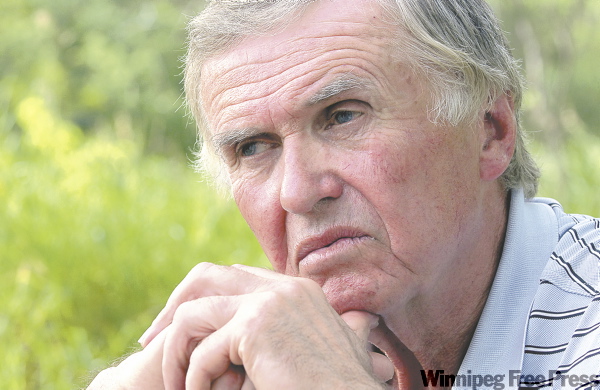
In an interview with the Saskatoon StarPhoenix, the 71-year-old Thatcher said he wrote the book simply to document the “truth.”
He said his greatest revenge is to show justice officials that he’s not bitter.
When released from prison in 2006, Thatcher resumed life as a rancher on the family land just outside Moose Jaw, Sask. He said he has a great relationship with his three children and four grandchildren, and is generally happy. But it’s not tough to feel the anger jumping off the pages of Thatcher’s book, Final Appeal: Anatomy of a Frame.
By the end of the third page, he’s already described a Regina police officer looking and acting like a “goon,” another who “stank to high heaven” and had “an intense smell of body odour” and a group of officers as “an abhorrent collection of thugs.” When hurling these and other insults, he invariably uses the person’s full name, and made no apologies during the interview.
“The whole book is the way I saw it. I didn’t flower it up,” he said.
Thatcher also gives his perspective on each piece of evidence, each witness, each twist and turn in the 1984 trial and its subsequent appeals. The taped conversation between Thatcher and a friend, the infamous credit card receipt found at the crime scene and Thatcher’s phone records from that night are all dissected.
Thatcher still says he didn’t kill his ex-wife, and he would not have been convicted had justice officials disclosed key details to him at the time of the trial.
“Why were these documents concealed? It was like defending yourself against the wind,” Thatcher said. “I wanted a record of what actually happened.”
Many people connected to the case declined to comment for this story. Others said the book contains the same old, tired ramblings Thatcher’s been peddling for years.
“The public has heard enough from this gentleman over the years,” said Ed Swayze, a retired Regina police officer who headed the Thatcher investigation.
“He had his say in court. He had his appeal. At some point, there’s got to be an end, not a sequel.”
JoAnn Wilson was found dead in the garage of her Regina home Jan. 21, 1983. She had been beaten, bludgeoned and shot.
The case gripped Saskatchewan. Thatcher was an MLA in the Grant Devine government, and son of former Liberal premier Ross Thatcher. He and Wilson had three children together but had been divorced for more than two years at the time of her death. She remarried in 1981.
Thatcher was arrested and charged with her murder in May 1984, the point at which his book begins.
“My first night in jail seemed to last forever,” Thatcher writes. Politicians before the courts, especially in Saskatchewan, “are perceived as guilty until proven innocent,” he adds.
In the book, Thatcher does not give an alternative theory of the killing, and doesn’t say who he thinks killed Wilson.
“I believed then, and still do, that the answers to JoAnn’s murder lay in the Wilson home,” he writes.
When asked about the passage, Thatcher refused to elaborate. He said he doesn’t plan to prove the identity of the killer. “It’s not my job to solve the case,” he said.
He lays out his version of the timeline, which he said proves he could not have been in Regina at the time of the killing.
Thatcher criticizes the discovery of a credit card receipt with his signature in the snow at the scene.
Among other alleged inconsistencies with the signature and price of gas purchased, he says a fingerprint analysis failed to find his prints, the gas attendant’s, or those of the police officer who plucked it from the snow. Only the prints of the second officer to handle the paper showed up, he writes.
One of the other key parts of the Crown’s case was an audio recording taped without Thatcher’s knowledge by his neighbour, Gary Anderson.
Anderson was working for police in exchange for immunity. Anderson earlier told police Thatcher tried to enlist him to kill Wilson. Anderson said he did not kill Wilson, but helped Thatcher dispose of evidence after the murder.
Thatcher reprints the transcript in his book.
Anderson invites Thatcher to meet near an old barn while police snipers hide from view. The conversation opens with some small talk. He tells Thatcher the car has been cleaned out and “I didn’t know what the hell you’d done with the gun.”
Thatcher tells him not to talk about it or “kid” him about it.
In another section, Thatcher says: “They got zero else and you know what there is to put together and it ain’t possible and it ain’t comin’ from me… It’s just always deny, deny, deny.”
Shortly after, the following exchange took place.
Anderson: “I had a helluva a time to clean that car out.”
Thatcher: “That right.”
A: “Had a bitch of a time gettin’ blood and stuff off.”
T: “Well, is there a chance it could ever surface? There is a chance it could surface?”
A: “No”
T: “OK.”
Several pages later, in closing, Anderson remarks, “Yeah, I’m glad you got her.”
“OK,” Thatcher replies.
To many, the tape is evidence of Thatcher’s guilt. “If that’s not a conversation of murder, I don’t know what is,” Swayze said.
In his book, Thatcher offers his own interpretation. “Glad you got her” was a reference to Thatcher gaining custody of his daughter, he writes.
Thatcher also devotes parts of two chapters to an alleged anonymous “confession” sent from Winnipeg to the Regina Leader-Post on the eve of one of his appeals. Signed “murderer with concern and guilt,” the long, poorly written letter is reprinted in the book. The original letter was accompanied by nude photos of a woman the writer claimed to be Wilson, and a hatchet the writer claimed was the murder weapon.
The writer claimed to be blackmailing Wilson following their affair, and killed her once she stopped paying. Thatcher is angry neither he nor his lawyer heard about it until after the appeal. When they asked to see the items, justice officials apparently said they’d been lost.
Leader-Post editor-in-chief Janice Dockham confirmed the newsroom did receive the package on the eve of Thatcher’s 1985 appeal.
“The reporter was instructed to turn it over to police,” Dockham said.
Dockham quoted from the 1994 review by the federal justice minister, which considered the material to be “a hoax.” It stated the Regina police investigated and, among other things, concluded Wilson was not the subject of the photos.
Thatcher said a new trial would top his wish list, but knows that won’t happen. He said he hopes the book can give his side of the story in a way that at least three previous books and a television movie did not. He hopes people read it with an open mind.
“They can accept or reject what I have to say,” he said. “(Justice officials) lied. They deceived… They did these things deliberately. Careers were built on my conviction.”
Thatcher said his children supported his desire to publish.
His granddaughter, now 12, often asks, “What happened to your wife?”
Thatcher said he hopes the book will help them understand the truth.
Earlier this year, following a public and political uproar when news of his impending book spread, the Saskatchewan government quickly passed a law prohibiting criminals from profiting from their crimes.
Both Thatcher and his publisher, ECW Press, believe his book will be exempt from the law, as it does not describe the grisly details.
Thatcher said he’s not sure what he’ll do if the government seizes the profits. “They stole 20 years of my life. If they want to steal this, c’est la vie.”
— Canwest News Service
Related Articles
Court delays plan by girl, 13, to sail world alone
Advertisement Advertise With Us
Advertisement Advertise With Us