

Giant arachnid species discovered in South Africa
Advertisement
Read this article for free:
or
Already have an account? Log in here »
To continue reading, please subscribe:
Monthly Digital Subscription
$0 for the first 4 weeks*
- Enjoy unlimited reading on winnipegfreepress.com
- Read the E-Edition, our digital replica newspaper
- Access News Break, our award-winning app
- Play interactive puzzles
*No charge for 4 weeks then price increases to the regular rate of $19.00 plus GST every four weeks. Offer available to new and qualified returning subscribers only. Cancel any time.
Monthly Digital Subscription
$4.75/week*
- Enjoy unlimited reading on winnipegfreepress.com
- Read the E-Edition, our digital replica newspaper
- Access News Break, our award-winning app
- Play interactive puzzles
*Billed as $19 plus GST every four weeks. Cancel any time.
To continue reading, please subscribe:
Add Free Press access to your Brandon Sun subscription for only an additional
$1 for the first 4 weeks*
*Your next subscription payment will increase by $1.00 and you will be charged $16.99 plus GST for four weeks. After four weeks, your payment will increase to $23.99 plus GST every four weeks.
Read unlimited articles for free today:
or
Already have an account? Log in here »
Hey there, time traveller!
This article was published 21/10/2009 (5912 days ago), so information in it may no longer be current.
For anyone who suffers from arachnophobia, it might be advisable to read no further.
That’s because this is a story about a spider — a very BIG spider.
Researchers have discovered an entirely new species of arachnid, and its gargantuan female members represent the largest of its family ever found.
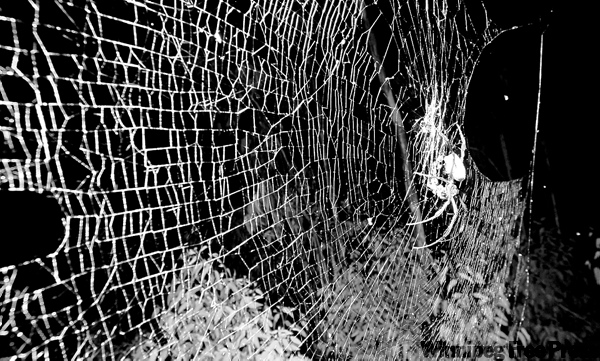
Dubbed Nephila komaci, this sucker has a tip-to-tip leg span of about 12 centimetres, including a body almost four centimetres wide. To get an idea how big that is, imagine the size of a man’s hand or a small saucer.
"They look like they’re all legs… They live in webs, right, so they’re spindly, relatively delicate spiders," said Jonathan Coddington, an arachnologist at the Smithsonian Institution’s National Museum of Natural History in Washington, one of the scientists who identified the new species.
"If you were standing there, you wouldn’t say that. You would probably freak out. Most people do."
Like other giant golden orb weavers in its family, N. komaci spins a web that is equally impressive in size, measuring more than a metre in diameter.
"The webs are so strong that you bounce off," Coddington said Tuesday. "It’s not a diaphanous experience."
He said the researchers aren’t sure why the females grow so big (at one-fifth their size, the male of the species is positively puny). But he suggested the bigger the spider, the more eggs it can lay in its lifetime, so size may confer an evolutionary advantage.
"They’ve probably outgrown most of their predators," Coddington said. Hummingbirds, which are known for plucking spiders off their webs while on the wing, "are too small to nail these guys. Bats could, too, but bats couldn’t take something like this."
In fact, with this behemoth of a spider, the traditional hunter has become the hunted, as it were. N. komaci would have no problem chowing down on any bird, bat or lizard unfortunate enough to get ensnared in its web, although its usual diet would run more to flies, bees and grasshoppers, he said.
The females also aren’t choosy about picking off the relatively dwarf-sized males of their own kind — if they’re not in the mood to mate, or even after copulation, noted Coddington.
While all Nephila species are poisonous — immobilizing their prey with a stab of venom and cocooning them in silk for later dining — the spiders are not harmful to humans, said co-discoverer Matjaz Kuntner, an arachnologist and evolutionary biologist at the Slovenian Academy of Sciences and Arts.
Kuntner called the discovery of the new species, reported in this week’s issue of the scientific journal PLoS One, "very exciting."
A few years ago, a South African colleague found a male and two females in Tembe Elephant Park, and it became clear scientists were seeing a valid new species.
— The Canadian Press