

Grizzlies roam into polar bear turf
Scientists study northern Manitoba where two animals make contact
Advertisement
Read this article for free:
or
Already have an account? Log in here »
To continue reading, please subscribe:
Monthly Digital Subscription
$1 per week for 24 weeks*
- Enjoy unlimited reading on winnipegfreepress.com
- Read the E-Edition, our digital replica newspaper
- Access News Break, our award-winning app
- Play interactive puzzles
*Billed as $4.00 plus GST every four weeks. After 24 weeks, price increases to the regular rate of $19.95 plus GST every four weeks. Offer available to new and qualified returning subscribers only. Cancel any time.
Monthly Digital Subscription
$4.99/week*
- Enjoy unlimited reading on winnipegfreepress.com
- Read the E-Edition, our digital replica newspaper
- Access News Break, our award-winning app
- Play interactive puzzles
*Billed as $19.95 plus GST every four weeks. Cancel any time.
To continue reading, please subscribe:
Add Free Press access to your Brandon Sun subscription for only an additional
$1 for the first 4 weeks*
*Your next subscription payment will increase by $1.00 and you will be charged $16.99 plus GST for four weeks. After four weeks, your payment will increase to $23.99 plus GST every four weeks.
Read unlimited articles for free today:
or
Already have an account? Log in here »
Hey there, time traveller!
This article was published 01/03/2010 (5878 days ago), so information in it may no longer be current.
POLAR bears and grizzly bears, two mighty beasts of the Canadian wilderness, could soon be battling over territory.
Hungry grizzly bears are increasingly encroaching on their northern counterparts’ territory in northern Manitoba, according to experts.
While flying above Wapusk National Park near Churchill, two years ago, a team of researchers unexpectedly spotted a grizzly bear.
"And it wasn’t a dirty polar bear or a moose — we saw the hump," said Robert Rockwell, a research associate at the American Museum of Natural History in New York.
In sheer size, an adult male polar bear is larger than a grizzly, weighing an average of 1,200 pounds. A grizzly comes in at about 600 pounds.
After the discovery two years ago, Rockwell, along with graduate student Linda Gormezano, set out to chart the history of grizzly bears in the area. They found there was no record of the animals in the area before 1996.
Rockwell and Gormezano’s findings were recently published in The Canadian Field-Naturalist.
Researchers have now tried to anticipate the possible effects of grizzly bears encroaching on polar bear territory — particularly dens used by female polar bears and their cubs.
"That’s going to bring the (two) in physical contact, and at that point you’ve got adult grizzlies and polar bear cubs, and that could be bad," he said.
Polar bear cubs are born blind and are very susceptible to predators. There is also concern for the welfare of polar bears because they are already officially listed as "extirpated," which means they are disappearing or retreating from the region, although they still live in other areas.
Some scientists speculate that polar bears in Wapusk will move further north as the ice in the Arctic sea retreats due to warming temperatures.
This could mean the grizzlies won’t interact with the polar bears at all.
The grizzlies are likely coming from the Rockies, the Yukon and Nunavut and may be on the move in search of better food, Rockwell said.
Moose, fish, caribou and berries — prime grizzly bear food — are all plentiful in Wapusk.
"The Cree elders (in the region) we talked to feel that now that grizzly bears have found this food source they will be staying," Rockwell said. "I think what’s happened is very simple… they have a found a place with lots of food and they aren’t going away. They will probably increase in number."
The two kinds of bears would have to learn to live together, Rockwell said, although they are unsure if the grizzly population will stick around.
"I’m sure that grizzlies aren’t stupid. If a 600-pound grizzly is approached by a 1,200-pound polar bear, I’m guessing that grizzly is going to show that polar bear just how fast it can run," he said. "So, I don’t see that there will be lots of conflicts like that. It’s a huge area. There’s lots of food."
There is also a possibility the two bears will breed, Rockwell said.
There have been reports of "grolars" in the Northwest Territories.
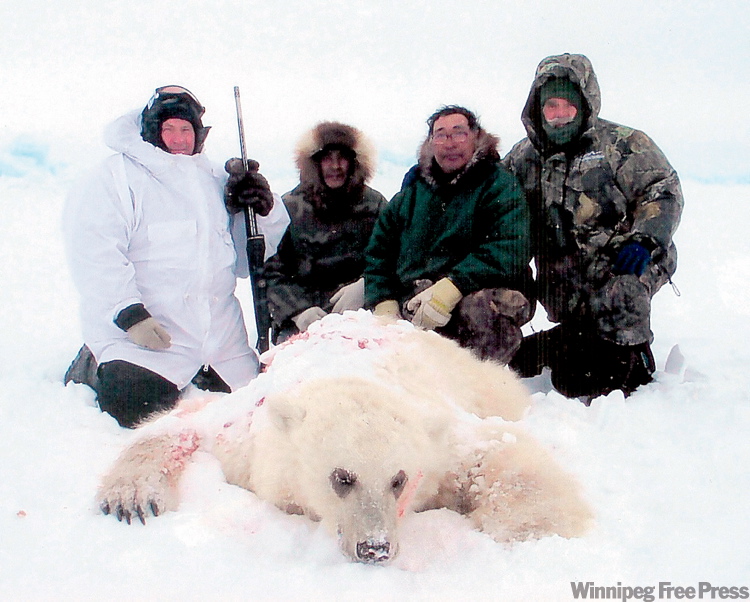
In May 2006, DNA tests confirmed that a strange-looking bear killed by an American hunter was the first cross-bred polar and grizzly bear ever discovered in the wild.
Jim Martell, who paid $50,000 for guides and a polar bear hunting tag, shot the mid-sized male after his Inuit guide pointed out what looked like a polar bear in the distance. Authorities seized the animal after noticing its white fur was mottled with brown patches, and its eyes were set inside thin circles of black skin. It also bore grizzly-like features, including long claws, a humped back and a dished face.
After genetic testing showed that the bear was half polar, the bear was returned, and Martell was spared the hefty fines associated with shooting an animal he was not permitted to hunt.
If the grizzly bears are indeed moving south from Nunavut, Gail Whelan Enns said this could mean climate change has affected their diet and access to food.
"I think it is worrisome," said Whelan Enns, director of Wildlife Manitoba.
"If there’s significant enough change and alteration in the habitat they’re used to, they’re going to get the heck out."
Geneticists estimate about 250,000 years ago, some grizzly bears wandered onto the sea ice and discovered a smorgasbord of seals that no animal had yet begun to hunt. Grizzlies have a naturally large variation in colour, and over time the lighter-coloured bears won out on the ice, and gradually the polar bear was born. The two species remain biologically close enough that polar bears and grizzlies have produced fertile offspring in zoos.
Daryll Hedman, from Manitoba Conservation, also contributed to the research, which was partially funded by the Hudson Bay Project.
— Canwest News Service