

Mission accomplished; Canadarm coming home
Advertisement
Read this article for free:
or
Already have an account? Log in here »
To continue reading, please subscribe:
Monthly Digital Subscription
$1 per week for 24 weeks*
- Enjoy unlimited reading on winnipegfreepress.com
- Read the E-Edition, our digital replica newspaper
- Access News Break, our award-winning app
- Play interactive puzzles
*Billed as $4.00 plus GST every four weeks. After 24 weeks, price increases to the regular rate of $19.95 plus GST every four weeks. Offer available to new and qualified returning subscribers only. Cancel any time.
Monthly Digital Subscription
$4.99/week*
- Enjoy unlimited reading on winnipegfreepress.com
- Read the E-Edition, our digital replica newspaper
- Access News Break, our award-winning app
- Play interactive puzzles
*Billed as $19.95 plus GST every four weeks. Cancel any time.
To continue reading, please subscribe:
Add Free Press access to your Brandon Sun subscription for only an additional
$1 for the first 4 weeks*
- Enjoy unlimited reading on winnipegfreepress.com
- Read the E-Edition, our digital replica newspaper
- Access News Break, our award-winning app
- Play interactive puzzles
*Your next Brandon Sun subscription payment will increase by $1.00 and you will be charged $17.95 plus GST for four weeks. After four weeks, your payment will increase to $24.95 plus GST every four weeks.
Read unlimited articles for free today:
or
Already have an account? Log in here »
Hey there, time traveller!
This article was published 01/03/2010 (5916 days ago), so information in it may no longer be current.
MONTREAL — It has travelled thousands of kilometres in space, repaired orbiting satellites, unclogged astronauts’ toilets, and helped build the International Space Station.
Now the Canadarm appears set to come home.
The Canadian Press has learned that NASA and the Canadian Space Agency have been working to bring home the original Canadarm, which first flew into space in 1981.
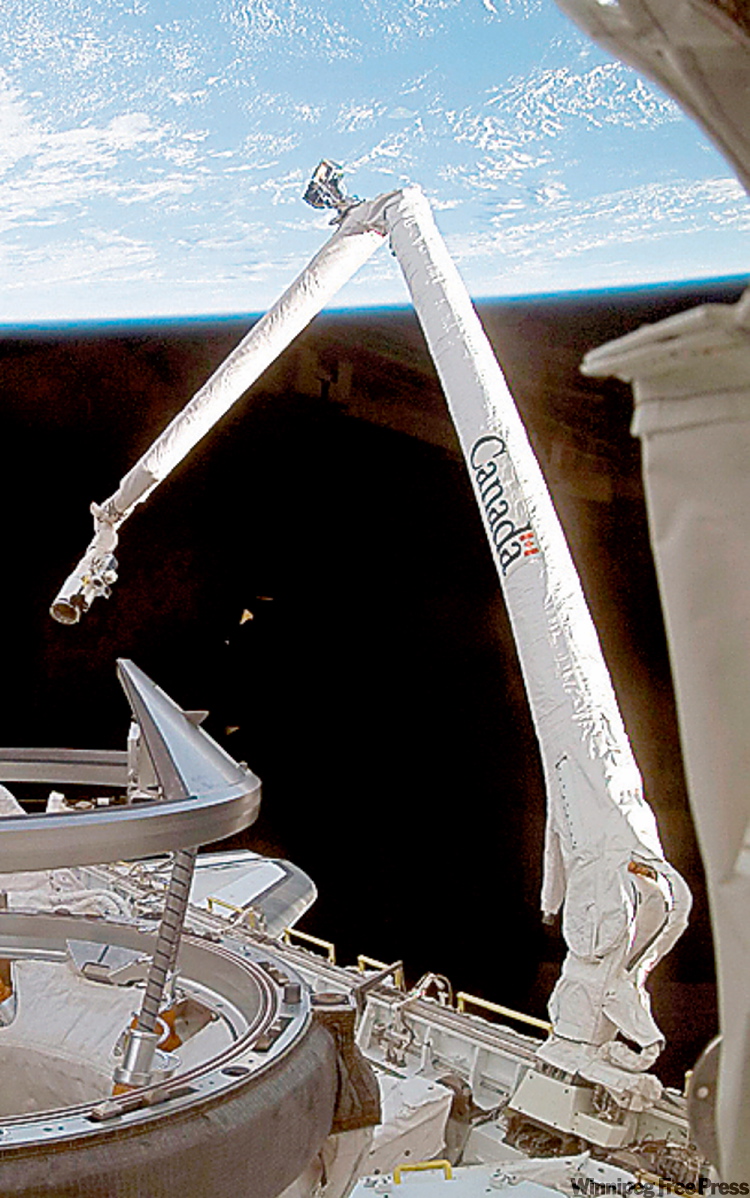
Discussions aimed at repatriating the iconic robotic limb have been going on between the U.S. and Canadian agencies for more than a year.
The conversations come as the U.S. closes its space-shuttle program, and seeks to divest assets from those missions. NASA has used five versions of the Canadarm over the years.
“The Canadian government retained ownership of the original Canadarm and NASA and the Canadian Space Agency are currently discussing its return,” NASA spokeswoman Katherine Trinidad said.
The Canadian Space Agency declined to comment on what it planned to do with the 15-metre, 411-kg tool.
NASA explains the original arm flew on the Space Shuttle Columbia and has rotated with the other arms to fly on numerous shuttle missions over the years.
The Canadarms are removed after every space flight and refitted on different shuttles, as necessary.
The space arm was deployed for the first time on Nov. 13, 1981, when it was lifted out of Columbia’s cargo bay by American astronaut and pilot Richard Truly.
“The arm is out and it works beautifully,” Truly reported to Mission Control at the time. “Its movements are much more flexible than they appeared during training simulations.”
Paul Cabot, the curator of the Canadian Air and Space Museum in Toronto, said his museum is interested in acquiring that piece of aerospace history. “We’ve contacted NASA, we’ve contacted the CSA, we’re waiting to see what happens,” he said.
He notes the Canadarm was built in nearby Brampton, Ont.: “We would like to bring it back to its origin and celebrate its history.”
The first Canadarm was designed, developed and built by a division of Spar Aerospace in Brampton, which was later acquired by MacDonald, Dettwiler and Associates Ltd.
The Conservative government blocked the 2008 sale of MDA to a U.S. firm, Alliant Techsystems.
On its website, the Canadian Space Agency says five Canadarms were built and delivered to NASA between April 1981 and August 1993.
Two were destroyed in the tragic explosions of the shuttles Columbia and Challenger. Canadarms are currently being used on the three U.S. shuttles still in service — Discovery, Atlantis and Endeavour. NASA is retiring the shuttles this fall.
— The Canadian Press