

Arctic crater yields clues to evolution of life on Earth
Advertisement
Read this article for free:
or
Already have an account? Log in here »
To continue reading, please subscribe:

Digital Subscription
One year of digital access for only $205*
- Enjoy unlimited reading on winnipegfreepress.com
- Read the E-Edition, our digital replica newspaper
- Access News Break, our award-winning app
- Play interactive puzzles
*First annual payment billed as $205.00 + GST for one year. This annual subscription will automatically renew at $233.00 + GST every 52 weeks (10% off the regular annual price of $259.35). Offer available to new and qualified returning subscribers only. Cancel any time.
To continue reading, please subscribe:
Add Free Press access to your Brandon Sun subscription for only an additional
$1 for the first 4 weeks*
- Enjoy unlimited reading on winnipegfreepress.com
- Read the E-Edition, our digital replica newspaper
- Access News Break, our award-winning app
- Play interactive puzzles
*Your next Brandon Sun subscription payment will increase by $1.00 and you will be charged $17.95 plus GST for four weeks. After four weeks, your payment will increase to $24.95 plus GST every four weeks.
Read unlimited articles for free today:
or
Already have an account? Log in here »
Hey there, time traveller!
This article was published 05/03/2010 (6041 days ago), so information in it may no longer be current.
Scientists studying an ancient meteorite crash site in the Canadian Arctic have detected traces of microbes that point to the key role played by impact craters in the evolution of life on Earth and could help determine whether life once existed on Mars.
The discovery — hailed by an 11-member team of researchers from Canada, Britain, the U.S. and Sweden as a scientific first — was made at Devon Island’s Haughton Crater, a uniquely dry and desolate geological gem probed frequently by experts from NASA because of its Mars-like features.
“Meteorite impact craters have been proposed as possible sites to find microbial life on Mars, as they are a focus for heat and water circulation,” the research team, including University of Western Ontario geologist Gordon Osinski, state in a summary of their findings.
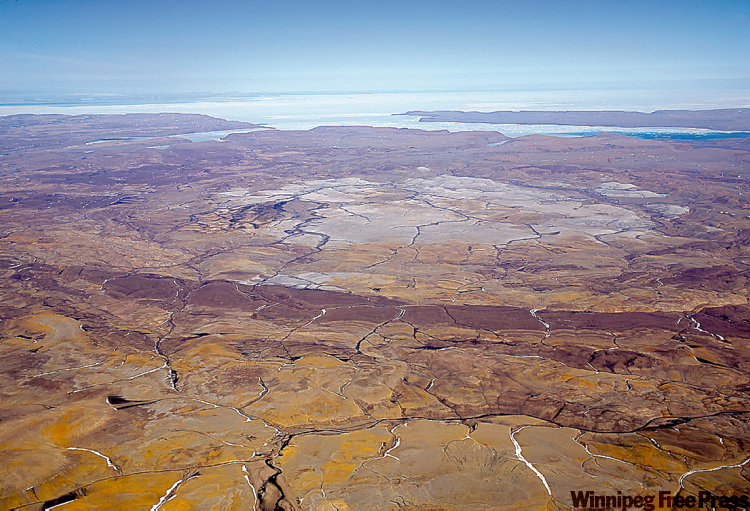
The researchers examined meteorite-shocked rocks from numerous sites throughout the 24-kilometre-wide crater and found traces of sulphur left by heat-loving, “thermophilic” bacteria that moved into the crash site following the impact.
“Evidence of widespread microbial activity” in the crater, the team says, has “shown for the first time that a crater was pervasively colonized by microbes, and that colonization of over 20 cubic kilometres of impact rock was rapid, within 10,000 years after impact, while the rock was still warm.”
The team concludes: “This emphasizes the potential of impact craters in the evolution of early life on Earth and the search for life on other planets.”
Several of the researchers, including team leader John Parnell of the University of Aberdeen, have made previous findings at the Haughton Crater highlighting its value in the search for extraterrestrial life as well as in detecting signs of primordial organisms from the dawn of Earth’s history. In 2005, a Parnell-led study at the Nunavut site yielded proof that billion-year-old biomarkers — faint chemical traces of organic matter — had survived the massive meteor strike that created the Haughton crater 23 million years ago.
The latest project has yielded proof the space rock that struck Devon Island created warm, protective niches for microscopic organisms, allowing them to flourish — and leave fossilized signatures of their activity — at the impact site.
The remoteness and “polar desert” environment of Devon Island means the crater has undergone much less change than other impact sites around the world, making it one of the best places on Earth to study a simulated Martian landscape.
In 2004, British scientist Charles Cockell described Devon Island as one of the Earth’s best remaining examples of “the sort of habitat that would have given rise to life on Earth.”
— Canwest News Service