

Rivers reveal Lake Agassiz’s ancient clues
Advertisement
Read this article for free:
or
Already have an account? Log in here »
To continue reading, please subscribe:
Digital Subscription
One year of digital access for only $1.44 a week*
- Enjoy unlimited reading on winnipegfreepress.com
- Read the E-Edition, our digital replica newspaper
- Access News Break, our award-winning app
- Play interactive puzzles
*Billed as $5.77 plus GST every four weeks. After 52 weeks, price increases to the regular rate of $19.95 plus GST every four weeks. Offer available to new and qualified returning subscribers only. Cancel any time.
To continue reading, please subscribe:
Add Free Press access to your Brandon Sun subscription for only an additional
$1 for the first 4 weeks*
- Enjoy unlimited reading on winnipegfreepress.com
- Read the E-Edition, our digital replica newspaper
- Access News Break, our award-winning app
- Play interactive puzzles
*Your next Brandon Sun subscription payment will increase by $1.00 and you will be charged $17.95 plus GST for four weeks. After four weeks, your payment will increase to $24.95 plus GST every four weeks.
Read unlimited articles for free today:
or
Already have an account? Log in here »
Hey there, time traveller!
This article was published 01/04/2010 (5900 days ago), so information in it may no longer be current.
Scientists say they have uncovered the path of a colossal flood that swept across northern Canada 13,000 years ago, plunging the northern hemisphere into a prolonged cold snap.
A Canadian-British team reported Thursday that it has found the "missing flood path" along the Mackenzie, Athabasca and Clearwater River systems that triggered the cooling event that is considered one of the most catastrophic geological events in Earth history.
Scoured out valley bottoms, giant gravel bars and fields of boulders all point to a massive freshwater pulse from Lake Agassiz, a huge basin that formed at the end of the last ice age.
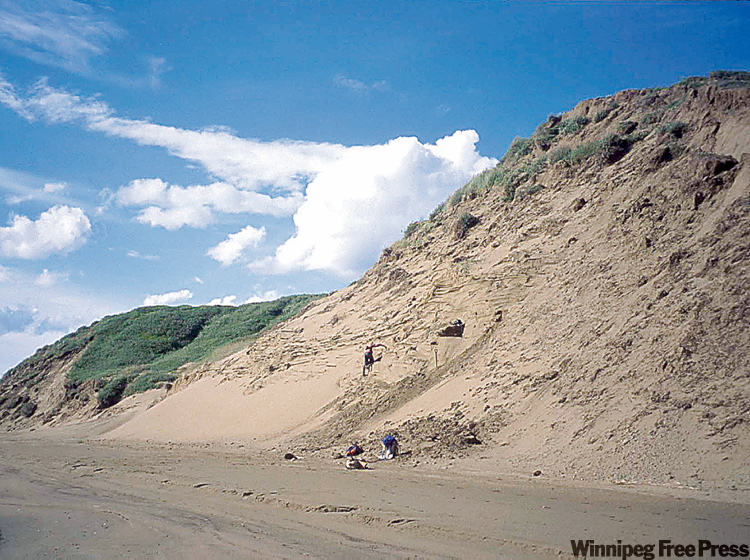
"You know something big happened when you look at the size of the boulders in that gravel," says geologist James Teller, of the University of Manitoba, pointing to rocks up to two metres across tossed around by the water.
He is co-author of the report published today in the journal Nature that adds an intriguing chapter to the story of Lake Agassiz, which used to be the world’s largest lake, covering a huge million-square-kilometre patch of what is now parts of Manitoba and Ontario.
Teller says there were several huge floods from the lake as ice dams burst, culminating with one about 8,400 years ago that sent water pouring out through Hudson Bay, altering ocean currents and triggering a sea level rise.
He and his colleagues say a much earlier outburst from Lake Agassiz 13,000 years ago appears to have had an even more dramatic impact on the climate, triggering an abrupt and prolonged cold snap in the Northern Hemisphere.
"It was a time when the globe began to be refrigerated for another 1,000 years even though we were in a warm-up related to the end of the last ice age," says Teller.
Researchers have theorized that a Lake Agassiz flood triggered the deep freeze, known as the Younger Dryas, but could not find a flood path.
They’ve now turned up "very persuasive dating evidence," Teller says, at the mouth of the Mackenzie River that drains into the Arctic Ocean.
The huge gravel bars on the delta caught the eye of Julian Murton, of University of Sussex in England, while he was on a field trip to study permafrost. He hauled some gravel back to Britain.
Lab analysis shows the gravel was deposited no more than 13,000 years ago and must have been dropped by a massive flood into the Arctic Ocean.
The dating evidence fits with geological features along rivers to the south. The "boulder gravel terraces" north of Fort McMurray, Alta., and huge scoured-out valleys along the Athabasca and Clearwater rivers could only have been left by a massive outpouring of water, says Teller, who has studied Lake Agassiz for close to 30 years.
The scientists say the cold snap it generated holds important lessons about how abruptly climate can change.
— Canwest News Service