

Inuit family vows to unearth Franklin logs
Longtime search for Arctic explorer's books may end
Advertisement
Read this article for free:
or
Already have an account? Log in here »
To continue reading, please subscribe:
Digital Subscription
One year of digital access for only $1.44 a week*
- Enjoy unlimited reading on winnipegfreepress.com
- Read the E-Edition, our digital replica newspaper
- Access News Break, our award-winning app
- Play interactive puzzles
*Billed as $5.77 plus GST every four weeks. After 52 weeks, price increases to the regular rate of $19.95 plus GST every four weeks. Offer available to new and qualified returning subscribers only. Cancel any time.
To continue reading, please subscribe:
Add Free Press access to your Brandon Sun subscription for only an additional
$1 for the first 4 weeks*
- Enjoy unlimited reading on winnipegfreepress.com
- Read the E-Edition, our digital replica newspaper
- Access News Break, our award-winning app
- Play interactive puzzles
*Your next Brandon Sun subscription payment will increase by $1.00 and you will be charged $17.95 plus GST for four weeks. After four weeks, your payment will increase to $24.95 plus GST every four weeks.
Read unlimited articles for free today:
or
Already have an account? Log in here »
Hey there, time traveller!
This article was published 03/09/2010 (5750 days ago), so information in it may no longer be current.
GJOA HAVEN, Nunavut — The search for the logbooks of the ill-fated Franklin expedition — the holy grail of Arctic exploration history — has taken on new life.
An Inuit family based in Gjoa Haven, the only settlement near the spot where the 1845 expedition got trapped in the ice, is promising to unearth those logbooks on Saturday.
Researchers and historians have been searching for the logbooks since the 129-man expedition led by Sir John Franklin disappeared while searching for the Northwest Passage.
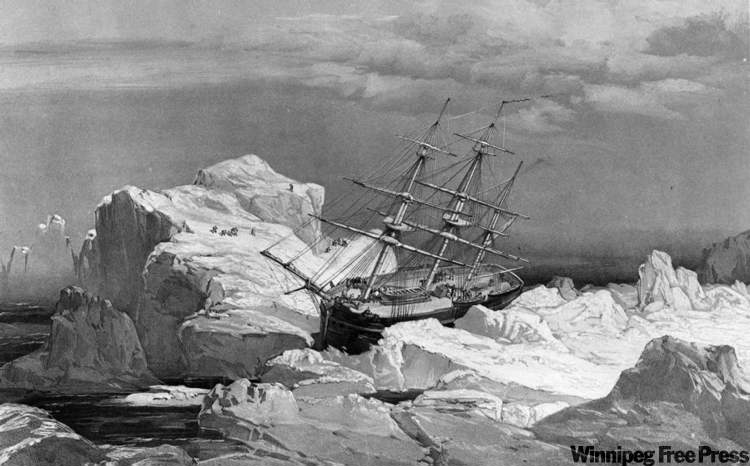
The expedition got trapped in ice at the northwest corner of King William Island, roughly 160 kilometres from Gjoa Haven. In 1847, 105 sailors endured a horrific march down the west coast of the island before succumbing to scurvy, starvation and lead poisoning. The final survivors resorted to cannibalism.
Descendants of George Washington Porter II, a Hudson’s Bay Co., manager, say they will excavate the logbooks from beneath a cairn in the centre of Gjoa Haven (population 1,100). "Timing is everything," said family spokesman Wally Porter. "And the time has come to show the world these logbooks."
Porter said in a recent interview that Porter II, who was his grandfather, buried the documents beneath the cairn when it was rebuilt in the late 1950s or early ’60s. The cairn had deteriorated since it was erected in 1944 to commemorate William "Paddy" Gibson, a Hudson’s Bay Co. inspector who had died in a plane crash two years before.
Down through the decades, historians have speculated that the Inuit on King William Island discovered the logbooks. But until now, the story has been that they scattered the pages to the wind.
The oral history relayed by Wally Porter suggests while the Inuit discoverers could not decipher the handwritten logbooks, they knew they had found something of value. He said his grandfather received the documents from a Roman Catholic priest based in Gjoa Haven. It is possible they were the only people in town who could read the English language.
According to Porter, his grandfather wrapped the logbooks in wax-treated canvas and sealed them inside a metal container before burying them. He added that the records under the cairn are covered by a marble stone left there by Roald Amundsen, who spent some winters in Gjoa Haven while becoming the first explorer to navigate the Northwest Passage in 1903-06.
If unearthed in readable condition, the logbooks would describe how the first two dozen men died, and how officers reacted. They would contain details about Franklin’s death and burial (whether on land or at sea), and would answer the disputed question: Did Franklin discover a navigable Northwest Passage? They would explain why the final survivors trekked south rather than east towards a known cache of food, and point to the location of the still-missing ships, the Erebus and the Terror.
The Porter family’s claim has its skeptics. Louie Kamookak, the Gjoa-Haven-based grandson of the man to whom the cairn is dedicated, says in the 1980s, he interviewed the two men who built the original cairn. He believes the excavation will turn up old trading-company documents. Still, he said he will attend the excavation.
An archaeologist/conservator from the Nunavut government will supervise the proceedings, and the CBC will record them. Once unearthed, whatever is found will be sent for preservation to the Canadian Conservation Institute in Ottawa, and then returned to the Porter family in Gjoa Haven.
Last November, historian David F. Pelly interviewed the Porter family about the documents and prepared a report for the Nunavut government. The Porters and the government have agreed the documents cannot be examined at the excavation site. They also have agreed the documents will remain the property of the Porter family, and that, after a process of conservation, they will be returned to Gjoa Haven for future display.
George Washington Porter II was born in 1895 at Herschel Island, the son of a Scottish whaling captain and an Alaskan Inuit, Mary Kappak. Educated at a mission school in the Aleutian Islands, he moved to Gjoa Haven in 1927 and set up an outpost for the Canalaska Trading Company. In the late 1930s, that company was absorbed by the Hudson’s Bay Co.
With his wife, Martha Nuliajuk, Porter II raised 10 children. In 1984, just before he died, he told his son Chester about the Franklin logbooks. Chester Porter shared that secret with family members in the last year.
Next month, Ken McGoogan, whose books include Fatal Passage and Lady Franklin’s Revenge, will publish How the Scots Invented Canada.
He was aboard the Clipper Adventurer that recently went aground while carrying adventure travellers through the Northwest Passage.
— Postmedia News