

Old trunk holds precious artifacts
Family auctions Indian heirlooms for $800,000
Advertisement
Read this article for free:
or
Already have an account? Log in here »
To continue reading, please subscribe:
Digital Subscription
One year of digital access for only $1.44 a week*
- Enjoy unlimited reading on winnipegfreepress.com
- Read the E-Edition, our digital replica newspaper
- Access News Break, our award-winning app
- Play interactive puzzles
*Billed as $5.77 plus GST every four weeks. After 52 weeks, price increases to the regular rate of $19.95 plus GST every four weeks. Offer available to new and qualified returning subscribers only. Cancel any time.
To continue reading, please subscribe:
Add Free Press access to your Brandon Sun subscription for only an additional
$1 for the first 4 weeks*
- Enjoy unlimited reading on winnipegfreepress.com
- Read the E-Edition, our digital replica newspaper
- Access News Break, our award-winning app
- Play interactive puzzles
*Your next Brandon Sun subscription payment will increase by $1.00 and you will be charged $17.95 plus GST for four weeks. After four weeks, your payment will increase to $24.95 plus GST every four weeks.
Read unlimited articles for free today:
or
Already have an account? Log in here »
Hey there, time traveller!
This article was published 08/10/2010 (5723 days ago), so information in it may no longer be current.
A Canadian family’s stunning attic discovery — a gem-studded, solid gold tiger’s head that once adorned a powerful sultan’s throne in India — was sold at a high-profile auction in Britain on Thursday for more than $700,000.
The unidentified Canadian family — described by Bonhams as having had “no idea” how much a mysterious collection of 200-year-old heirlooms might be worth — was the highlight of the London-based auction house’s sale of important Islamic and Indian art.
Bonhams spokesman Julian Roup told Postmedia News the golden tiger was purchased by “a Middle East buyer,” but no further information about the object’s new owner or the Canadian consignors was provided. Stowed away in a trunk of souvenirs inherited from Scottish ancestors, the bejewelled tiger came from the throne of Tipu Sultan, a major figure in Indian and Islamic history who gained fame in the 1780s for his successful resistance to British imperialism.
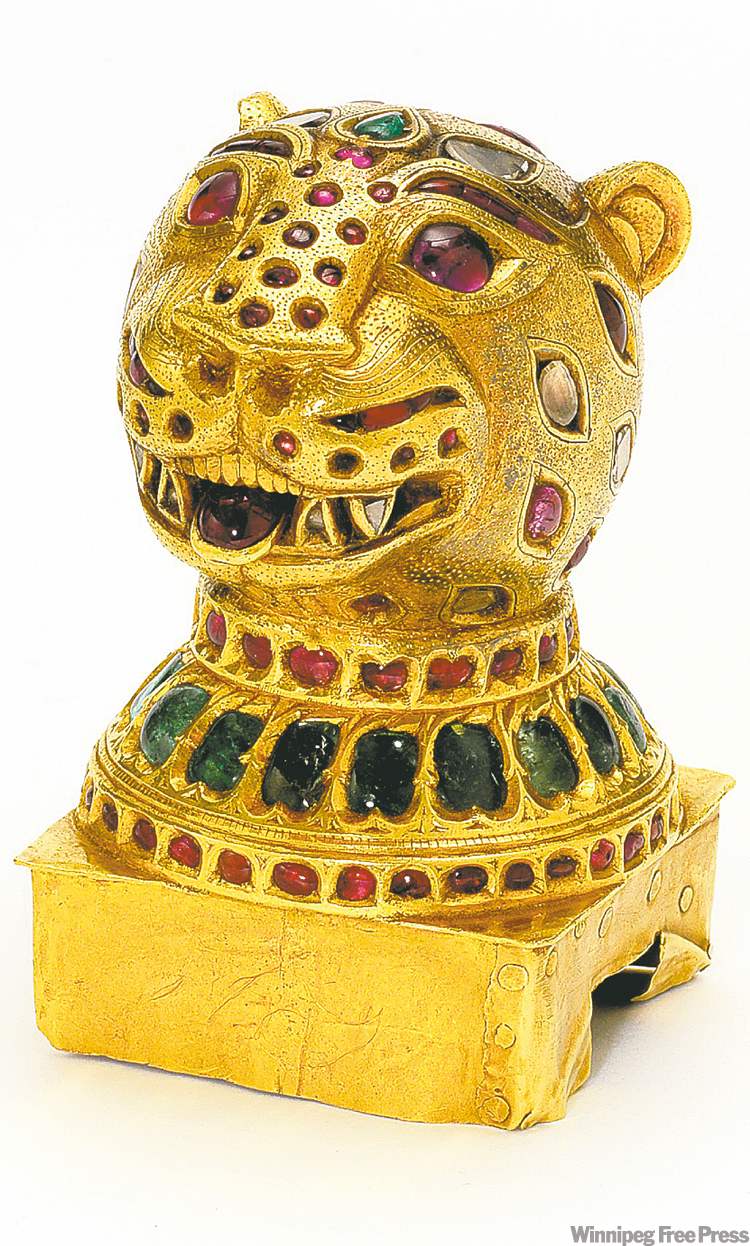
Tipu was killed when his army was finally defeated by British-led forces in the landmark 1799 Battle of Seringapatam.
Along with the elaborately crafted tiger’s head — studded with diamonds, rubies and emeralds, and which had been expected to sell for a maximum of about $480,000 — the Canadian family also consigned a gem-encrusted sword from the same era and a spherical gold container once used to hold bezoar stones.
The sword and bezoar-stone holder, each valued at about $25,000 ahead of Thursday’s sale, sold for about $31,000 and $62,000, respectively. That brought the Canadian family’s total take from the auction to just under $800,000, minus a buyer’s premium of about 15 per cent to be paid to Bonhams.
The three objects were originally acquired as spoils of war by British Lt.-Gen. Sir Thomas Bowser, a leader in the British victory over Tipu and his army on May 4, 1799.
The attack was carried out to give the British government-backed East India Company unfettered trading rights in the Kingdom of Mysore in southwest India.
The artifacts were handed down through several generations of Bowser descendants before they ended up in Canada, packed in a trunk of intriguing but long-overlooked family mementoes.
“Bowser was either given the items as part of the prize distribution process or bought them in the prize auctions held in Seringapatam in May and June 1799,” Roup told Postmedia News last month.
“The vendor family had no idea of the value until recently. They had kept the pieces together in the family down the years more as heirlooms than anything else.”
The discovery of the Tipu tiger in Canada had raised some questions in Britain about the ethics involved in auctioning items of cultural significance seized in a long-ago imperial war.
British Prime Minister David Cameron, during a recent visit to India, was publicly questioned about whether the Koh-i-Noor diamond — a centrepiece jewel in the British crown — should be returned to the country from which it was obtained during the era of British rule in India. Cameron responded the repatriation of legally acquired artifacts would leave institutions such as the British Museum “stripped bare,” according to the Financial Times.
— Postmedia News