

Mayerthorpe mystery may never be solved
How did killer sneak back to slay Mounties?
Advertisement
Read this article for free:
or
Already have an account? Log in here »
To continue reading, please subscribe:
Monthly Digital Subscription
$1 per week for 24 weeks*
- Enjoy unlimited reading on winnipegfreepress.com
- Read the E-Edition, our digital replica newspaper
- Access News Break, our award-winning app
- Play interactive puzzles
*Billed as $4.00 plus GST every four weeks. After 24 weeks, price increases to the regular rate of $19.95 plus GST every four weeks. Offer available to new and qualified returning subscribers only. Cancel any time.
Monthly Digital Subscription
$4.99/week*
- Enjoy unlimited reading on winnipegfreepress.com
- Read the E-Edition, our digital replica newspaper
- Access News Break, our award-winning app
- Play interactive puzzles
*Billed as $19.95 plus GST every four weeks. Cancel any time.
To continue reading, please subscribe:
Add Free Press access to your Brandon Sun subscription for only an additional
$1 for the first 4 weeks*
- Enjoy unlimited reading on winnipegfreepress.com
- Read the E-Edition, our digital replica newspaper
- Access News Break, our award-winning app
- Play interactive puzzles
*Your next Brandon Sun subscription payment will increase by $1.00 and you will be charged $17.95 plus GST for four weeks. After four weeks, your payment will increase to $24.95 plus GST every four weeks.
Read unlimited articles for free today:
or
Already have an account? Log in here »
Hey there, time traveller!
This article was published 24/01/2011 (5581 days ago), so information in it may no longer be current.
STONY PLAIN, Alta. — How exactly did James Roszko infiltrate a police cordon and murder four Alberta Mounties almost six years ago?
An provincial court inquiry examining the case has heard that the answer will never be known for sure, but with just one day of testimony left, the evidence suggests two scenarios.
Constables Anthony Gordon, Peter Schiemann, Brock Myrol and Leo Johnston were ambushed and shot by Roszko inside a Quonset hut on Roszko’s property near Mayerthorpe on the morning of March 3, 2005.
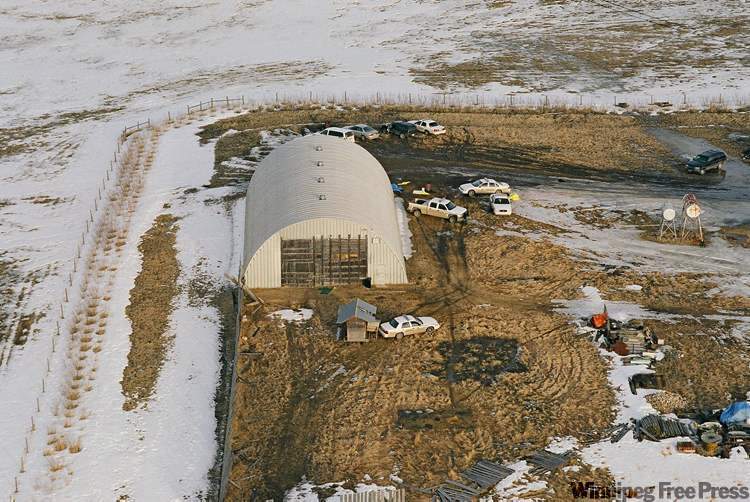
The men had been guarding a marijuana grow-op and cache of stolen car parts inside the shed at the time of the shooting.
Roszko had fled the scene a day earlier but somehow managed in the intervening hours to get ahold of a semi-automatic assault rifle, sneak past the officers and kill them around 10 a.m.
Insp. James Hardy, the lead investigator into the shootings, told the inquiry this week that police scoured the property looking for evidence of how Roszko got back in.
Residents said Roszko might have had a tunnel into the Quonset. Radar and infrared scanners probed the subsurface and found nothing. The only way in, it appears, was the massive front entrance, big enough to drive vehicles in and out.
“We left no stone unturned,” Hardy told inquiry Judge Daniel Pahl.
“We attempted exhaustively to say when (Roszko) in fact entered that Quonset hut, but it’s one of those unfortunate pieces I cannot answer.”
Hardy also testified that he couldn’t determine definitively how Roszko got ahold of the murder weapon — a .308 Heckler and Koch semi-automatic military assault rifle.
Outside court, Hardy said he had theories, but none he would share publicly.
“I’m just not comfortable talking about (that),” he told reporters.
Nevertheless, the evidence gleaned from a variety of RCMP witnesses at the inquiry suggests two scenarios: Roszko managed to duck into the Quonset either during the night or in the morning in the minutes preceding the ambush. Once inside he acquired the assault rifle.
The inquiry heard that accomplices Shawn Hennessey and Dennis Cheeseman gave Roszko a covert ride back to the acreage no later than 3 a.m., giving him four hours to skulk 1.5 kilometres over snowy ground to the Quonset before the sun rose around 7:15 a.m.
RCMP Sgt. Jim Martin, the man in charge of the Mayerthorpe detachment when the shooting happened, ordered the Quonset guarded overnight to protect the continuity of the evidence and in case Roszko came back. Auto-theft investigators Stephen Vigor and Garrett Hoogestraat were to arrive the next morning to catalogue the car parts.
Johnston was called in to guard the scene starting at 3 a.m. To help him, Gordon was brought in from the nearby Whitecourt detachment.
Johnston was in a police pickup and was tasked with guarding Roszko’s trailer and the rest of the acreage.
Gordon sat in a marked police cruiser with a direct view of the Quonset’s main door.
Roszko, by that time, was already en route to the Quonset on foot, socks on over his boots to muffle his steps. He used a white sheet to cover himself and blend in with the snow.
He would have been under a half moon, but the hearing did not hear whether it was obscured.
In a cruel irony, Martin had ordered what few lights there were at the Quonset turned on to let Roszko know police were there and to discourage him from trying anything rash. Those lights would have been a beacon, leading Roszko right where he wanted to go.
Hardy told court they found tracks in the snow suggesting Roszko trekked wide around the compound to pop out the far side right at the corner of the front of the Quonset, maybe two metres from the doorway.
The bedsheet and a pillow case, along with gloves, water and bear spray were found at that corner.
Crime-scene photos at the inquiry showed that by the time the ambush began, Gordon’s cruiser had moved to the side of the Quonset beside Johnston’s pickup, both facing away and with no view of the main door. That was not explored at the inquiry.
Vigor and Hoogestraat testified that after the sun rose, in the half hour before the shooting and after Myrol and Schiemann arrived, the four constables were out back of the Quonset sedating Roszko’s dogs. No one was watching the front.
The question of why Roszko wanted to get back into the Quonset — the one spot police were focused — may lie with the murder weapon.
All of Roszko’s other weapons — a shotgun and four rifles — were later found secreted there. Police searching the Quonset that night didn’t find them, likely because the Quonset was a pig sty of farm tools, barrels, car parts, drums, plywood, pots, crates and garbage.
— The Canadian Press