

What should politicians reveal?
Blurry line divides public's right to know
Advertisement
Read this article for free:
or
Already have an account? Log in here »
To continue reading, please subscribe:
Monthly Digital Subscription
$1 per week for 24 weeks*
- Enjoy unlimited reading on winnipegfreepress.com
- Read the E-Edition, our digital replica newspaper
- Access News Break, our award-winning app
- Play interactive puzzles
*Billed as $4.00 plus GST every four weeks. After 24 weeks, price increases to the regular rate of $19.95 plus GST every four weeks. Offer available to new and qualified returning subscribers only. Cancel any time.
Monthly Digital Subscription
$4.99/week*
- Enjoy unlimited reading on winnipegfreepress.com
- Read the E-Edition, our digital replica newspaper
- Access News Break, our award-winning app
- Play interactive puzzles
*Billed as $19.95 plus GST every four weeks. Cancel any time.
To continue reading, please subscribe:
Add Free Press access to your Brandon Sun subscription for only an additional
$1 for the first 4 weeks*
- Enjoy unlimited reading on winnipegfreepress.com
- Read the E-Edition, our digital replica newspaper
- Access News Break, our award-winning app
- Play interactive puzzles
*Your next Brandon Sun subscription payment will increase by $1.00 and you will be charged $17.95 plus GST for four weeks. After four weeks, your payment will increase to $24.95 plus GST every four weeks.
Read unlimited articles for free today:
or
Already have an account? Log in here »
Hey there, time traveller!
This article was published 30/07/2011 (5396 days ago), so information in it may no longer be current.
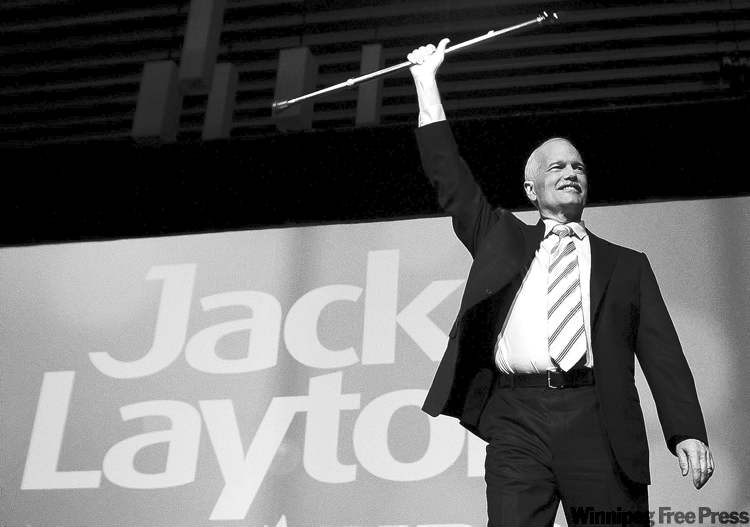
On election night, Jack Layton held his cane high overhead — using the walking aid as a symbol of his health and vigour.
When he emerged this past week at a news conference with a thin face, raspy voice and a suit too baggy for his weakened frame, it appeared as though the cane was now holding him up.
He announced he had a new cancer for which he would seek treatment. He confidently said he expected to be well enough to return to Parliament by the fall.
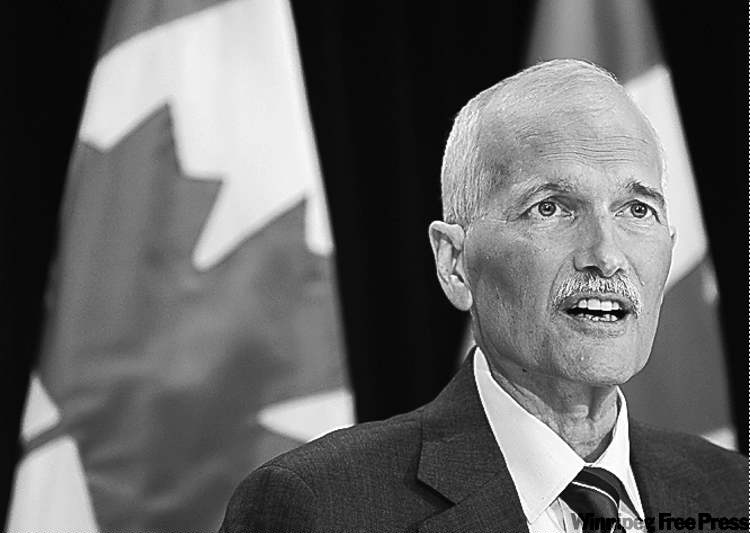
Then he was gone — leaving many unanswered questions. Tough questions, such as what new kind of cancer was he facing? What were his odds?
But how much should voters know?
There is a blurry line dividing the public’s right to know and a public figure’s right to privacy, experts say. Who deserves to know what and when is an issue that is being redefined in Canada, with some saying we are shifting closer to our neighbour to the south, where full disclosure is always expected.
“We are moving towards that, slowly,” says Jeff Sallot, a media expert from Carleton University in Ottawa.
The NDP provided answers about Layton’s health prior to the election, including whether he would be up for the gruelling campaign and the job of prime minister that he sought. Media critics argue that the public, in choosing a politician, needs that kind of information to know what they’re getting in a candidate, including whether they are physically able to do the job and perform their duties once in office.
Voters don’t elect someone based on their health record, but it is one factor in the decision-making process, says Lawrence K. Altman, a longtime New York Times health columnist.
“When you run for office, you give up a lot of rights to privacy and being transparent with one’s health is one of the things that you do as a public figure,” says Altman, now a fellow at the Woodrow Wilson International Center for Scholars.
“The public, in my mind, has a right to know about the health of a political leader and it’s up to the leader to disclose it and be transparent about it.”
Sallot agrees, but offers a caveat when it comes to Layton.
First, he’s not prime minister, so he isn’t making critical decisions about the course of the country, Sallot says. Second, the country won’t be heading back to the polls for at least four years, so nobody has to decide now whether Layton is physically able to be prime minister.
“There’s no immediate need for the public to know,” Sallot says.
For now, Sallot says, Layton should be entitled to his privacy. Should Layton not be able to return in the fall to his duties as Opposition leader, then he would need to make a further statement about his health, Sallot says.
The health and private lives of politicians have long been fodder for news stories and gossip. In return, our leaders have walked, danced, run or played sports in the public eye to prove just how healthy they are.
Cuban leader Fidel Castro was shown in videos talking with friends and walking to quell persistent questioning about his well-being. Former Russian leader Boris Yeltsin gyrated on a stage with dancers when he was dogged by health concerns. North Korean leader Kim Jong Il has walked before the cameras to prove he’s still healthy enough to be a dictator. And Venezuelan President Hugo Chavez has brought the public along for the ride on his recovery from cancer over the past month.
We live in an information culture, where we are bombarded with these images and details, fuelling our curiosity.
“There is this weird notion that politicians are almost like Hollywood stars and starlets and that… there’s a right to know every aspect of their lives,” says transplanted Manitoban Leigh Turner from the Center for Bioethics at the University of Minnesota.
“Even if it was a more prominent position, like Stephen Harper, I would still be inclined to think that the right to know doesn’t necessarily extend to every single aspect of their health status at the very first moment they get it from their physicians.”
Using the term “right to know” is a bit of a misnomer when it comes to politicians and their medical conditions. Layton is under no legal obligation to hand out any of his health information to the public. Neither is his doctor.
“Why should the confidentiality of the doctor-patient relationship apply to him any differently than to us? And the answer to that is, it doesn’t,” says Udo Schuklenk, the Ontario research chair in bioethics from Queen’s University.
“The only moral obligation he has was to tell us that, at this point in time, he’s ineligible for his duties because of some illness. … That’s really the baseline at the end of the day.”
So far, the disclosure has been narrow: Layton has cancer, but the exact diagnosis and prognosis aren’t known.
The White House regularly provides information about the president’s health, while candidates for office will go to great lengths to prove they are healthy and fit enough for the job. The same has been true to a lesser extent in Canada.
— Postmedia News
Notable political health issues
Stephen Harper, 2006
Following the federal election, the prime minister was rushed to hospital in the middle of the night with chest pains. A spokesman at the time said the incident was an asthma attack.
John McCain, 2008
The Republican presidential candidate released more than 1,000 pages of medical history to the media, part of a campaign tactic meant to show he was healthy enough to lead the United States.
Jean Chrétien, 1991
Two years before becoming prime minister, Chrétien went under the knife to have a benign nodule removed from his right lung — without even his press spokesman knowing about it.
Lucien Bouchard
The flesh-eating disease forced the amputation of his left leg in the mid-1990s. Bouchard received an outpouring of support and went on to become premier of Quebec.
Ronald Reagan
Every time the American president had surgery — there were three of them — the public knew intimate details of what happened.
Paul Tsongas, 1984
The American politician retired from the U.S. Senate so he could focus on his fight with cancer. John Kerry ended up winning his seat. Tsongas made a return to politics in 1992 to seek the Democratic nomination, losing to Bill Clinton.
Woodrow Wilson, 1919
After suffering a stroke that left him paralyzed, the American president spent a year out of the public light, with his doctor and wife believed by many to be the ones running the country.
Franklin Delano Roosevelt
F.D.R.’s decline in health from polio was kept from the public, but not always well. He was rarely seen in a wheelchair, but was seen at events sitting or standing with the help of an aide.
Grover Cleveland
During his presidency, Cleveland quietly had a surgical procedure for cancer performed on a yacht in the waters off New York City.
— Postmedia News