

19th-century shipwreck artifact treasure trove
Advertisement
Read this article for free:
or
Already have an account? Log in here »
To continue reading, please subscribe:
Digital Subscription
One year of digital access for only $75*
- Enjoy unlimited reading on winnipegfreepress.com
- Read the E-Edition, our digital replica newspaper
- Access News Break, our award-winning app
- Play interactive puzzles
*Billed as $5.77 plus GST every four weeks. After 52 weeks, price increases to the regular rate of $19.95 plus GST every four weeks. Offer available to new and qualified returning subscribers only. Cancel any time.
Monthly Digital Subscription
$4.99/week*
- Enjoy unlimited reading on winnipegfreepress.com
- Read the E-Edition, our digital replica newspaper
- Access News Break, our award-winning app
- Play interactive puzzles
*Billed as $19.95 plus GST every four weeks. Cancel any time.
To continue reading, please subscribe:
Add Free Press access to your Brandon Sun subscription for only an additional
$1 for the first 4 weeks*
- Enjoy unlimited reading on winnipegfreepress.com
- Read the E-Edition, our digital replica newspaper
- Access News Break, our award-winning app
- Play interactive puzzles
*Your next Brandon Sun subscription payment will increase by $1.00 and you will be charged $17.95 plus GST for four weeks. After four weeks, your payment will increase to $24.95 plus GST every four weeks.
Read unlimited articles for free today:
or
Already have an account? Log in here »
Hey there, time traveller!
This article was published 10/08/2011 (5400 days ago), so information in it may no longer be current.
A series of dives last month to the rediscovered Arctic Ocean wreck of HMS Investigator has revealed glimpses of what Parks Canada archeologists believe to be an unprecedented “treasure” of historical artifacts preserved in silt below the deck of the sunken 19th-century British ship, Postmedia News has learned.
The July expedition to the vessel’s resting place in Mercy Bay, a frigid patch of water off the shore of Banks Island in the Northwest Territories, saw divers collect a handful of evocative relics — including a sailor’s shoe and a largely intact rifle — that lay “in plain sight” and were at risk of disappearing in the seabed sludge.
But their key finding was confirming the likelihood that “thousands” of other objects — scientific specimens, crewmen’s personal belongings, architectural fixtures, a stash of vintage booze in the ship’s “spirits room” — have remained entombed and protected in the Royal Navy vessel since it became trapped in ice, was abandoned and then sank during a failed search for the lost Franklin Expedition in the early 1850s.
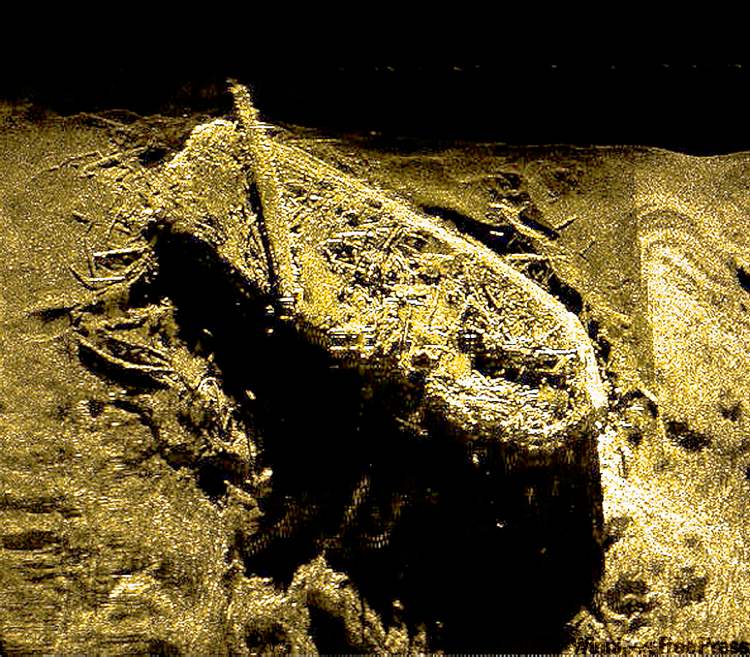
“We were blessed with really exceptional weather and very, very co-operative ice conditions,” Ryan Harris, a Parks Canada underwater archeologist, told Postmedia News.
“There’s a very high level of siltation inside the hold and that actually bodes quite well for preservation of what will probably amount to thousands upon thousands — or hundreds of thousands — of artifacts that are likely inside the vessel.”
He said the ship itself is in remarkably good condition and described the “surreal” experience of seeing a ship so rich in history coming into view with each dive.
The Investigator, captained by Irish-born Robert McClure, had left a British port in 1850 to join what had become a desperate search for the lost ships and missing 129 men from Sir John Franklin’s ill-fated Arctic expedition, HMS Erebus and HMS Terror.
McClure entered the Arctic from the Pacific but was forced to leave the ship when it became locked in ice at Mercy Bay in 1853. He ordered the creation of a cache of supplies on the nearby shore of Banks Island, then led his men on a sledge journey across the sea ice to their rescue by another British ship at Melville Island.
The crew’s eastward route back to Britain marked the first recorded transit of the Northwest Passage — a combined voyage by ship and sledge that won McClure everlasting fame despite his failure to find Franklin and the loss of the Investigator, which sank in 1854.
Last summer, Harris and his Parks Canada colleagues became the first people to set eyes on the Investigator in 156 years and earned international acclaim for the feat.
But this year’s dives offered the first close look at the 36-metre-long ship, which Harris said appears to have held up well despite being submerged for more than a century-and-a-half and suffering regular grindings from the seasonal ebb and flow of sea ice in Mercy Bay.
Key to that preservation, said Harris, was the copper cladding on the hull of the Investigator that was applied to protect all Royal Navy vessels — including the Erebus and Terror — bound for ice-choked Arctic waters in Canada.
A metre-wide section of the copper shield at risk of being shorn off the ship by an iceberg was also detached and recovered by the team.
— Postmedia News