

Afghanistan’s corruption permeates life
But some hope for future reform
Advertisement
Read this article for free:
or
Already have an account? Log in here »
To continue reading, please subscribe:
Digital Subscription
One year of digital access for only $75*
- Enjoy unlimited reading on winnipegfreepress.com
- Read the E-Edition, our digital replica newspaper
- Access News Break, our award-winning app
- Play interactive puzzles
*Billed as $5.77 plus GST every four weeks. After 52 weeks, price increases to the regular rate of $19.95 plus GST every four weeks. Offer available to new and qualified returning subscribers only. Cancel any time.
Monthly Digital Subscription
$4.99/week*
- Enjoy unlimited reading on winnipegfreepress.com
- Read the E-Edition, our digital replica newspaper
- Access News Break, our award-winning app
- Play interactive puzzles
*Billed as $19.95 plus GST every four weeks. Cancel any time.
To continue reading, please subscribe:
Add Free Press access to your Brandon Sun subscription for only an additional
$1 for the first 4 weeks*
- Enjoy unlimited reading on winnipegfreepress.com
- Read the E-Edition, our digital replica newspaper
- Access News Break, our award-winning app
- Play interactive puzzles
*Your next Brandon Sun subscription payment will increase by $1.00 and you will be charged $17.95 plus GST for four weeks. After four weeks, your payment will increase to $24.95 plus GST every four weeks.
Read unlimited articles for free today:
or
Already have an account? Log in here »
Hey there, time traveller!
This article was published 13/08/2011 (5395 days ago), so information in it may no longer be current.
KABUL — Just off embassy row in the centre of Kabul is a neighbourhood called Sherpur. It’s also spelled Sher Poor, but that’s simply an irony. Aside from the streets, which in some places rival rutted mountain passes, there is nothing poor about Sherpur.
Behind the stone and concrete walls that frame Sherpur’s neighbourhood blocks are marbled villas and mansions. They were built over the last five years by the warlords, drug traffickers, politicians, ministers, bankers and other businessmen who have grown rich off the heroin trade or the billions of dollars in foreign aid that have streamed into Afghanistan since 2002.
Sometimes referred to as the “Poppy Garden,” this neighbourhood is the seat of Afghanistan’s power elite.
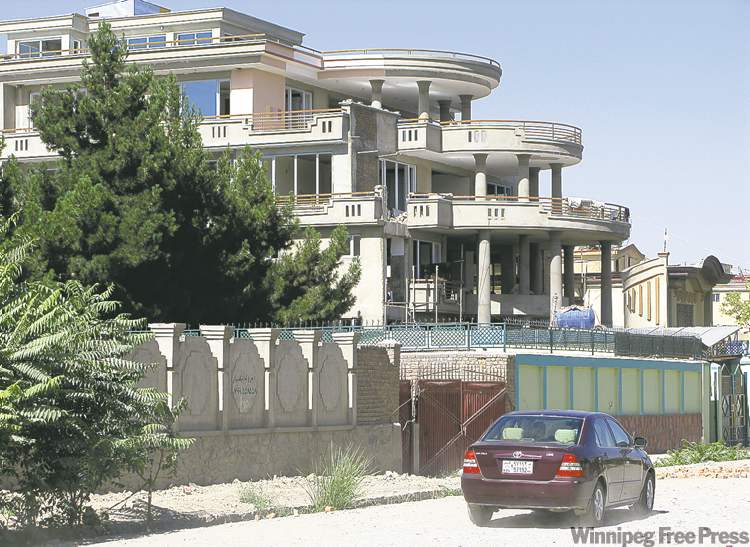
There is no mistaking the wealth, no attempt to conceal it.
Outside these bunkered homes is a different world where open sewers trickle through bombed-out neighbourhoods and destitute children play among the persistent rubble of 30 years of war.
About 84 per cent of Afghanistan’s gross domestic product is foreign aid, yet touring this city is proof the vast majority of Afghans have not felt its benefits.
Few roads are paved. Many are hard-packed mud and stone or so deeply potholed they represent more of an obstacle course than a thoroughfare.
The soccer stadium — where the Taliban once executed prisoners for halftime entertainment — awaits new turf, and the poor gather at the nearby Shohada Cemetery to water down the dust on the graves hoping relatives or friends will pay them for their trouble.
Kabul businessman Hasib Sayed, 30, who is also Canadian with a home in Toronto, said he comes to the cemetery occasionally to hand out money.
“Corruption is part of life here,” he said. “Anybody who thinks there is a fix for that I think is unrealistic. It will have its cycle and eventually go away. You have to understand that after 30 years of war, these old men who run the country don’t know anything else.
“These are not politicians. These are bullies. It will eventually come to an end and a new generation we are hoping will change things and think of the future and not just the present.”
But Habib Zahori, 28, a writer and journalist and part of that new generation, disagrees.
“It is very difficult now to get rid of these warlords, these criminals,” he said. “At the beginning the Afghans had a golden chance to bring these criminals to justice, including the Taliban, but they lost that opportunity.
“I believe this country is going toward another civil war, much bloodier and much uglier. Americans brought more weapons to this country. I believe as soon as the government collapses the army and police with divide into two factions each down the middle with one side joining the Taliban and the other side joining the warlords.”
Everybody here complains about corruption because everybody experiences it.
A police officer seeking promotion has to bribe his superior. To finance that bribe he taxes his patrolmen who in turn tax the public. Kabul’s dozens of police and army checkpoints — some mobile, others permanent — serve as bribe-collection points. The money goes right up the chain of command.
Students pay bribes to gain access to the best university faculties and for the right to study abroad.
These, however, are only the fringes of a corrupt society. The real money is at the centre of power.
The Kabul Bank, which processed wages for government employees, crashed last year after about US$900 billion vanished into undocumented no-interest loans to 207 insiders. The fall almost ruined Afghanistan’s struggling $12-billion economy.
Recipients of these loans reportedly included top government officials such as President Hamid Karzai’s brother Mahmood Karzai. Both the bank’s former executive director and board chairmen were charged last month and another 38 people are under investigation.
The government took action only after pressure from the International Monetary Fund and members of the International Security Assistance Force. Karzai’s reluctance to pursue the case probably stemmed from the fact many of the loans went to government officials close to him.
Certain businesses in Afghanistan are considered off-limits to all but a handful of insiders. Foremost among them is the fuel business. This includes securing the transportation of oil to major ISAF bases throughout the country.
To assure the deliveries remain secure a sort of oil mafia bribes insurgents not to attack these strategically important supplies. In this way, ISAF money helps finance the insurgency.
“You don’t dare touch oil unless you are one of the about four or five guys,” Sayed said.
The shame of corruption that casts a shadow over Kabul is, however, countered by the hope evident in the resilient spirit of the city’s artisans, artists and small manufacturers.
Many bombed-out structures have become homes to dry-goods stores, food stalls, butchers, mechanics, ironmongers and tiny manufacturing operations as entrepreneurs use just about anything they can get their hands on to build businesses. The old part of the city is filled with pedlars and shoppers.
Journalism is energetic and fearless. Radio and television have regular talk shows where Afghans speak out about social, political and artistic issues.
In Kabul today, the talk of the town concerns the new TV comedy series called The Ministry. It’s about a vain, pompous minister of garbage in the fictitious and grim country of Hechland (the Dari word for “Nothing Land”).
The show is considered the Afghan version of Ricky Gervais’s hit The Office. In the opening segments we learn that the minister’s secretary hates men and that his daily grind consists of having to deal with a member of parliament who wants 10 armoured cars for his personal protection, another who wants authorization for a drug-trafficking business and a third who wants government jobs for his family.
Like all good comedy, it reflects the wrenching reality of a city of shame. But its very existence represents hope itself.
— Postmedia News