

Scientist gets Nobel after death
Canadian-born doctor died three days before medicine prize awarded
Advertisement
Read this article for free:
or
Already have an account? Log in here »
To continue reading, please subscribe:
Monthly Digital Subscription
$1 per week for 24 weeks*
- Enjoy unlimited reading on winnipegfreepress.com
- Read the E-Edition, our digital replica newspaper
- Access News Break, our award-winning app
- Play interactive puzzles
*Billed as $4.00 plus GST every four weeks. After 24 weeks, price increases to the regular rate of $19.95 plus GST every four weeks. Offer available to new and qualified returning subscribers only. Cancel any time.
Monthly Digital Subscription
$4.99/week*
- Enjoy unlimited reading on winnipegfreepress.com
- Read the E-Edition, our digital replica newspaper
- Access News Break, our award-winning app
- Play interactive puzzles
*Billed as $19.95 plus GST every four weeks. Cancel any time.
To continue reading, please subscribe:
Add Free Press access to your Brandon Sun subscription for only an additional
$1 for the first 4 weeks*
*Your next subscription payment will increase by $1.00 and you will be charged $16.99 plus GST for four weeks. After four weeks, your payment will increase to $23.99 plus GST every four weeks.
Read unlimited articles for free today:
or
Already have an account? Log in here »
Hey there, time traveller!
This article was published 04/10/2011 (5323 days ago), so information in it may no longer be current.
Canadian-born Ralph Steinman was awarded the Nobel Prize in medicine Monday — three days after pancreatic cancer claimed his life, despite his efforts to adapt his own discoveries in immunotherapy for treatment.
Steinman didn’t know he was to be awarded medicine’s most sought-after prize, shared with American Bruce Beutler and Jules Hoffmann of France.
The Nobel committee was unaware of Steinman’s death Friday when it announced Monday he was to share the award, worth about $1.5 million. Since 1974, the Nobel statutes haven’t allowed posthumous awards unless a laureate dies after the announcement but before the Dec. 10 award ceremony.
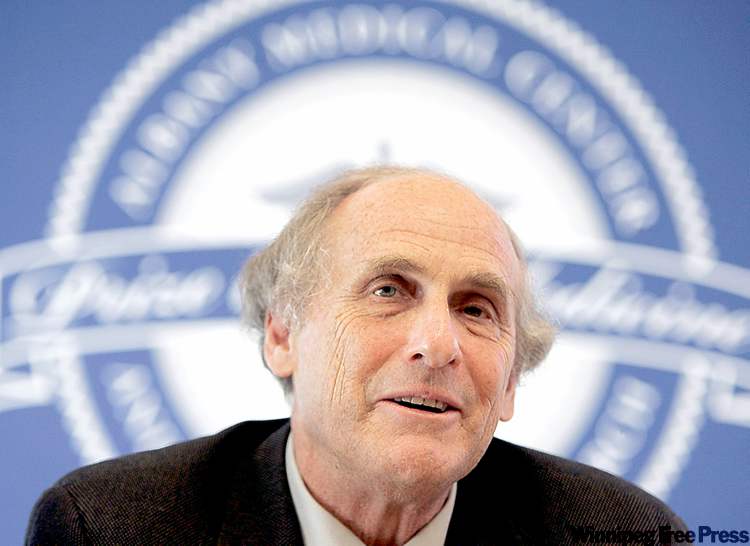
However, after an emergency meeting Monday, the Swedish foundation said the prize would remain in effect, saying: “The Nobel Prize to Ralph Steinman was made in good faith, based on the assumption that the Nobel laureate was alive.”
Officials said the situation was unprecedented and Steinman’s survivors would receive his share of the prize money, but it wasn’t immediately clear who would represent him at the ceremony in Stockholm.
Montreal-born Steinman, who was 68 when he died, was cited for his identification of dendritic cells, which help regulate adaptive immunity, an immune-system response that purges invading micro-organisms from the body.
He used the discovery to try to save his own life, said a statement from Rockefeller University in New York, where the cell biologist had carried out his research since 1970.
“He was diagnosed with pancreatic cancer four years ago, and his life was extended using a dendritic-cell-based immunotherapy of his own design,” the university said.
In Stockholm, Nobel committee member Goran Hansson said the committee didn’t know Steinman had died when it chose him as a winner.
“It is incredibly sad news,” Hansson said. “We can only regret that he didn’t have the chance to receive the news he had won the Nobel Prize. Our thoughts are now with his family.”
Nobel officials said they believe it is the first time a laureate has died before the announcement without the committee’s knowledge.
The scientist, recently given a new lab in his role as head of Rockefeller University’s Center for Immunology and Immune Diseases, received many honours for his work, including the Albert Lasker Award for Basic Medical Research in 2007 and the Canadian Gairdner Award in 2003.
“For several years, we’ve been wondering and hoping that Ralph Steinman might be winning the Nobel Prize, and today when I heard that he won it, I was delighted,” said Dr. Lorne Tyrrell of the University of Alberta, chair of the Gairdner Foundation board that selected him as a winner. “It was such a cruel turn of fate to find out that he passed away on Friday, because I think nothing would have made him happier near the end of his life, to have heard that he won the Nobel Prize,” Tyrrell said from Kyoto, Japan, where he was attending a conference.
Steinman’s discovery dates back to 1973, when he found a new cell type, the dendritic cell, which has a unique capacity to activate T-cells. Those cells have a key role in adaptive immunity, when antibodies and killer cells fight infections. They also develop a memory that helps the immune system mobilize its defences next time it comes under a similar attack.
Beutler and Hoffmann were cited for their discoveries in the 1990s of receptor proteins that can recognize bacteria and other micro-organisms as they enter the body, and activate the first line of defence in the immune system, known as innate immunity.
The trio’s discoveries have enabled the development of improved vaccines against infectious diseases, Hansson said. In the long term they could also yield better treatments of cancer, rheumatoid arthritis, Type 1 diabetes, multiple sclerosis and chronic inflammatory diseases.
— The Canadian Press