

Warming may wipe out Canadian tradition
Advertisement
Read this article for free:
or
Already have an account? Log in here »
To continue reading, please subscribe:
Monthly Digital Subscription
$1 per week for 24 weeks*
- Enjoy unlimited reading on winnipegfreepress.com
- Read the E-Edition, our digital replica newspaper
- Access News Break, our award-winning app
- Play interactive puzzles
*Billed as $4.00 plus GST every four weeks. After 24 weeks, price increases to the regular rate of $19.95 plus GST every four weeks. Offer available to new and qualified returning subscribers only. Cancel any time.
Monthly Digital Subscription
$4.99/week*
- Enjoy unlimited reading on winnipegfreepress.com
- Read the E-Edition, our digital replica newspaper
- Access News Break, our award-winning app
- Play interactive puzzles
*Billed as $19.95 plus GST every four weeks. Cancel any time.
To continue reading, please subscribe:
Add Free Press access to your Brandon Sun subscription for only an additional
$1 for the first 4 weeks*
*Your next subscription payment will increase by $1.00 and you will be charged $16.99 plus GST for four weeks. After four weeks, your payment will increase to $23.99 plus GST every four weeks.
Read unlimited articles for free today:
or
Already have an account? Log in here »
Hey there, time traveller!
This article was published 05/03/2012 (5144 days ago), so information in it may no longer be current.
A team of Canadian climate scientists is predicting the widespread disappearance of outdoor hockey rinks across the country in the next 50 years due to global warming — with some regions of the sport’s spiritual birthplace likely to witness an even earlier eclipse of old-time shinny on natural ice.
“The ability to skate and play hockey outdoors is a critical component of Canadian identity and culture,” three researchers from Montreal’s McGill and Concordia universities write in the latest issue of the U.K.-based scholarly journal Environmental Research Letters.
“Wayne Gretzky learned to skate on a backyard skating rink; our results imply that such opportunities may not be available to future generations of Canadian children.”
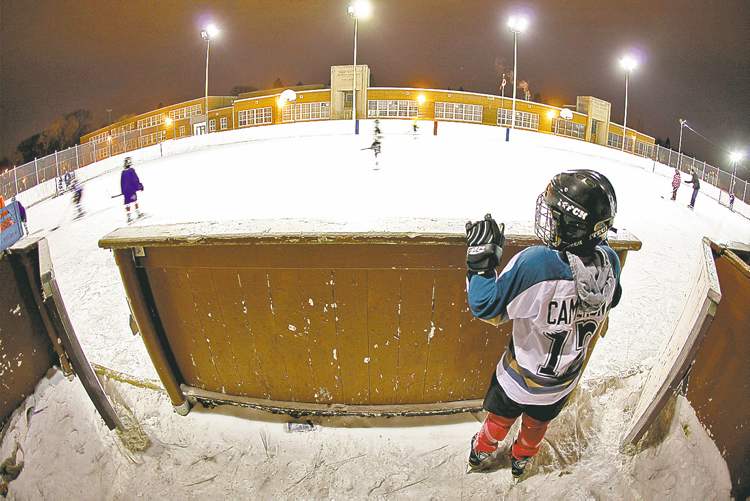
The scientists — Nikolay Damyanov and Lawrence Mysak of McGill and Concordia’s Damon Matthews — tracked historical temperature trends recorded since 1951 at 142 meteorological stations in every corner of the country. They also interviewed outdoor icemakers in Quebec and Ontario to find out what temperatures are required to start up an open-air rink and keep it usable for the duration of the skating season.
The researchers learned that, in general, it takes three consecutive days with a maximum temperature of -5 C to make ice and begin the outdoor skating season.
The length of the season is more difficult to pin down, but the researchers set the same -5 C standard to tally the approximate number of days when outdoor rinks should have been usable.
“Many individual locations have seen a statistically significant decrease in the number of viable ice-flooding days, suggesting a significant shortening of the length of the outdoor skating season over much of the country between 1951 and 2005,” the published paper states, identifying B.C., southern Alberta and the rest of the Prairies as the areas with the sharpest drop in the number of game days. The historical warming effect was noticeable but not as significant in Ontario and Quebec, while research sites in Atlantic Canada showed, overall, no significant change in the durability of outdoor rinks over the past half-century.
Although the researchers did not make detailed calculations projecting the temperature trends into the future, they observed that continued winter warming — as predicted for Canada in standard climate-change models — will result in fewer and fewer viable locations for outdoor rinks in Canada and shorter and shorter seasons in most places where skating persists.
Referring to southern B.C. and Alberta, the researchers stated: “A simple linear extrapolation of the OSS (outdoor skating season) length trend from the last 30 years of our record into the future shows that the number of viable rink-flooding days could reach zero by mid-century.”
— Postmedia News