

America’s first migrants
Giant sloth bones show humans may have arrived here much earlier than once thought
Advertisement
Read this article for free:
or
Already have an account? Log in here »
To continue reading, please subscribe:
Monthly Digital Subscription
$1 per week for 24 weeks*
- Enjoy unlimited reading on winnipegfreepress.com
- Read the E-Edition, our digital replica newspaper
- Access News Break, our award-winning app
- Play interactive puzzles
*Billed as $4.00 plus GST every four weeks. After 24 weeks, price increases to the regular rate of $19.95 plus GST every four weeks. Offer available to new and qualified returning subscribers only. Cancel any time.
Monthly Digital Subscription
$4.99/week*
- Enjoy unlimited reading on winnipegfreepress.com
- Read the E-Edition, our digital replica newspaper
- Access News Break, our award-winning app
- Play interactive puzzles
*Billed as $19.95 plus GST every four weeks. Cancel any time.
To continue reading, please subscribe:
Add Free Press access to your Brandon Sun subscription for only an additional
$1 for the first 4 weeks*
*Your next subscription payment will increase by $1.00 and you will be charged $16.99 plus GST for four weeks. After four weeks, your payment will increase to $23.99 plus GST every four weeks.
Read unlimited articles for free today:
or
Already have an account? Log in here »
Hey there, time traveller!
This article was published 24/03/2012 (5124 days ago), so information in it may no longer be current.
A University of Manitoba scientist’s analysis of ancient animal remains found in Ohio — including the leg bone of an extinct giant sloth believed to have been butchered by an Ice Age hunter more than 13,000 years ago — has added weight to a once-controversial argument humans arrived in North America thousands of years earlier than previously believed.
The discovery of what appear to be dozens of cut marks on the femur of a gargantuan, 1,300-kilogram Jefferson’s ground sloth is being hailed as the earliest trace of a human presence in the Great Lakes state.
But the find also represents a significant new piece of evidence in support of the theory the first inhabitants of Canada, the U.S. and the rest of the Americas were not the so-called Clovis people — known from distinctive tools they left at various archeological sites from about 12,600 years ago — but a much earlier wave of Ice Age migrants ancestral to many of today’s New World aboriginal populations.
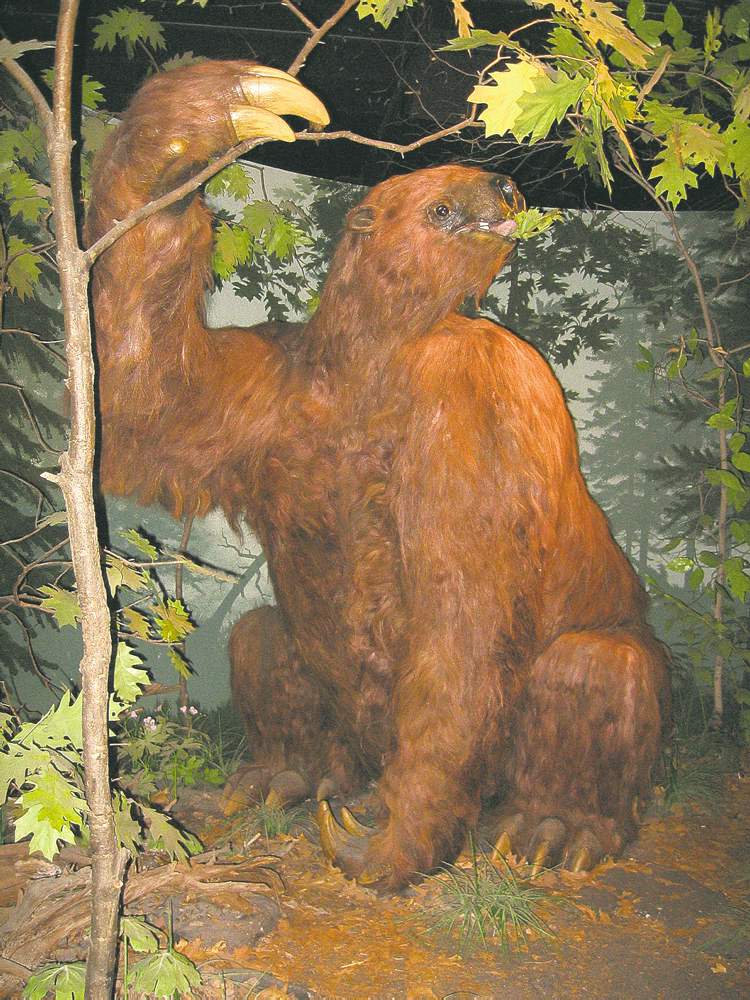
The butchered-sloth discovery — recently confirmed by University of Manitoba researcher Haskel Greenfield, co-author of a paper published in the latest issue of the journal World Archaeology — bolsters the growing consensus prehistoric Asians crossed from eastern Russian to western Alaska as early as 16,000 years ago, possibly travelling down the coast of B.C. before spreading to the continental interior and the far reaches of South America.
These purported “pre-Clovis” people left indications of their presence in the Western Hemisphere that only recently have become accepted as solid proof by many mainstream archeologists.
The sloth bone took a circuitous route to scientific significance. Discovered in an Ohio swamp at least 95 years ago, the specimen was first documented by a U.S. geologist in 1915 before sitting on the shelf of a local museum for close to a century, overlooked by modern researchers.
U.S. experts led by an archeologist from the Cleveland Museum of Natural History recently re-examined the bone and other ancient remains and contacted Greenfield — a specialist in early human tools and hunting — to help determine if the 44 incisions on the giant sloth’s femur were, in fact, made by humans stripping meat from the downed beast.
“I went down to Cleveland full of skepticism,” Greenfield told Postmedia News. “Partly, it was because other colleagues of mine had seen the specimen very briefly (and from a distance) and were sure that the marks were natural. It was only when I got up close to the specimen and began to look at it microscopically did I find a very different situation — one that I could not discount as caused by natural forces.”
Greenfield said it was “the total pattern that overturned my skepticism — the location of the marks, their shape, their size, the direction that they were made from, etc., as well as the fact that the morphology of the marks was most similar to those made by stone tools.”

The published paper — co-authored by Greenfield, CMNH archeologist Brian Redmond, U.S. National Park Service scientist Gregory McDonald and Firelands (Ohio) Historical Society researcher Matthew Burr — noted that, “until now, evidence of butchering and human utilization of ground sloths has been limited to South America.”
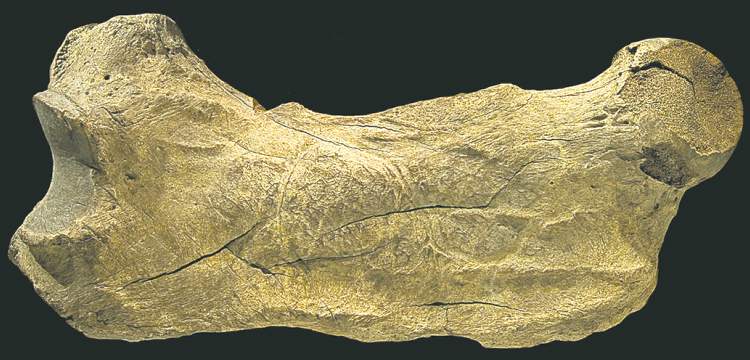
But apart from the breakthrough discovery early humans were hunting giant sloths as far north as the Great Lakes, the extreme age of the specimen — pegged at 13,435 to 13,738 years old through radiocarbon dating — offered a fresh clue in the mystery surrounding humanity’s arrival in the Americas and dispersal throughout the hemisphere.
“There is a variety of other pre-Clovis evidence that has accumulated slowly and surely in recent years,” said Greenfield. “Our study demonstrated that people were in northern Ohio and predated Clovis in the region by about 700 years.”
— Postmedia News