

Saga of tsunami bike is about much more than restoring a motorcycle
Advertisement
Read this article for free:
or
Already have an account? Log in here »
To continue reading, please subscribe:
Monthly Digital Subscription
$1 per week for 24 weeks*
- Enjoy unlimited reading on winnipegfreepress.com
- Read the E-Edition, our digital replica newspaper
- Access News Break, our award-winning app
- Play interactive puzzles
*Billed as $4.00 plus GST every four weeks. After 24 weeks, price increases to the regular rate of $19.95 plus GST every four weeks. Offer available to new and qualified returning subscribers only. Cancel any time.
Monthly Digital Subscription
$4.99/week*
- Enjoy unlimited reading on winnipegfreepress.com
- Read the E-Edition, our digital replica newspaper
- Access News Break, our award-winning app
- Play interactive puzzles
*Billed as $19.95 plus GST every four weeks. Cancel any time.
To continue reading, please subscribe:
Add Free Press access to your Brandon Sun subscription for only an additional
$1 for the first 4 weeks*
*Your next subscription payment will increase by $1.00 and you will be charged $16.99 plus GST for four weeks. After four weeks, your payment will increase to $23.99 plus GST every four weeks.
Read unlimited articles for free today:
or
Already have an account? Log in here »
Hey there, time traveller!
This article was published 12/05/2012 (5076 days ago), so information in it may no longer be current.
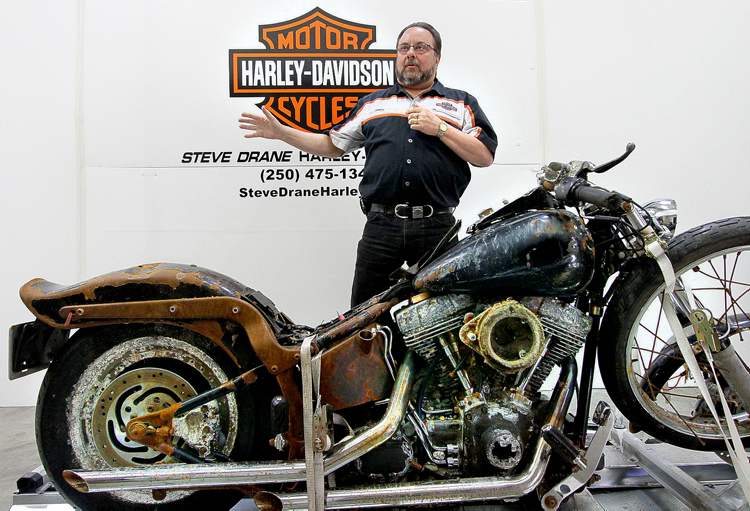
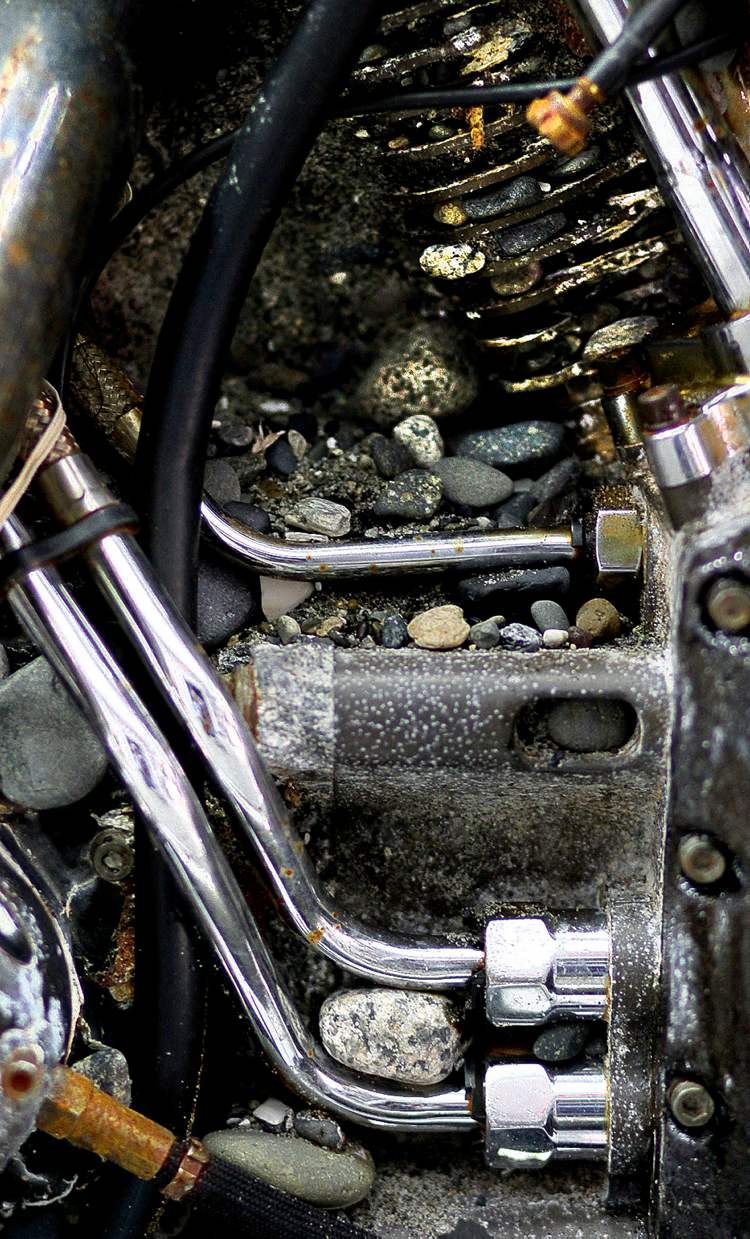
VICTORIA — After a year floating over from Japan, the tsunami bike looks like the worst garage sale find ever: spokes busted, seat gone, gas tank full of sand. Rocks are jammed against the crankcase. Even the rust has rust.
Steve Drane has seen worse, though. Thirty years ago, he restored a long-submerged motorcycle fished from a nest of stolen ones.
So yes, looking at the banged-up machine in his eponymous Harley-Davidson shop in Langford, B.C., Drane figures the 2004 Night Train that arrived from British Columbia’s Haida Gwaii on Sunday can be brought back to life.
The question now is whether the Japanese owner, a man who lost not just his worldly goods but much of his family, will want his Harley returned — or whether he’ll be happy enough knowing that halfway around the world, strangers care.
You might know the bones of this story already; how Haida Gwaii’s Peter Mark found the motorcycle half-buried in a remote Graham Island beach April 18.
It had bobbed across the Pacific in a Styrofoam-packed container swept to sea in Japan’s devastating earthquake and tsunami in March 2011.
Tofino Harley lover Ralph Tieleman heard about the find and gave Mark a call.
“We left it on the beach, it’s totalled,” Mark told him.
Maybe not, said Tieleman, who then made an offer: “If you can meet me… I’ll pick it up.”
So Mark spent 61/2 hours driving over logging roads, digging out the bike by hand, then using a Come-Along jack to get it off the beach, where it was maybe one high tide from being buried forever.
Tieleman hopped in his truck and drove a 3,500-kilometre Vancouver Island-Prince Rupert round trip, depositing the motorcycle with longtime friend Drane on Sunday.
It was Drane’s dream to restore the bike and return it for free to its owner, identified as Ikuo Yokoyama of Yamamoto, Japan.
“The first thought that went through my mind was: ‘Somebody lost something that they really love.’ “
In reality, it’s not certain what will happen next. Others in the Harley corporate family are keen to write a happy ending, too. First, they have to find out whether Yokoyama, a 29-year-old reportedly living in a shelter after losing three family members and his home in the tsunami, even wants the motorcycle.
“I don’t want to just impose my will on the guy,” Drane said Monday. “After going through that trauma over there, he might have a different view.”
TV interviews indicate Yokoyama would like to see it, though.
In the meantime, Drane is being inundated with news media from Japan, L.A., New York, everywhere. “I’ve probably done 30 radio interviews.”
The bike itself is a camera magnet. “For what it’s been through, it’s amazingly intact. The front forks actually still go up and down.”
As fascinating as the motorcycle is the motivation of those who have gone to such lengths to save it.
“I’ve got a few Harleys,” said Tieleman, 53, who bought his first at age 15.
“If I lost one of them, I would appreciate someone doing the same thing for me.”
It seems Tieleman, a Tofino longhair who gets by doing this and that — “This morning I was digging clams,” he said Monday — appreciates fine things. He is a serious art collector who owns works by Emily Carr, Tom Thomson and the Group of Seven’s Arthur Lismer, who lived in and painted the Tofino area.
Tieleman even took a slight detour while bringing the bike to Victoria.
“I was visiting the Art Gallery of Greater Victoria and the bike was in the back of my truck. People were looking at it and saying: ‘This is art.'”
Even so, the bike doesn’t matter as much as the meaning it, along with other tsunami debris drifting toward Vancouver Island, has to those across the Pacific.
“What we’re going to be seeing here is parts of people’s lives washing up,” Tieleman said.
Just how much tsunami debris will hit Vancouver Island is uncertain. Much of what has been excitedly discovered so far — shampoo and water bottles with Asian markings — is just the normal trash from passing freighters.

Veteran Tofino beachcomber Barry Campbell, whose finds over the past four decades include 345 glass fishing floats and a message in a bottle from a Japanese school, says it takes a strong south to southwest wind to push debris to shore. Otherwise the weak, ill-defined flow that comes within a couple of hundred kilometres of the B.C. coast might just carry debris past Vancouver Island, past Haida Gwaii, past Alaska and back to Japan.
Some stuff is definitely coming in, though. A photo posted to The Maritime Museum of B.C.’s online Tsunami Debris Project shows a shipping pallet a Japanese company paid to have Fed-Exed from Tofino.
That shows how much meaning these objects have in Japan. Restoring a motorcycle and sending it home won’t restore lost lives, but it would show that people here care.
— Victoria Times Colonist