

Anger at Quebec’s anti-protest law spreads, drowns out tuition talk
Advertisement
Read this article for free:
or
Already have an account? Log in here »
To continue reading, please subscribe:
Monthly Digital Subscription
$0 for the first 4 weeks*
- Enjoy unlimited reading on winnipegfreepress.com
- Read the E-Edition, our digital replica newspaper
- Access News Break, our award-winning app
- Play interactive puzzles
*No charge for 4 weeks then price increases to the regular rate of $19.00 plus GST every four weeks. Offer available to new and qualified returning subscribers only. Cancel any time.
Monthly Digital Subscription
$4.75/week*
- Enjoy unlimited reading on winnipegfreepress.com
- Read the E-Edition, our digital replica newspaper
- Access News Break, our award-winning app
- Play interactive puzzles
*Billed as $19 plus GST every four weeks. Cancel any time.
To continue reading, please subscribe:
Add Free Press access to your Brandon Sun subscription for only an additional
$1 for the first 4 weeks*
*Your next subscription payment will increase by $1.00 and you will be charged $16.99 plus GST for four weeks. After four weeks, your payment will increase to $23.99 plus GST every four weeks.
Read unlimited articles for free today:
or
Already have an account? Log in here »
Hey there, time traveller!
This article was published 26/05/2012 (4941 days ago), so information in it may no longer be current.
MONTREAL – The unpredictable nightly protests that helped spur a government crackdown have largely been a Montreal-only affair — until now.
Since Premier Jean Charest passed a law last week limiting protests in the province, defiant demonstrations have popped up in cities not known as hotbeds of activism.
Small groups from Granby, south of Montreal, to Jonquiere, north of Quebec City, have joined Montrealers in taking to the streets with pots and pans to protest Bill 178.
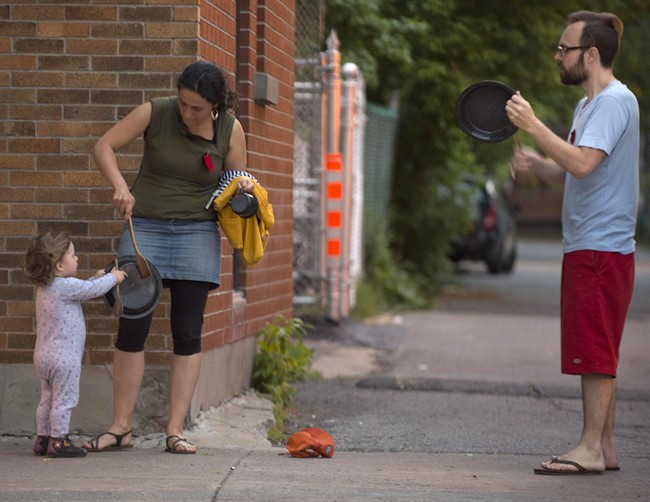
Their message is clear: This conflict is not just about tuition anymore.
In recent days, between 50 and 200 people have been gathering to protest the law in Trois-Rivieres, an industrial city roughly halfway between Montreal and Quebec City.
“This has gone beyond the student movement,” said Gaetan Bouchard, a local blogger and longtime social activist.
“Bill 78 has brought out many citizens and workers,” Bouchard added. “The group has been about 50-50: half students, half people of all ages and all horizons.”
Unlike Montreal’s protests, some of which have ended with broken windows and mass arrests, the demonstrations outside the city have tended to be calm.
Their festive atmosphere — the goal is to make as much noise as possible — makes an inviting environment for families and the elderly.
Reports from the 500-strong march in Granby described a wide cross-section of ages taking part, a sharp contrast from the student-dominated protests of previous weeks.
Participants have also remarked on their apparent spontaneity. There are no organizing committees, or leaders. Details are simply spread on Facebook or through word of mouth.
It is enough to give devoted leftists a ray of hope after almost 10 years of Charest’s Liberal government.
“I’m 44-years-old — I feel like I’ve been waiting my entire life for this,” said Bouchard.
Bill 78 stipulates that demonstrations of more than 50 people must give advance notice to the police, including their intended route.
It also threatens heavy fines against student associations and their leaders if they contravene parts of the law.
Even though the law has only been used sparingly by police so far, Quebec’s student federations filed legal motions against it on Friday.
The Charest government hoped its bill would end the volatile scenes outside Quebec universities and colleges where students tried to establish picket lines.
Students were jostled and pepper-sprayed as police sought to enforce injunctions allowing the resumption of classes.
Such incidents have almost ceased altogether, but the bill has done little to temper the ongoing marches.
Some claim it has had the opposite effect by giving ordinary Quebecers a reason to protest.
Montreal’s nightly marches have grown in size since the bill was passed, including a demonstration on Tuesday in which more than 100,000 are estimated to have taken part.
“The demonstrations now are no longer about the tuition raises,” said Jacques Hamel, a sociologist at the Universite de Montreal.
“The people in the streets with their casserole dishes aren’t overwhelmingly people who would have confronted the government on other questions.”
But success in mobilizing against the law threatens to complicate matters for Quebec’s student leaders, who are expected to resume negotiations with the government soon.
They have added the law’s repeal to their list of demands, even though that could take the focus away from the issue at the origin of the current conflict: tuition.
“We’re still fighting about tuition fee hikes,” said Martine Desjardins, who leads the FEUQ, one of the main student federations.
“With the government passing this bill, it just changes the objective a little bit. So we have to fight on both sides.”