

‘What if you were made to feel invisible?’
Report into B.C. killings released
Advertisement
Read this article for free:
or
Already have an account? Log in here »
To continue reading, please subscribe:
Monthly Digital Subscription
$1 per week for 24 weeks*
- Enjoy unlimited reading on winnipegfreepress.com
- Read the E-Edition, our digital replica newspaper
- Access News Break, our award-winning app
- Play interactive puzzles
*Billed as $4.00 plus GST every four weeks. After 24 weeks, price increases to the regular rate of $19.95 plus GST every four weeks. Offer available to new and qualified returning subscribers only. Cancel any time.
Monthly Digital Subscription
$4.99/week*
- Enjoy unlimited reading on winnipegfreepress.com
- Read the E-Edition, our digital replica newspaper
- Access News Break, our award-winning app
- Play interactive puzzles
*Billed as $19.95 plus GST every four weeks. Cancel any time.
To continue reading, please subscribe:
Add Free Press access to your Brandon Sun subscription for only an additional
$1 for the first 4 weeks*
*Your next subscription payment will increase by $1.00 and you will be charged $16.99 plus GST for four weeks. After four weeks, your payment will increase to $23.99 plus GST every four weeks.
Read unlimited articles for free today:
or
Already have an account? Log in here »
Hey there, time traveller!
This article was published 18/12/2012 (4876 days ago), so information in it may no longer be current.
VANCOUVER — Bias against the poor, drug-addicted sex workers in Vancouver’s troubled Downtown Eastside led to a series of failures that allowed serial killer Robert Pickton to spend years hunting his victims unimpeded by police, a public inquiry has found.
Commissioner Wally Oppal’s 1,448-page final report, released Monday, chronicles years of mistakes that allowed Pickton to lure dozens of women to his farm in Port Coquitlam, B.C., with little interference from police and even less concern from the public.
He noted even referring to Pickton’s victims as missing women is a misnomer. “The women didn’t go missing. They aren’t just absent, they didn’t just go away. They were taken.”
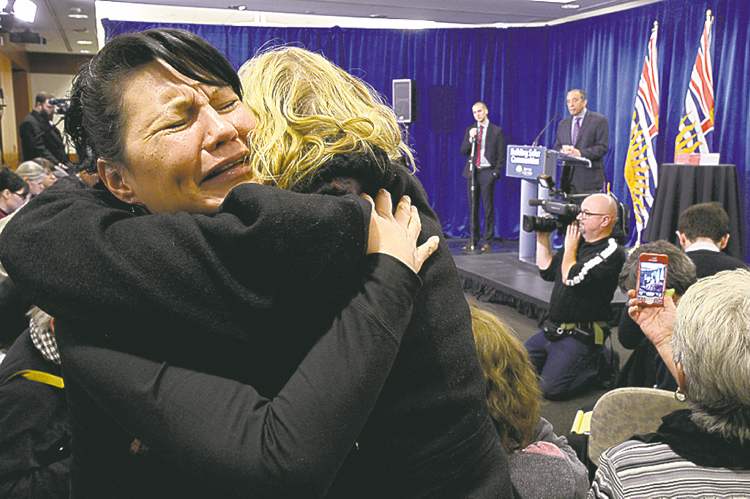
In a news conference interrupted by applause, jeers, drumming and aboriginal singing, Oppal appealed to the general public, asking people to imagine what life was like for Pickton’s victims and other women like them, even before they crossed paths with Pickton.
He said they were treated — in life and in death — as nobodies.
“I ask you to imagine how you would feel; put yourself in the shoes of one of the missing and murdered women and think how it would feel if you were dismissed, considered unworthy of attention by the majority of the people in your city. “What if you were made to feel invisible, unworthy?”
Oppal’s report found the problems with the investigation included structural ones — poor co-operation between Vancouver police and the RCMP, for example. But many were a result of something far more insidious and difficult to cure.
“Would the response of the Vancouver police and the public have been any different if these women had come from the west side of town? I think the answer is clear,” Oppal told The Canadian Press in an interview discussing his report’s conclusions.
“There was an institutional, systemic bias against the women… They were poor, they were aboriginal, they were drug-addicted and they were not taken seriously.”
Those biases were compounded by a lack of leadership among Vancouver police and the RCMP, he said.
Still, Oppal concluded the effects of that bias were not intentional, leading to systemic failures rather than a conscious decision to ignore Vancouver’s missing women.
Oppal spent eight months hearing evidence about the failed investigations by the Vancouver police and the Port Coquitlam RCMP into reports of missing sex workers and evidence Pickton was a suspect.
The result is a highly critical document that describes parallel yet largely separate investigations that were each plagued by indifference and poor police work. Oppal made 63 recommendations, including a regional police force for the greater Vancouver region, immediate improvements to services for sex workers, changes to police policies to ensure they reflect the needs of the impoverished women in the Downtown Eastside and more services for sex workers and other vulnerable women.
He also said the B.C. government should appoint an aboriginal elder to oversee the implementation of his recommendations and to help draft formal apologies to begin a reconciliation process with families and the community. And he recommended the province set up a compensation fund for families of missing and murdered women.
But it’s not clear whether Oppal’s report will satisfy his many critics, including relatives of missing and murdered women and numerous advocacy groups, which have denounced the inquiry as a flawed process that ignored the voices of the women it was created to protect and put too much emphasis on police.
There were reports of missing women in Vancouver dating back to the 1980s, and those disappearances increased dramatically in the mid-1990s.
When relatives and friends attempted to report those women missing, officers and staff with the Vancouver police department told them the women were transient drug addicts who weren’t in any trouble or were simply on vacation, Oppal’s report noted, referring back to testimony from families at the inquiry.
The first major investigative blunders began in 1997, when Pickton attacked a sex worker at his farm, leaving her with injuries so severe she died twice on the operating table. Pickton was charged with attempted murder, but prosecutors eventually stayed the case, after which 19 more women later connected to Pickton’s farm disappeared.
Following the attack, police seized clothing and other material from Pickton’s property, which, when tested following his arrest in 2002, revealed the DNA of two missing sex workers.
Among the many mistakes by police, Oppal’s report counted the failure to test that evidence or follow up with additional interviews with the victim, who told officers after her attack she believed other sex workers had been to Pickton’s property.
— The Canadian Press
Related Articles
Missing B.C. women were not even seen
Advertisement Advertise With Us
Advertisement Advertise With Us