

Camels the ships of the… High Arctic?
Mummified bones dug up in tundra
Advertisement
Read this article for free:
or
Already have an account? Log in here »
To continue reading, please subscribe:
Monthly Digital Subscription
$1 per week for 24 weeks*
- Enjoy unlimited reading on winnipegfreepress.com
- Read the E-Edition, our digital replica newspaper
- Access News Break, our award-winning app
- Play interactive puzzles
*Billed as $4.00 plus GST every four weeks. After 24 weeks, price increases to the regular rate of $19.95 plus GST every four weeks. Offer available to new and qualified returning subscribers only. Cancel any time.
Monthly Digital Subscription
$4.99/week*
- Enjoy unlimited reading on winnipegfreepress.com
- Read the E-Edition, our digital replica newspaper
- Access News Break, our award-winning app
- Play interactive puzzles
*Billed as $19.95 plus GST every four weeks. Cancel any time.
To continue reading, please subscribe:
Add Free Press access to your Brandon Sun subscription for only an additional
$1 for the first 4 weeks*
*Your next subscription payment will increase by $1.00 and you will be charged $16.99 plus GST for four weeks. After four weeks, your payment will increase to $23.99 plus GST every four weeks.
Read unlimited articles for free today:
or
Already have an account? Log in here »
Hey there, time traveller!
This article was published 06/03/2013 (4703 days ago), so information in it may no longer be current.
CAMELS may be called the ships of the desert, but ancient, mummified bones dug from the tundra are confirming the animals now synonymous with the arid sands of Arabia actually developed in what is now Canada’s High Arctic.
And those remains from Ellesmere Island — the most northerly spot to ever yield camel bones — are also raising important questions about the future of the warming Arctic.
About 31/2 million years ago, Strathcona Fiord on the island’s west-central coast would have looked a lot more like a northern forest than an Arctic landscape, said paleobotanist Natalia Rybczynski of the Canadian Museum of Nature in Ottawa.
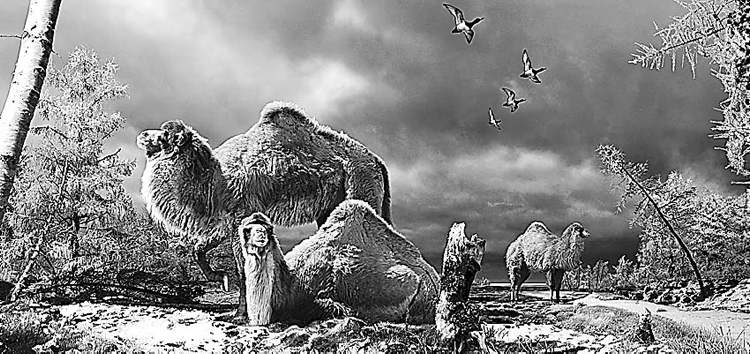
“Larch-dominated, lots of wetlands, peat,” said Rybczynski, lead author of a study published Tuesday in Nature Communications. Nearby fossil sites have yielded evidence of ancient bears, horses, deer, badgers and frogs. The average yearly temperature would have been about 0 C.
“If you were standing in it and watching the camel, it would have the feel of a boreal-type forest.”
The only thing missing, really, were moose. The camel “is taking that moose role, the really huge herbivore,” Rybczynski said.
The Arctic camel was 30 per cent larger than modern camels, she said. Her best guess is it was one-humped.
Although native camels are now only found in Africa and Asia, scientists have long believed the species actually developed in North America and later died out. Camel remains have been previously found in the Yukon.
What makes Rybczynski’s find special is not only how far north it was found, but its state of preservation.
The 30 fragments found amidst the sand and pebbles of the tundra were mummified, not fossilized. So despite their age, the pieces preserved tiny fragments of collagen within them, a common type of protein found in bones.
Analyzing that protein not only proved the fragments were from camels, but from a type of camel that is much more closely related to the modern version than the Yukon camel. Out of the dozens of camel species that once roamed North America, the type Rybczynski found was one of the most likely to have crossed the Bering land bridge and colonized the deserts.
“This is the one that’s tied to the ancestry of modern camels.”
Her research is also important for what it suggests about the Arctic climate. Back when this camel was browsing leaves and shoots, the entire global climate averaged about two or three degrees warmer than it is now. That’s about as much a difference as scientists say the Earth can undergo today without catastrophic changes.
— The Canadian Press