

B.C. First Nation takes aboriginal-title fight to Canada’s highest court
Advertisement
Read this article for free:
or
Already have an account? Log in here »
To continue reading, please subscribe:

Digital Subscription
One year of digital access for only $205*
- Enjoy unlimited reading on winnipegfreepress.com
- Read the E-Edition, our digital replica newspaper
- Access News Break, our award-winning app
- Play interactive puzzles
*First annual payment billed as $205.00 + GST for one year. This annual subscription will automatically renew at $233.00 + GST every 52 weeks (10% off the regular annual price of $259.35). Offer available to new and qualified returning subscribers only. Cancel any time.
To continue reading, please subscribe:
Add Free Press access to your Brandon Sun subscription for only an additional
$1 for the first 4 weeks*
- Enjoy unlimited reading on winnipegfreepress.com
- Read the E-Edition, our digital replica newspaper
- Access News Break, our award-winning app
- Play interactive puzzles
*Your next Brandon Sun subscription payment will increase by $1.00 and you will be charged $17.95 plus GST for four weeks. After four weeks, your payment will increase to $24.95 plus GST every four weeks.
Read unlimited articles for free today:
or
Already have an account? Log in here »
Hey there, time traveller!
This article was published 07/11/2013 (4690 days ago), so information in it may no longer be current.
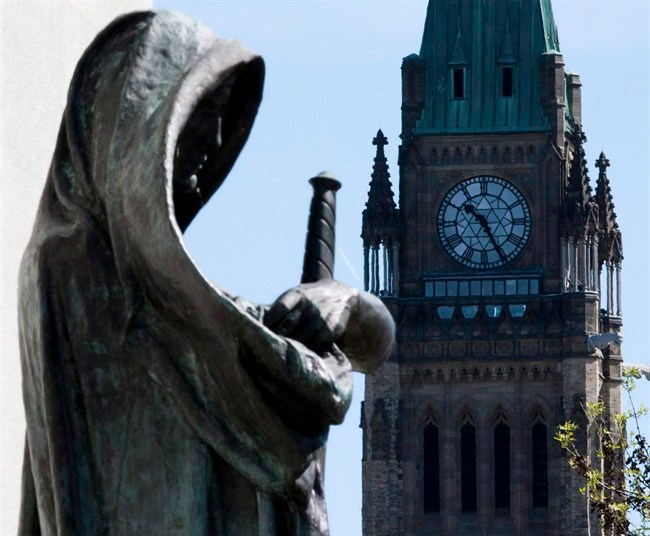
OTTAWA – A small British Columbia First Nation has gone before the Supreme Court of Canada in a case that could have far-reaching effects on aboriginal title across the country — two decades after a provincial government decision over logging rights.
Leaders of the Tsilhqot’in Nation said they were ready to hear only one answer to their arguement that they should have title to a vast stretch of land in B.C.’s Interior.
“Our hearts are beating as one and the strength is here,” Xeni Gwet’in Coun. Loretta William said Thursday outside court in Ottawa, while inside defence lawyers began their arguments before a panel of nine judges.
“Everyone is here for the same reason, to have our title rights recognized,” William said. “You can feel it, there’s a certain energy here.”
The case began more than 20 years ago when the B.C. government granted logging rights in an area within the Xeni Gwet’in Nation’s traditional territory near Williams Lake, about 500 kilometres northeast of Vancouver.
In 1990, the Xeni Gwet’in and its larger Tsilhqot’in National Government filed a lawsuit against the province of British Columbia, the regional manager of the Cariboo forest region and the Attorney General of Canada over logging in an area of 438,000 hectares in the Chilcotin region.
B.C. Supreme Court Judge David Vickers heard more than 300 days of testimony over five years, and in his November 2007 ruling found that the Tsilhqot’in people had occupied the area for two centuries.
Vickers ruled that the provincial Forest Act did not apply within aboriginal title lands and B.C. had infringed on the rights and title of the Tsilhqot’in people.
He also found the band did have aboriginal rights throughout the claimed area, including the right to hunt, trap and earn a moderate living from it.
However, while Vickers ruled the band had aboriginal title to about 40 per cent of the claimed land, he said he could not grant a declaration of title because the claim was pursued as “all or nothing.”
The Tsilhqot’in Nation, the province and the federal government appealed and the B.C. Court of Appeal upheld the finding that aboriginal title applied only to areas of “intensive presence at a particular site,” and not the broad range of land used at times by a semi-nomadic people.
The band sought leave to appeal to the Supreme Court of Canada, which announced earlier this year it would hear the case.
The lower court decision was more restrictive and extreme than anything seen in common law before, lawyers for the Tsilhqot’in said in written arguments to the high court.
“At the same time, by imposing this rigid standard in every case, it accords no weight (let alone equal weight) to aboriginal perspectives on occupation or the manner in which the society used the land to live,” the band argued.
“It has removed the ‘aboriginal’ from aboriginal occupation.”
Lawyers for the Attorney General of Canada said both lower court rulings accorded with previous cases that found there are three elements to demonstrating aboriginal title — physical occupation, exclusivity of occupation and continuity of occupation.
“All three elements are necessary to establish title, and no one element is independently sufficient,” the federal attorney general said in documents filed with the court.
“As the evidence presented at trial failed to establish these elements with respect to the land claimed, the courts below did not err in dismissing the claim.”
The Supreme Court of Canada is expected to set out in its decision just how aboriginal land title can be established. The ruling is not expected until next year.
“We’ve got all the time in the world,” William said.
“We’re going to wait, that’s what we’re here for. We’ll always be on our land and we will wait forever, but we want to get this land question dealt with as do all the other First Nations across Canada.”
The case has drawn intervention from provinces including Manitoba, Quebec, Alberta and Saskatchewan, as well as the Union of British Columbia Indian Chiefs, the Assembly of First Nations and B.C.’s First Nations Summit.
The Tsilhqot’in are opposed to a gold-and-copper mine proposed by Taseko Mines Ltd., southwest of Williams Lake, B.C., and they hope a high-court victory will help them stop the project.
— By Dene Moore and Beth Leighton in Vancouver —