

Cops with cameras: Growing number of police armed with recording devices
Advertisement
Read this article for free:
or
Already have an account? Log in here »
To continue reading, please subscribe:

Digital Subscription
One year of digital access for only $205*
- Enjoy unlimited reading on winnipegfreepress.com
- Read the E-Edition, our digital replica newspaper
- Access News Break, our award-winning app
- Play interactive puzzles
*First annual payment billed as $205.00 + GST for one year. This annual subscription will automatically renew at $233.00 + GST every 52 weeks (10% off the regular annual price of $259.35). Offer available to new and qualified returning subscribers only. Cancel any time.
To continue reading, please subscribe:
Add Free Press access to your Brandon Sun subscription for only an additional
$1 for the first 4 weeks*
- Enjoy unlimited reading on winnipegfreepress.com
- Read the E-Edition, our digital replica newspaper
- Access News Break, our award-winning app
- Play interactive puzzles
*Your next Brandon Sun subscription payment will increase by $1.00 and you will be charged $17.95 plus GST for four weeks. After four weeks, your payment will increase to $24.95 plus GST every four weeks.
Read unlimited articles for free today:
or
Already have an account? Log in here »
Hey there, time traveller!
This article was published 20/01/2014 (4580 days ago), so information in it may no longer be current.
MONTREAL – In an age where nearly everyone has a camera on their smart phone, a growing number of police forces are looking to arm their officers with a recording device of their own.
From small town California to bustling London, England, law enforcement officials argue that body-worn video cameras will help improve transparency and restore public trust in the police.
The idea is gaining traction in Canada.
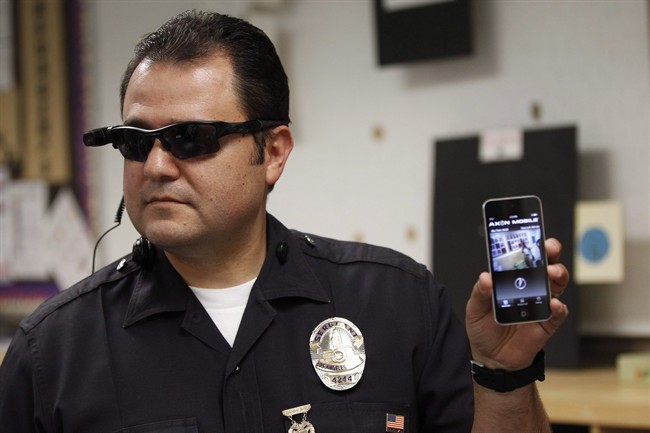
Calgary has used them in a limited capacity since last August and they have also been tested in cities such as Toronto, Edmonton and Ottawa.
Montreal, Vancouver and Toronto are considering their wide use.
The cameras are about the size of a smart phone and are clipped to the officer’s chest.
In Montreal, the request for the devices came from the police officers themselves, who say videos posted online and spread on social media often fail to show the full exchange in an intervention.
“The goal of this is to show both sides of the story. What they are scared of is that people will only see part of the intervention,” said Ian Lafreniere, a spokesman for Montreal police.
“This is why police officers would love to have cameras, because you could see it exactly what happens. When you’re working in Montreal, you know that you’ll be filmed not only by personal cameras, but by surveillance cameras as well. “
Montreal police, like those elsewhere, have found themselves under increased scrutiny because of videos by citizens posted online.
Earlier this month, a cop was captured on video telling a homeless man he would tie him to a pole for an hour in the freezing cold if his behaviour didn’t improve.
The officer can be seen telling the man that if another citizen complained to police about him he would “tie him to a pole for an hour.”
The introduction of the cameras is intended to restore trust in the police force.
Civil liberties groups point out such cameras raise a number of privacy issues.
But some of those same groups see the potential for major benefits as well, such as protecting residents from harassment and racial profiling.
In a report outlining the pros and cons of the issue, the American Civil Liberties Union said it’s against “pervasive government surveillance” but added that “when cameras primarily serve the function of allowing public monitoring of the government instead of the other way around, we generally regard that as a good thing.”
“Overall, we think they can be a win-win—but only if they are deployed within a framework of strong policies to ensure they protect the public without becoming yet another system for routine surveillance of the public,” the group said.
For the pilot project in Calgary, officers began testing out the cameras in November 2012, with 50 cameras deployed across the police force.
Cameras were activated when officers were responding to a call or came across an incident requiring investigation. The city is planning to gradually expand the program.
Proponents of body-worn cameras point to a scientific study conducted in Rialto, California, where cameras were introduced in February 2012.
Public complaints against officers dropped by 88 per cent compared with the previous 12 months. The use of force by officers fell by 60 per cent.
Lafreniere said Montreal has been exploring the possibility of using the cameras for a year, and the major question now is whether its financially feasible.
“Buying a camera is just one part of the deal,” he said, explaining that processing and storing such a massive amount of video could end up being far more costly.
“We have to deal with all the footage afterward, because it could be required to deal with complaints and in court.”