

Nova Scotia sending robots into classrooms this fall as coding training expands
Advertisement
Read this article for free:
or
Already have an account? Log in here »
To continue reading, please subscribe:
Monthly Digital Subscription
$0 for the first 4 weeks*
- Enjoy unlimited reading on winnipegfreepress.com
- Read the E-Edition, our digital replica newspaper
- Access News Break, our award-winning app
- Play interactive puzzles
*No charge for 4 weeks then price increases to the regular rate of $19.00 plus GST every four weeks. Offer available to new and qualified returning subscribers only. Cancel any time.
Monthly Digital Subscription
$4.75/week*
- Enjoy unlimited reading on winnipegfreepress.com
- Read the E-Edition, our digital replica newspaper
- Access News Break, our award-winning app
- Play interactive puzzles
*Billed as $19 plus GST every four weeks. Cancel any time.
To continue reading, please subscribe:
Add Free Press access to your Brandon Sun subscription for only an additional
$1 for the first 4 weeks*
*Your next subscription payment will increase by $1.00 and you will be charged $16.99 plus GST for four weeks. After four weeks, your payment will increase to $23.99 plus GST every four weeks.
Read unlimited articles for free today:
or
Already have an account? Log in here »
Hey there, time traveller!
This article was published 06/05/2016 (3506 days ago), so information in it may no longer be current.
HALIFAX – In a corner of the Nova Scotia legislature, Grade 6 students Bridget Daly and Hannah Harley ponder how to program small, yellow-and-black robots shaped like bumble bees.
The 11-year-olds from Rockingham Elementary School in Halifax are setting direction and speed for a race between two “beebots” at Province House — an example of what’s coming to all elementary schools this fall as the government expands computer coding in the curriculum.
The girls said learning computer code is a welcome challenge, and hands-on technology like the beebots will be a help in solving math and science problems.
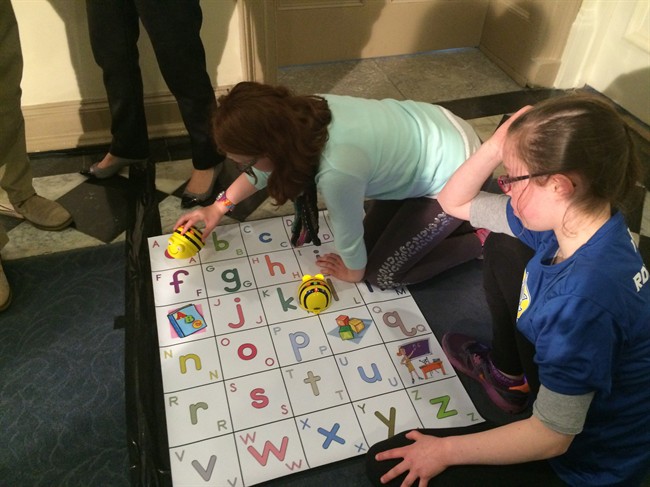
“Instead of having to visualize it and thinking about it you can use it without having any problems,” said Hannah.
Education Minister Karen Casey used Thursday’s demonstration to promote $1 million in funding included in the spring budget for computer coding.
The money will give students from kindergarten to Grade 6 access to technical devices such as iPads, tech invention kits, and wireless probes and software.
“Some of the skills that they will be getting through the use of technology are things like teamwork, critical thinking, problem solving and creativity,” said Casey.
She said coding will be applied across a range of subjects to help students prepare for post-secondary opportunities and an increasingly technical workforce.
The funding will also be used to train teachers through a professional development program running this month and next, and also at an IT summer camp.
Casey said Nova Scotia is a national leader in incorporating coding in its curriculum, having introduced basic coding for students from kindergarten to Grade 3 last September.
“What we’ve been told is unique is that we have taken our (education) action plan and directly connected it to our strategy for coding and then went on . . . to have the resources there and the professional development for teachers,” she said.
She said the Education Department’s goal is to have computer coding fully integrated through every Grade 6 classroom within three years, and through junior and senior high schools within five years.
In January, British Columbia responded to a call from its growing tech sector and announced plans for coding in schools there.
Premier Christy Clark said beginning in September schools would receive a new curriculum with a coding program to be phased in over three years. The goal is to incorporate coding basics for students from kindergarten to Grade 12 within the next decade.
Coding is also on the agenda for New Brunswick’s education system, and has been a mandatory part of the school curriculum in the United Kingdom since 2014.
Schools in New York City and Chicago will also be required to offer computer science to all students.
Nova Scotia Premier Stephen McNeil said it’s important to prepare students for job opportunities in a world economy being shaped by technology.
“It’s our view that those countries that have invested in their students in terms of coding will be the economies that will capitalize on the opportunities,” said McNeil.