

‘Bugger of a fight’: Historians question criticism of Canada’s Normandy battles
Advertisement
Read this article for free:
or
Already have an account? Log in here »
To continue reading, please subscribe:
Digital Subscription
One year of digital access for only $1.44 a week*
- Enjoy unlimited reading on winnipegfreepress.com
- Read the E-Edition, our digital replica newspaper
- Access News Break, our award-winning app
- Play interactive puzzles
*Billed as $5.77 plus GST every four weeks. After 52 weeks, price increases to the regular rate of $19.95 plus GST every four weeks. Offer available to new and qualified returning subscribers only. Cancel any time.
To continue reading, please subscribe:
Add Free Press access to your Brandon Sun subscription for only an additional
$1 for the first 4 weeks*
- Enjoy unlimited reading on winnipegfreepress.com
- Read the E-Edition, our digital replica newspaper
- Access News Break, our award-winning app
- Play interactive puzzles
*Your next Brandon Sun subscription payment will increase by $1.00 and you will be charged $17.95 plus GST for four weeks. After four weeks, your payment will increase to $24.95 plus GST every four weeks.
Read unlimited articles for free today:
or
Already have an account? Log in here »
Hey there, time traveller!
This article was published 03/06/2019 (2554 days ago), so information in it may no longer be current.
OTTAWA – D-Day: the letter stands for nothing, but the term itself represents a great deal more.
It conjures indelible images of landing craft speeding towards the beaches of Normandy. Of ramps lowering and soldiers being mowed down by withering German machine-gun fire. Of troops pressing forward in the face of certain death and driving the Nazis from the beaches.
Of freedom and democracy prevailing — eventually — over tyranny and evil.
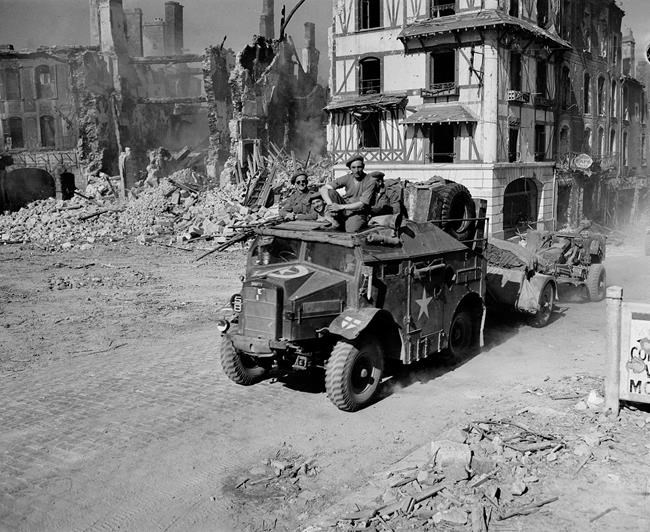
Millions of Canadians will stop on June 6 to commemorate the 75th anniversary of that pivotal event, which saw Canada stand shoulder-to-shoulder with the U.S. and Britain in smashing through Hitler’s supposedly impregnable Atlantic Wall on the coast of France, marking the beginning of the end of the Second World War.
Yet as dramatic and harrowing as D-Day was for the 14,000 Canadian soldiers who eventually landed on Juno Beach that day, and the thousands more sailors and airmen supporting them, it was only the beginning. Over the next three months, the Canadians would score victories but also suffer defeats — some of which would tarnish Canada’s reputation for decades.
Indeed, the Canadians would be criticized during the war and after for being slow, poorly trained and inept in the days and weeks immediately after D-Day — particularly for their role in a key operation known as the Falaise Gap. Only in recent years have historians started to question that view, saying such assessments are inaccurate and paint over the very real challenges that the Canadians faced in Normandy.
“There’s a lot of complaints about the Canadians in Normandy as the campaign goes on — that we’re not aggressive enough, that we aren’t all that good, that closing the Falaise Gap is our failure,” says former Canadian War Museum head Jack Granatstein.
“I think you can make a case for that. But you can also point fingers at the British and the Americans too. The reality is we were fighting a first-class army and the Germans were very, very good…. Everybody knew it was going to be a bugger of a fight.”
D-Day has come to be seen as a triumph for Canadian troops, who were able to push farther inland on June 6, 1944, than any other Allied force. The next four days, however, were arguably just as important as the Germans tried to prevent the allies from establishing a foothold on the European mainland by pushing them back into the sea.
It was here that the Canadians, along with their British comrades, faced their first round of criticism. Specifically, the feeling at the time and for years afterward was that the Anglo-Canadians were slow and inept, as evidenced by their failure to quickly capture several key objectives such as the city of Caen and the airfield at Capriquet.
Those same criticisms resurfaced in relation to the Falaise Gap, where the Canadians struggled in August 1944 to cut off the retreat of two German armies that were being encircled by the allies. The gap would eventually be closed, leading to the capture of 50,000 German soldiers, but tens of thousands of others managed to escape to fight again.
“It is not difficult to put one’s finger upon occasions in the Normandy campaign when Canadian formations failed to make the most of their opportunities,” Canada’s official Second World War historian C.P. Stacey wrote in 1960, in what would be an oft-cited and repeated view of the Canadian effort in Normandy, which cost 5,000 Canadian lives and left 13,000 wounded or missing.
“In particular, the capture of Falaise was long delayed and it was necessary to mount not one but two set-piece operations for the purpose at a time when an early closing of the Falaise Gap would have inflicted most grievous harm upon the enemy and might even, conceivably, have enabled us to end the war some months sooner than was actually the case.”
However, the past 15 years or so have seen historians such as Marc Milner of the University of New Brunswick’s Gregg Centre for the Study of War and Society take a second look at such assessments, part of a growing consensus that such criticisms of the Canadian performance during the 77-day Normandy campaign are off the mark.
Milner has argued that the primary task for Canadian soldiers in the days immediately after June 6 was not to capture huge swaths of territory, but to blunt the inevitable tank-driven counterattacks the Germans would inevitably launch following the D-Day landings. As evidence, he notes the Canadians had nearly twice as much artillery and heavy guns than any other unit.
“It’s only the panzers that can stop the D-Day landings,” says Milner, whose 2014 book “Stopping the Panzers” was based on his extensive research. “So the expectation is the Germans will launch a massive panzer and mechanized (attack) on the flat ground north and west of Caen. And we’re the people who stop the panzers from destroying the D-Day operation.”
Milner’s assessment has gained acceptance among other Canadian historians, who have also started to question the long-held view Canadian troops were poorly trained and led in Normandy.
There has also been pushback on the notion that the Canadians somehow failed the Allied cause when they were slow in closing the Falaise Gap two months later, with historians arguing that past assessments did not take into account various factors such as the German’s skill and experience.
“They’re slow because they’re fighting through very difficult terrain and against a very determined enemy,” says Canadian War Museum historian Tim Cook, adding the Canadians had been fighting non-stop for weeks by that point.
“(The Canadians) are constantly fighting and they’re short of fuel and they’re short of men and they’ve been fighting hard. … I think of the words of one of the Canadians who was there who said: ‘It wasn’t slow for us.'”
— Follow @leeberthiaume on Twitter.


Advertisement Advertise With Us
Advertisement Advertise With Us