

A primer on the governance system of the Wet’suwet’en Nation
Advertisement
Read this article for free:
or
Already have an account? Log in here »
To continue reading, please subscribe:

Digital Subscription
One year of digital access for only $205*
- Enjoy unlimited reading on winnipegfreepress.com
- Read the E-Edition, our digital replica newspaper
- Access News Break, our award-winning app
- Play interactive puzzles
*First annual payment billed as $205.00 + GST for one year. This annual subscription will automatically renew at $233.00 + GST every 52 weeks (10% off the regular annual price of $259.35). Offer available to new and qualified returning subscribers only. Cancel any time.
To continue reading, please subscribe:
Add Free Press access to your Brandon Sun subscription for only an additional
$1 for the first 4 weeks*
- Enjoy unlimited reading on winnipegfreepress.com
- Read the E-Edition, our digital replica newspaper
- Access News Break, our award-winning app
- Play interactive puzzles
*Your next Brandon Sun subscription payment will increase by $1.00 and you will be charged $17.95 plus GST for four weeks. After four weeks, your payment will increase to $24.95 plus GST every four weeks.
Read unlimited articles for free today:
or
Already have an account? Log in here »
Hey there, time traveller!
This article was published 03/03/2020 (2357 days ago), so information in it may no longer be current.
VANCOUVER – A B.C. Supreme Court case in 2011 explained the traditional Wet’suwet’en governance system. Here is a look at the decision and how the system works:
Clans and houses: The five Wet’suwet’en clans are each comprised of several houses, 13 in all. A house is a matrilineage of people related through their mothers and each house as one or more territory. Together, they comprise the Wet’suwet’en territory.
“The Wet’suwet’en occupation and use of land is organized by the clan and house system upon which the law and essential social structure is ultimately based,” the court decision says.
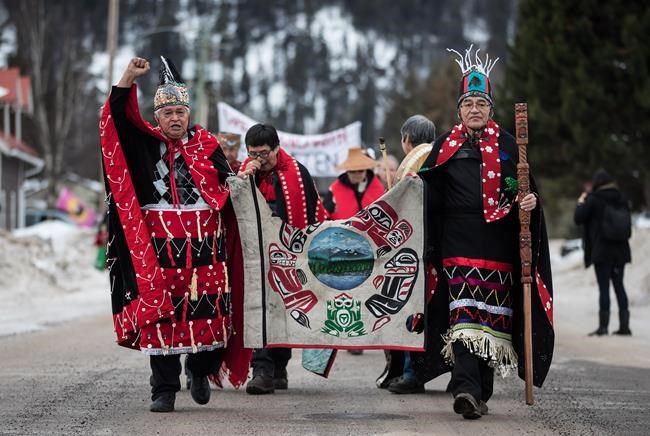
Each house has a head chief and a sub-chief, or wing chief, and each chief has rights and responsibilities specific to the particular territory over which that chief is given a duty to protect.
“The rights and responsibilities are confirmed, co-ordinated and directed to the common good, in other words, governed, through the feast,” it says.
Significance of feast halls: The feast hall is central to the traditional form of governance and is used for making important decisions. It’s where Wet’suwet’en law is both enacted and upheld.
It is also in the feast that people are given their titles, their robes and their crests and the authority over the territory associated with those titles. This succession is witnessed by the Wet’suwet’en and the neighbouring peoples, the Babine, Nutseni and Gitksan.
Becoming a hereditary chief: Before European contact, a Wet’suwet’en member began the journey to becoming a hereditary chief while still inside their mother’s womb, the Office of the Wet’suwet’en says.
Elders, shamans and chiefs would often feel the expectant mother’s belly and determine if the baby was destined to future leadership. From that point, the child would be groomed or tutored to be a wise, strong and responsible leader. They would begin a succession of feasts over the course of their life that would ultimately lead to gaining a wing chief name, then a head chief name.
Before receiving a high-ranking chief name, a person would travel into the wilderness to live with the animals for an extended period of time. They would learn the ways of the animal world before returning to the community to assume a chief name. When they returned, they would have to demonstrate what they learned. This exercise exposed the prospective chief to the human world as well as the animal world, thus ensuring he or she had the utmost respect for both.
This report by The Canadian Press was first published March 3, 2020.
Related Articles
Band councils should be included in draft deal: Councillor
Advertisement Advertise With Us