

August jobs report lands on campaign trail as labour market claws closer to recovery
Advertisement
Read this article for free:
or
Already have an account? Log in here »
To continue reading, please subscribe:

Digital Subscription
One year of digital access for only $205*
- Enjoy unlimited reading on winnipegfreepress.com
- Read the E-Edition, our digital replica newspaper
- Access News Break, our award-winning app
- Play interactive puzzles
*First annual payment billed as $205.00 + GST for one year. This annual subscription will automatically renew at $233.00 + GST every 52 weeks (10% off the regular annual price of $259.35). Offer available to new and qualified returning subscribers only. Cancel any time.
To continue reading, please subscribe:
Add Free Press access to your Brandon Sun subscription for only an additional
$1 for the first 4 weeks*
- Enjoy unlimited reading on winnipegfreepress.com
- Read the E-Edition, our digital replica newspaper
- Access News Break, our award-winning app
- Play interactive puzzles
*Your next Brandon Sun subscription payment will increase by $1.00 and you will be charged $17.95 plus GST for four weeks. After four weeks, your payment will increase to $24.95 plus GST every four weeks.
Read unlimited articles for free today:
or
Already have an account? Log in here »
Hey there, time traveller!
This article was published 10/09/2021 (1845 days ago), so information in it may no longer be current.
OTTAWA – Federal leaders looked to paint a stark economic choice Canadians face at the ballot box as the parties try to woo crucial votes in a tight race with promises of fully healing the country’s labour market.
The recovery over the past few months continued in August as Statistics Canada released a report Friday showing an increase of 90,200 jobs for the month, bringing overall employment to within 0.8 per cent of pre-pandemic levels seen in February 2020.
Not since the start of the pandemic has the country been that close to fully recouping historic job losses in March and April 2020, leaving party leaders scrapping Friday over how to close the remaining gap and push job growth into high gear.
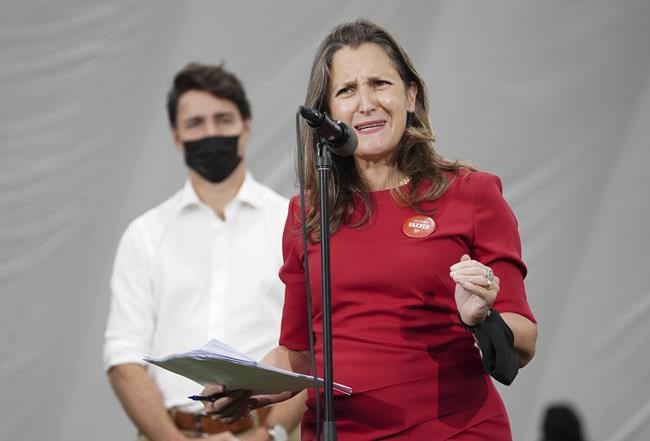
Speaking in Hamilton, Ont., Liberal Leader Justin Trudeau said there is still a need to help sectors that are further away from a full recovery, which is why his government wants to continue pumping out pandemic supports.
A short while later, Conservative Leader Erin O’Toole spoke broadly about his party’s plans to help businesses hire more workers, noting the targeted help he wants to provide to troubled sectors, much like Trudeau, and putting upward pressure on wages.
Meanwhile, NDP Leader Jagmeet Singh argued the merits of investing in social programs like pharmacare, dental care and mental health support to lead to more job creation, while speaking of pushing for good wages, in line with O’Toole.
The Liberal government’s April budget projected that federal pandemic supports would drive employment above pre-pandemic levels by August. Instead, the country was shy 156,000 jobs, although experts said the gap is wider, potentially closer to 500,000, once accounting for population growth.
The Liberals, Conservatives and New Democrats are offering some form of hiring credit for businesses to offset increased payroll costs as part of similar-sounding pledges to create one million jobs.
An analysis by two labour market experts on the Finances of the Nation website said the Liberal and NDP focus on businesses with persistent revenue losses, or being unable to open, may not get the uptake needed as a cloudy future dampens any expansion plans.
University of Waterloo economist Mikal Skuterud and labour economist Tammy Schirle from Wilfrid Laurier University also wrote the Conservative plan could create more jobs in the short-term because it was open to more businesses, but also could be more expensive because of the higher subsidies being offered.
In an interview, Skuterud said parties could focus subsidies on companies that hire people who have been out of work for six months or more, who now account for 27.4 per cent of all unemployed, to really help the labour market heal.
“That makes a lot of sense, since that’s where the big barrier is and where the potential benefits to getting these folks back to work will be biggest,” he said.
Canadian Labour Congress president Bea Bruske said whoever forms government needs a strategy to help the long-term unemployed, who are less likely to get hired the longer they are jobless, and face long-term earnings declines if they find new work.

Part of that strategy should be to create what she called quality jobs that are full-time, have benefits, are sustainable, and offer a living wage. Bruske said simply creating low-quality jobs may not get people back to work.
“Finding pathways back to employment has been a real challenge and the numbers really bear that out,” she said. “We really want to make sure that the parties are targeting the issues that are going to allow people to get back to work.”
Leah Nord with the Canadian Chamber of Commerce said whoever forms government after the Sept. 20 vote needs to focus on skills training to help create a more diverse workforce, and manage a skills mismatch that has created labour shortages in some sectors.
“Economic recovery was never going to happen overnight, but basking in the glow of business re-openings isn’t a strategy,” Nord said.
This report by The Canadian Press was first published Sept. 10, 2021.
Related Articles
Liberals win 4th mandate as NDP vote collapses and Singh announces he will resign













Advertisement Advertise With Us
Advertisement Advertise With Us