

Canadian military moves toward inclusivity, adds feminine versions of ranks in French
Advertisement
Read this article for free:
or
Already have an account? Log in here »
To continue reading, please subscribe:
Monthly Digital Subscription
$0 for the first 4 weeks*
- Enjoy unlimited reading on winnipegfreepress.com
- Read the E-Edition, our digital replica newspaper
- Access News Break, our award-winning app
- Play interactive puzzles
*No charge for 4 weeks then price increases to the regular rate of $19.00 plus GST every four weeks. Offer available to new and qualified returning subscribers only. Cancel any time.
Monthly Digital Subscription
$4.75/week*
- Enjoy unlimited reading on winnipegfreepress.com
- Read the E-Edition, our digital replica newspaper
- Access News Break, our award-winning app
- Play interactive puzzles
*Billed as $19 plus GST every four weeks. Cancel any time.
To continue reading, please subscribe:
Add Free Press access to your Brandon Sun subscription for only an additional
$1 for the first 4 weeks*
*Your next subscription payment will increase by $1.00 and you will be charged $16.99 plus GST for four weeks. After four weeks, your payment will increase to $23.99 plus GST every four weeks.
Read unlimited articles for free today:
or
Already have an account? Log in here »
Hey there, time traveller!
This article was published 08/02/2022 (1411 days ago), so information in it may no longer be current.
MONTREAL – When Josée Payeur joined the Canadian Armed Forces in 2001, the Quebec woman felt that people who occasionally used the unofficial feminine version of her rank when addressing her in French were trying to belittle her.
“It happened a couple of times in the past that somebody called me by the feminine version of my rank, and it felt like an insult,” Payeur said in an interview Monday.
“What I experienced the most as a woman in the military was to not be taken seriously. It’s always really subtle, micro-aggression … little jokes always close to being inappropriate.”
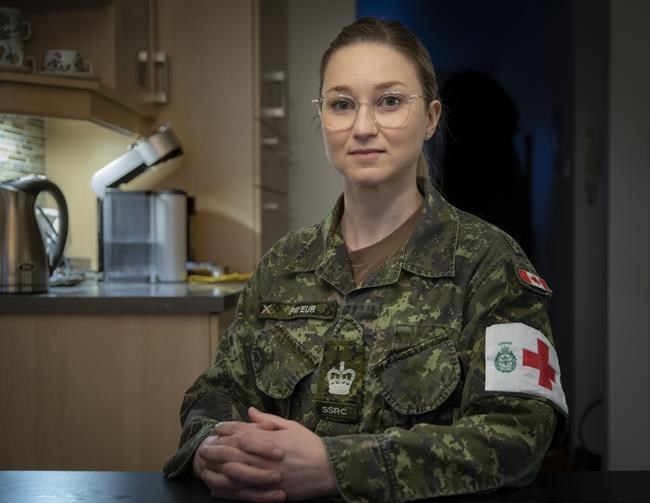
But as of last week, the French versions of all military ranks for the first time have official feminine equivalents, and Payeur, a warrant officer, said she couldn’t be prouder. Instead of being “un adjudant” in French, Payeur is now “une adjudante,” a subtle but significant difference.
Maj.-Gen. Lise Bourgon pushed for the change as acting chief of military personnel. She said the move away from exclusively masculine terminology is aimed at ensuring members have options and can be addressed in a way that reflects who they are.
“I’ve felt through my entire career that I didn’t always fit in,” said Bourgon, who’s been in the military for 34 years. “I had to use a masculine term to represent myself. That’s not who I am, not the gender that I’m comfortable with.”
Up until this month, inclusive ranks in French had not been implemented in the Canadian military, and all members could only be officially addressed by the masculine rank. The feminine equivalents take a feminine article and typically have a minor change at the end of the word, for example “colonelle” instead of “colonel” and “lieutenante” instead of “lieutenant.”
“Now, I can finally call myself la Majore-Générale,” Bourgon said in an interview Monday. “I wouldn’t say there was a tear in my eye, but almost!”
All ranks have been feminized in French by consulting the LGBTQ community, visible minorities and Indigenous leaders, “so that everyone was supportive of it,” Bourgon said, adding the option to feminize one’s rank will remain a personal decision.
The change comes as the Canadian Armed Forces look into becoming more diverse and inclusive. The Royal Canadian Navy dropped the term “seaman” when referring to its junior ranks in 2020 and replaced it with “sailor” to reflect a more gender-neutral work environment.
But there was still a need to modernize the ranks in French, Bourgon said, noting that in French pronouns, nouns, and adjectives reflect the gender of what they refer to.
“If you can’t use gender, then you are using a masculine term,” she said.
Payeur, who works for military health-care services in Montreal, said she initially wondered if the change would increase the stigma on women in the military.
“It’s already hard for us, because we sometimes get put on the side,” Payeur said. “The military is changing right now, and I’m so happy about it, but I fear it might put an emphasis on the fact that we are women. There’s still work to be done.”
Overall, though, she said she’s thrilled to see that inclusion and respect toward women have become priorities, which wasn’t always the case.
“It’s also part of my role, to be a model for other women who will join the army. I have to be proud of saying I’m a woman, and that I don’t have to be ashamed of being one in the army,” she said. “We need to celebrate it.”
This report by The Canadian Press was first published on Feb. 8, 2022.