

‘It’s not a police officer’: Portapique inquiry’s timeline shows how bloody night unfolded
Advertisement
Read this article for free:
or
Already have an account? Log in here »
To continue reading, please subscribe:

Digital Subscription
One year of digital access for only $205*
- Enjoy unlimited reading on winnipegfreepress.com
- Read the E-Edition, our digital replica newspaper
- Access News Break, our award-winning app
- Play interactive puzzles
*First annual payment billed as $205.00 + GST for one year. This annual subscription will automatically renew at $233.00 + GST every 52 weeks (10% off the regular annual price of $259.35). Offer available to new and qualified returning subscribers only. Cancel any time.
To continue reading, please subscribe:
Add Free Press access to your Brandon Sun subscription for only an additional
$1 for the first 4 weeks*
- Enjoy unlimited reading on winnipegfreepress.com
- Read the E-Edition, our digital replica newspaper
- Access News Break, our award-winning app
- Play interactive puzzles
*Your next Brandon Sun subscription payment will increase by $1.00 and you will be charged $17.95 plus GST for four weeks. After four weeks, your payment will increase to $24.95 plus GST every four weeks.
Read unlimited articles for free today:
or
Already have an account? Log in here »
Hey there, time traveller!
This article was published 28/02/2022 (1678 days ago), so information in it may no longer be current.
Warning: this story contains graphic material.
HALIFAX—It began with an anniversary, and then an assault.
And then, in a stretch of about 45 minutes on the night of April 18, 2020, 13 lives were lost — the start of the worst mass killing in Canadian history.
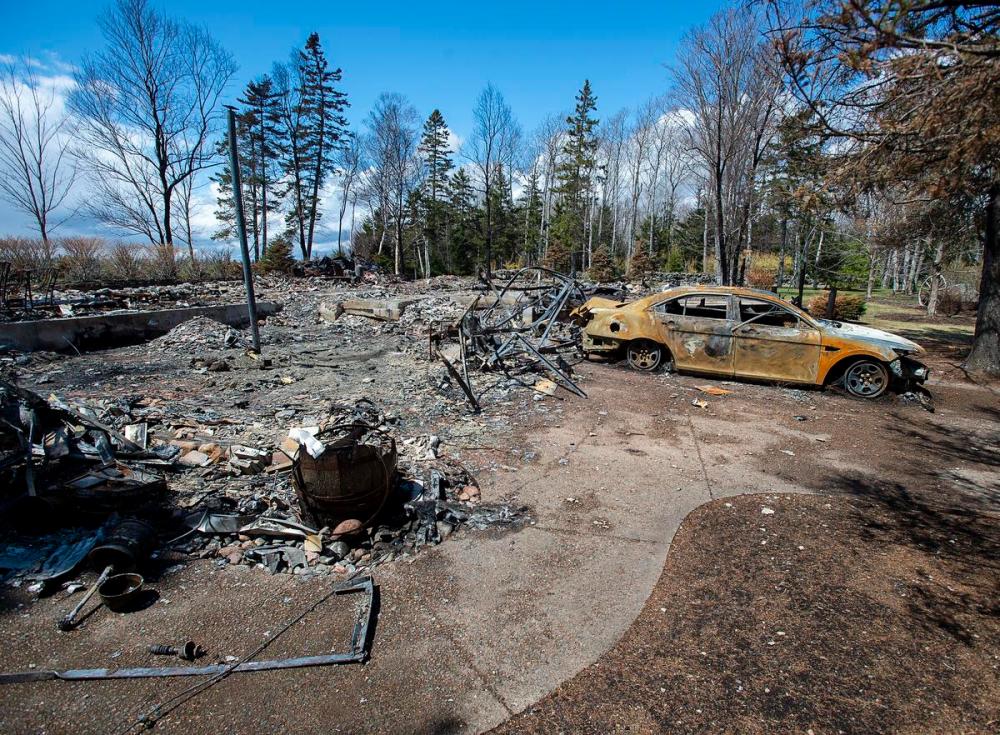
By the time it ended, 13 hours later, another nine lives would be taken in northern Nova Scotia before police gunned down the killer in a gas station nearly 100 kilometres away.
Police knew that night the killer was using a replica police car — one of the first victims warned officers before being killed in front of her children — yet it took 10 hours to warn the public.
On Monday, the third day of the Mass Casualty Commission (MCC) inquiry into the mass killing, commission counsel Roger Burrill laid out the results of the MCC investigation into the events that night in Portapique.
What follows is a timeline of those events, as near as can be reconstructed from witness testimony, 911 transcripts, forensic reports, police records and other evidence.
The picture that emerges is of a ruthless gunman, killing without hesitation, taking those 13 lives and then disappearing into the dark just as police begin to arrive. That last fact raises one of the most significant questions hanging over the inquiry.
By 10:30 p.m. on April 18, at least six police — three 911 operators and three RCMP officers — had been given, by at least four different people, the perpetrator’s name and the fact that he was driving a replica RCMP car. It wasn’t until 8 a.m. the next day that the Mounties shared that information with the public — and when they did, it was on the force’s Twitter feed, rather than the provincial emergency alert system.
Why?
That’s the question Nick Beaton would most like to have answered. He’s the widower of Kristen Beaton, and the father of the unborn child she was carrying when Gabriel Wortman shot and killed her in her car on April 19.
Beaton has repeatedly said that, had he known the gunman was driving a replica RCMP car, he would never have let his wife leave the house that Sunday.
That information might also have saved the life of Heather O’Brien; she and Beaton were both shot dead in their cars on Plains Road in Debert. It might also have saved Lillian Hyslop, who was gunned down on the side of Highway 4 in Wentworth during her daily walk.
Jamie Blair told a 911 operator about the car shortly before she was killed on April 18. Minutes later, her son told another 911 operator that the killer was in a police car. Andrew MacDonald, who was wounded by Wortman, told a 911 operator and at least two RCMP officers on the scene about the cop car. MacDonald’s wife gave the same detail to an RCMP sergeant over the phone.
Yet it was not until Lisa Banfield, the killer’s common-law wife, told police the same thing at some point after 6:30 the next morning that the wheels started to turn.
Before 10 p.m.
Wortman and Banfield are celebrating their 19th anniversary with drinks in the evening at his warehouse at 136 Orchard Beach Dr. in Portapique. The exact timing of the subsequent events is uncertain, but before 10 p.m., Wortman assaults Banfield, sets his home at 200 Portapique Beach Rd. on fire, then does the same to the warehouse.
Banfield, whom Wortman locked in the back of the replica RCMP car in the warehouse, manages to escape and runs into the woods surrounding the warehouse, where she will hide until the morning.
About 10:00 to 10:05 p.m.
Wortman goes to the house of the Blair family, across the street from and slightly north of his warehouse. There he shoots Greg Blair on his front deck.
Jamie Blair calls 911 at 10:01 and says that Greg has been shot, that the gunman was her neighbour Gabriel and that he’s driving a police car.
“My neighbour … I think he just shot my husband … he’s lying on the deck … there’s a police car in the f—ing driveway.
“There’s an RCMP … it’s decked and labelled RCMP … (inaudible) … but it’s not a police officer,” she says.
Still on the phone with 911, she hides her two children in her bedroom, out of sight between the bed and the wall, and barricades the door with her body.
The gunman enters the house, shoots the family’s cat and dog, then shoots Jamie Blair multiple times through the bedroom door. When she falls to the floor, he opens the door and shoots her again, fatally. He apparently does not see the children in their hiding place.
He leaves the house, but not before attempting to set it on fire — turning the gas on and pulling logs out of the fire onto the floor.
The children flee, running over to Lisa McCully’s house next door, where McCully’s children let them in. The children call 911 and will stay on the phone with the operator for the next two hours.
About 10:05 to 10:20 p.m.
The sequence of events is again uncertain here.
In this period the gunman kills Jolene Oliver, Aaron Tuck and Emily Tuck in one house, Peter and Joy Bond in another house 60 metres away, and Lisa McCully outside her home next to the Blairs’.
In the most plausible scenario, according to the MCC investigation, the gunman drives about 900 metres to Cobequid Court, at the southern foot of Orchard Beach Drive, and there kills the Tuck family and the Bond family, though in what order is unclear.
Peter Bond is shot in the doorway of his house; Joy Bond’s body was found in the living room. Their television was on.
Aaron Tuck’s body was also found in the doorway of his house. The bodies of Jolene Oliver and Emily Tuck were found just down the hallway. Their television was on, too.
It’s possible that the gunman killed McCully outside her house — across the road from the gunman’s now-blazing warehouse — before he drove down to Cobequid Court. However, based on data obtained from her cellphone, it’s more plausible that he encounters McCully between 10:13 p.m. and 10:15 p.m. after returning from the Cobequid Court killings and shoots her on the road in front of her house.
Inside the house, her children and the Blairs’ children are on the phone with 911, telling the operator that the gunman is their neighbour Gabriel and that he’s driving a replica police car.
The 911 operator asks the Blairs’ son to confirm that.
“Yes, it was,” he says. “Just like the, um, the — like a police car.”
Later the operator asks, “Did it have lights stuff on it, or?”
“Yeah and it — and it has the cop symbol on it, like, and he owns a cop car … He owns like seven Ford, like, white Ford cars. They’re all identical,” says the boy.
They tell 911 that McCully left the house and that she hasn’t come back.
About 10:20 to 10:28 p.m.
The gunman heads further north on Orchard Beach Drive, parks his car in the U-shaped driveway of Frank and Dawn Gulenchyn. It seems likely, based on available information, that he shoots them and then sets the house on fire. It burns to the ground.
Meanwhile, Andrew and Kate MacDonald are driving south on the same road, with Andrew in the driver’s seat. From their home further north on Portapique Beach Road, they have seen the glow of the warehouse fire, and are going to investigate.
As they pass the Gulenchyns’ house, they see the replica RCMP car in the driveway. Reaching the gunman’s blazing warehouse, Andrew calls 911 at 10:25 p.m. to report it.
As he talks to 911, Andrew turns the car around and heads north. As they again pass the Gulenchyns’ house, they can see flames inside. Andrew reports the second fire to 911 and tells the operator that there’s a police car in the Gulenchyns’ driveway.
The gunman, back in the replica car, spots the MacDonalds’ car and begins to drive toward them.
“He’s coming around,” says MacDonald to the 911 operator. “I don’t know if he’s going to talk to me or what.”
The police car pulls up alongside the MacDonalds, its front passenger door about two feet from Andrew’s driver-side door. He points a gun equipped with a laser sight through the window, and at 10:27 p.m. fires two shots; one hits Andrew in the shoulder, the other grazes his head.
“It’s our neighbour, Gabe. He just shot me in the arm!” he says to the operator.
MacDonald stomps on the gas and his car races north, with the gunman’s car in pursuit. Further up, where Orchard Beach intersects with Portapique Beach Road, MacDonald bears right, heading for Highway 2.
The gunman gives up pursuit, instead turning left on Portapique Beach Road.
“It’s not a cop. It’s not the cops,” Kate MacDonald tells the 911 operator. “It was somebody else.”
Before they reach the highway, the MacDonalds come across two Mountie constables who have just arrived on the scene, Stuart Beselt and Aaron Patton. Andrew knows Beselt personally, and stops to tell them what’s happened.
He tells both officers that he was shot by his neighbour Gabe, and that he is driving a replica police car.
Kate, meanwhile, has been transferred by 911 to the RCMP risk manager, Staff Sgt. Brian Rehill. She confirms the detail about the replica car and the shooter’s name.
About 10:28 to 10:39 p.m.
While the evidence is somewhat circumstantial, it appears plausible that the killer turns his replica RCMP car south down Portapique Beach Road, past his own burning house, to that of Joanne Thomas and John Zahl, which neighbours another piece of property Wortman owns.
At some point prior to 10:39 p.m. he shoots both of them and sets their house on fire.
The MCC investigations hypothesize that the gunman then drives on a trail through the woods between Portapique Beach Road and Orchard Beach Drive — they run parallel to each other at this point — emerging at the back of the property of his still-flaming warehouse.
Across the street, in the McCully house, the Blair and McCully children, still on the phone with 911, tell the operator at 10:39 p.m. there is a car emerging from the driveway of the warehouse.
They say they can hear talking and then … gunshots.
About 10:39 to 10:40 p.m.
Corrie Ellison has walked up the road from his father’s place, which he and his brother Clinton are visiting, to investigate the warehouse fire.
He encounters the gunman, who fires at him, first from the replica police car, then again at close range after exiting the car. In all he shoots Ellison five times. (A forensic investigation hypothesizes that Ellison might have been leaning into a vehicle when first shot.)
About 10:40 to 10:51 p.m.
With police arriving on the scene, the gunman leaves.
While the details are uncertain, investigators hypothesize that he turns south again down Orchard Beach Drive, toward Cobequid Court. There he turns left, heading east to where Cobequid Court intersects with a private dirt road which runs alongside a berry field.
Some time around 10:45 p.m., the Zimmerman family, whose house on Portapique Crescent overlooks that road, see headlights moving quickly, heading up what locals call “blueberry field road.”
Patricia Zimmerman tells police of “a set of lights, moving like a bat out of hell, zipping down a road that nobody ever really uses.”
The road gets near the highway, but terminates at Brown Loop, an unpaved 670-metre road that connects to Highway 2 at two points.
At this point, the only police checkpoint is at Portapique Beach Road further to the west.
The gunman likely uses Brown Loop to access the highway and drive east.
At 10:51 p.m. a surveillance camera at Wilsons Gas Stops in Great Village, nine kilometres away, seems to show an RCMP car travelling east on Highway 2, away from Portapique, with no lightbar or tail lights activated.
The gunman would spend the night in a parking lot in an industrial park in Debert.
On Tuesday — still summarizing the events of April 18 in Portapique — the MCC is scheduled to present the results of its investigation into the movements of first responders that evening.
Steve McKinley is a Halifax-based reporter for the Star. Follow him on Twitter: @smckinley1
Related Articles
First Mounties at mass shooting willing to testify
Advertisement Advertise With Us
Advertisement Advertise With Us