

Nova Scotia mass shooting inquiry: Here’s what been revealed so far — and what’s expected this week
Advertisement
Read this article for free:
or
Already have an account? Log in here »
To continue reading, please subscribe:

Digital Subscription
One year of digital access for only $205*
- Enjoy unlimited reading on winnipegfreepress.com
- Read the E-Edition, our digital replica newspaper
- Access News Break, our award-winning app
- Play interactive puzzles
*First annual payment billed as $205.00 + GST for one year. This annual subscription will automatically renew at $233.00 + GST every 52 weeks (10% off the regular annual price of $259.35). Offer available to new and qualified returning subscribers only. Cancel any time.
To continue reading, please subscribe:
Add Free Press access to your Brandon Sun subscription for only an additional
$1 for the first 4 weeks*
- Enjoy unlimited reading on winnipegfreepress.com
- Read the E-Edition, our digital replica newspaper
- Access News Break, our award-winning app
- Play interactive puzzles
*Your next Brandon Sun subscription payment will increase by $1.00 and you will be charged $17.95 plus GST for four weeks. After four weeks, your payment will increase to $24.95 plus GST every four weeks.
Read unlimited articles for free today:
or
Already have an account? Log in here »
Hey there, time traveller!
This article was published 27/03/2022 (1602 days ago), so information in it may no longer be current.
Nova Scotia’s public inquiry into Canada’s worst mass killing resumes Monday with what is expected to be some of its first significant testimony, from the first three RCMP officers to arrive on the scene of the shootings.
In 13 hours over April 18 and 19, 2020, Gabriel Wortman killed 22 people and torched multiple houses in northern Nova Scotia before himself being shot dead by police.
During the initial weeks of the hearing, the Mass Casualty Commission has heard its investigators’ projected timeline of the evening of April 18, based on interviews with witnesses, police statements, 911 transcripts, police records and other evidence. Their attention will this week turn to the second day of the rampage.
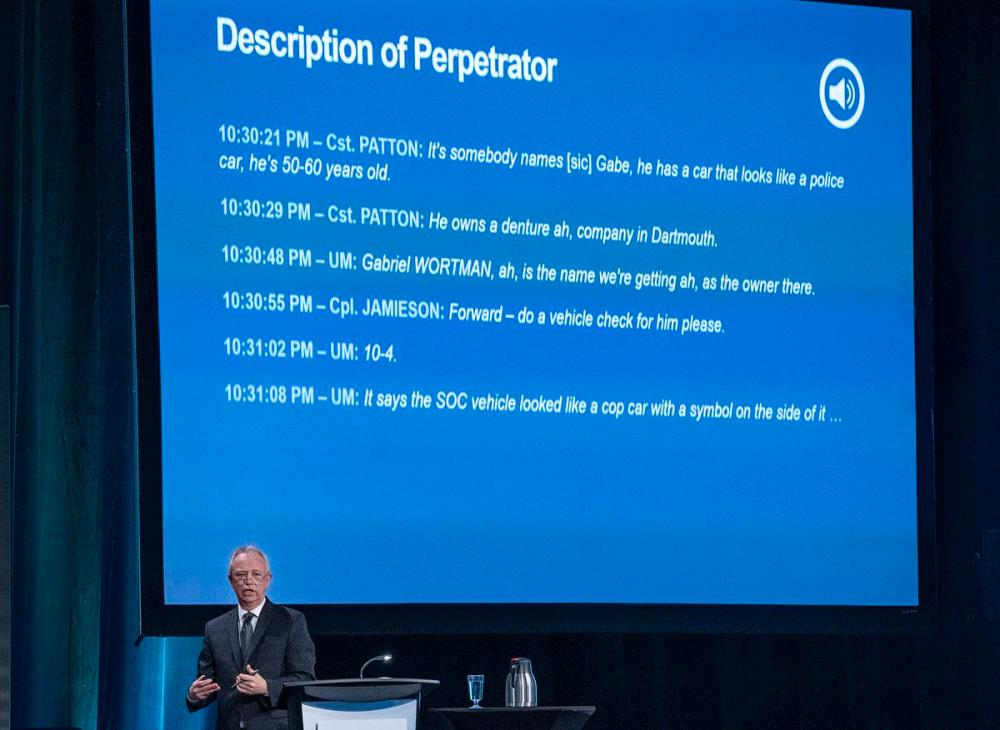
Here’s what we’ve heard so far — and what we expect to hear this week.
What the gunman did
The commission has heard that on April 18, 2020, Wortman, a 51-year-old denturist, began the day by celebrating a 19th anniversary with his common-law wife, Lisa Banfield. Later that evening, drinks in his warehouse and a video chat with friends in Maine spiralled into an argument that culminated in the gunman setting his house and warehouse on fire and imprisoning Banfield in the back of his replica police car.
Banfield, according to her police statement, managed to escape the car and hid in the woods surrounding the property until the next morning. The gunman, meanwhile, dressed in a Mountie uniform, took the replica car and began, in methodical fashion, to kill people.
On the other side of Orchard Beach Drive, he drove up to the Blair house, and shot Greg Blair on his front deck. Inside, Blair’s wife Jamie called 911, and told them that her husband had been shot, that the shooter was their neighbour, Gabriel, and that he was driving a police car.
She barricaded herself and her two children inside the master bedroom, hiding the children between the bed and the wall. While she was still on the phone with 911, the gunman entered the house, shot the family’s cat and dog, then shot Jamie Blair through the bedroom door. When she fell to the floor, he opened the door and shot her again.
He then left after attempting to set the house on fire.
What happened next is not entirely clear.
Either the gunman killed Lisa McCully on her front lawn next door to the Blair house, then proceeded south to Cobequid Court, where he killed Aaron Tuck, Emily Tuck and Jolene Oliver in one house, and Peter and Joy Bond in another, or he did things in the opposite order, travelling 800 metres south to Cobequid Court first, then returning to kill McCully.
The commission investigation favours the latter timeline.
From there, Wortman travelled north, killing Frank and Dawn Gulenchyn and burning their house, then shooting and wounding Andrew MacDonald in the road after pulling the replica police car up beside MacDonald’s.
MacDonald, who had driven to check out the flaming warehouse before returning past the Gulenchyns’ house, was on the phone to 911 at the time, and told the operator there was a police car pulling alongside.
After being shot through the shoulder, MacDonald stomped on the gas and sped his car north up to the highway, with the gunman in pursuit.
At the intersection of Orchard Beach Drive and Portapique Beach Road, MacDonald turned right, heading north up to the highway. There he would encounter Const. Stuart Beselt, the first RCMP officer to arrive on the scene that night.
The killer turned south on Portapique Beach Road, heading down toward where his home was burning.
Further south from there was the home of Joanne Thomas and John Zahl, whose house neighboured another property the gunman owned.
The evidence for what happened there and when is somewhat circumstantial, but the commission investigation hypothesizes that sometime before 10:39 p.m., the gunman killed both Thomas and Zahl, set their house on fire, and drove on a trail through the woods that took him to the back of his property on Orchard Beach Drive, where his warehouse was still burning.
There he killed Corey Ellison, who had walked up the road to investigate the fire. Ellison was his last victim of the night; after that, according to the commission timeline, the killer again went south to Cobequid Court, this time turning left to access a dirt road that headed toward Hwy. 2.
A surveillance video from a gas station in Great Village captured what appears to be a police car heading away from Portapique at 10:51 p.m., leading the commission to conclude that the killer must have left Portapique around 10:45 p.m.
What the police did
Beselt was the first RCMP officer to arrive on scene in Portapique in response to the 911 call from Jamie Blair.
Close behind him were Const. Aaron Patton and Const. Adam Merchant. Beselt, an acting corporal, took charge. His conversation with MacDonald convinced him that this was a situation requiring Immediate Action Rapid Deployment (IARD) — a proactive set of tactics whereby police in an active-shooter situation seek to hunt and engage the suspect.
Beselt, Patton and Merchant geared up, and with carbines drawn, headed down Portapique Beach Road in the dark on foot. As they approached the gunman’s burning house, they heard shots to the east — the gunman killing Ellison.
The men plunged into the woods, emerging in back of Wortman’s property where the warehouse still burned. On the road in front of his warehouse, they found Ellison’s body — the first they would find that night.
Across the street, the Blair children had fled to Lisa McCully’s house next door, where they called 911.
The IARD team checked in on the children, told them to hide in the basement. Back outside, they spotted a flashlight across the street, moving in the dark. Thinking it was the gunman, all three men dropped to their bellies in the grass, pointing their guns toward the light.
In reality, the flashlight belonged to Clinton Ellison, who had just discovered his brother’s body, and who, thinking that the flashlight across the street might be the gunman, extinguished his own, and ran into the woods to hide.
The IARD team checked back in on the children, told them to lock themselves in the basement, and gave them a password by which they’d be able to identify police, before heading north up the road to check out what they thought were gunshots.
In short order, the officers found themselves heading south again on Portapique Beach Road, past the killer’s burning house, knocking on doors and telling residents to evacuate.
At the bottom of the road, they saw the home of Thomas and Zahl, now fully engulfed in flames.
Over the radio, a decision was made to evacuate the children from the McCully house.
Const. Chris Grund and Const. Bill Neil entered Portapique on foot — the first police officers to enter the scene other than the IARD team — and made their way to the McCully house.
At 12:25 a.m. — a little over two hours and 20 minutes after the initial 911 call — Grund drove the children out of Portapique and to a hospital in the family car; Neil remained behind at the house. At 12:45 a.m., the IARD team joined him there, and all four men remained there until they were evacuated by an Emergency Response Team almost two hours later.
What happens next at the inquiry
On Monday, the Mass Casualty Commission resumes its inquiry, with Beselt, Merchant and Patton testifying under oath. Somewhat unusually, for witnesses of such import, they will be testifying together, as a panel.
More unusually, the commission has asked that lawyers representing the families of victims and others submit any questions they have to the commission, to be asked of the witnesses by commission counsel.
That’s not going over well with the participating lawyers.
“I think we’ve been heard on the idea that we’re pretty staunchly against the idea of the commission counsel specifically asking questions on our behalf,” said Michael Scott, a lawyer representing many of the families of victims in a lawsuit against the RCMP. “That doesn’t seem practical and it’s entirely unnecessary. It serves absolutely no purpose.”
After the commission questions the three officers, Scott and other participant lawyers will again petition the commission to give them the opportunity to do the same.
“It’s absolutely horrible optics, in the sense that one of the primary functions of this commission is to address concerns that people have in these institutions,” said Scott. “And it really sends a horrible message when you’re saying the participants who were given full standing, who are here to inquire into the facts, are not allowed to ask questions.”
If and when they do, many of the big questions to which they want answers will have to do with the decision-making process of the initial three officers and their supervisors.
Why was an IARD team decided upon rather than setting up containment, which might have prevented the gunman from escaping the scene? Why were other officers ordered not to enter Portapique?
Why did IARD team head down Portapique Beach Road toward the gunman’s house, rather than to the Blairs’ house, which was the source of the initial 911 call? In fact, in the commission’s account of the events of April 18, it appears that the officers never went to the Blair house that first night.
“I expect there will be a lot of questions about their ability to communicate and how they were receiving orders,” said Scott. “There’s some lack of clarity about, who was in charge. Beselt is in charge on the ground, but who is he taking direction from, because it appears like he’s taking direction from several people, which makes the chain of command there a bit unclear.”
After the questioning of the officers, the commission moves on Wednesday to begin the examination of the events of April 19, the second day of the mass killings.
Steve McKinley is a Halifax-based reporter for the Star. Follow him on Twitter: @smckinley1
Related Articles
N.S. mass shooting inquiry hears RCMP testimony
Advertisement Advertise With Us
Advertisement Advertise With Us