

Rift over money breaks up talks on health care; premiers blamed
Advertisement
Read this article for free:
or
Already have an account? Log in here »
To continue reading, please subscribe:

Digital Subscription
One year of digital access for only $205*
- Enjoy unlimited reading on winnipegfreepress.com
- Read the E-Edition, our digital replica newspaper
- Access News Break, our award-winning app
- Play interactive puzzles
*First annual payment billed as $205.00 + GST for one year. This annual subscription will automatically renew at $233.00 + GST every 52 weeks (10% off the regular annual price of $259.35). Offer available to new and qualified returning subscribers only. Cancel any time.
To continue reading, please subscribe:
Add Free Press access to your Brandon Sun subscription for only an additional
$1 for the first 4 weeks*
- Enjoy unlimited reading on winnipegfreepress.com
- Read the E-Edition, our digital replica newspaper
- Access News Break, our award-winning app
- Play interactive puzzles
*Your next Brandon Sun subscription payment will increase by $1.00 and you will be charged $17.95 plus GST for four weeks. After four weeks, your payment will increase to $24.95 plus GST every four weeks.
Read unlimited articles for free today:
or
Already have an account? Log in here »
Hey there, time traveller!
This article was published 08/11/2022 (1433 days ago), so information in it may no longer be current.
VANCOUVER — Ministers who gathered for meetings to address the national health crisis left Tuesday without assurances of more funding from their federal counterpart, who blamed premiers for giving them “marching orders” to stop negotiating.
British Columbia Health Minister Adrian Dix, who co-chaired the second day of the gatherings Tuesday with federal minister Jean-Yves Duclos, said the federal government withdrew from a joint statement on the talks and pulled out of a joint news conference.
Duclos referred to a statement issued earlier Tuesday by the Council of the Federation, the group representing all premiers, before talks wrapped up.
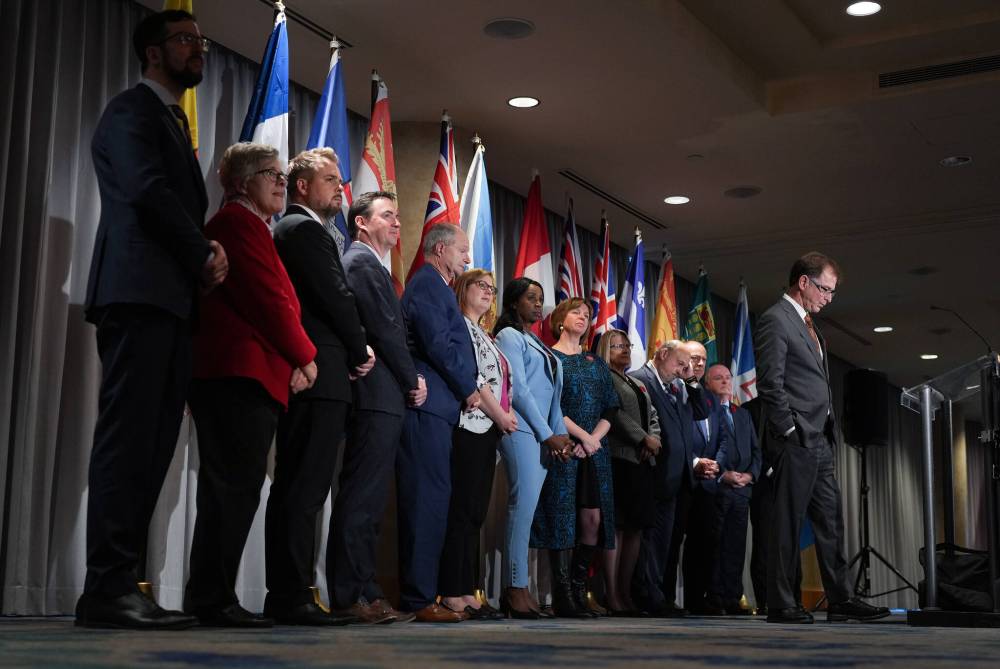
B.C. Health Minister Adrian Dix (front right) is flanked by his provincial counterparts during a news conference without federal Health Minister Jean-Yves Duclos. (Darryl Dyck / The Canadian Press)
In the statement, the premiers said they were disappointed with the lack of a federal response to the request from provinces and territories to get 35 per cent of health costs covered by Ottawa, up from 22 per cent.
However, Duclos declined to say at a separate news conference whether he came to the table with more cash, adding only that premiers did not want health ministers to accept any conditions, like providing data on the health-care workforce.
“Unfortunately, despite (Monday’s) gesture of good faith, provincial and territorial colleagues, our colleagues, have received marching orders by their premiers not to make further progress,” Duclos said.
“As a result, the premiers are preventing all of us health ministers from taking concrete and tangible steps that would make an immediate difference in the daily lives of health workers and patients.
“Obviously, this is disappointing.”
Instead of allowing health ministers to engage in meaningful discussions, premiers were “forcing” them to focus only on money, Duclos said.
“We need to work together so that patients everywhere in Canada can get the care they need, when they need it and where they need it. These are fundamental priorities that we all agreed upon. Why in the world won’t premiers let us health ministers work on these priorities?”
The premiers reiterated their call on Prime Minister Justin Trudeau to meet with them. Dix has said a national conference on the Canada Health Transfer, the federal money doled out to all jurisdictions, is needed.
Duclos said he told health ministers the federal government would provide targeted funding for priorities they have expressed for many months.
“We’ve had a total of 11 virtual meetings over the last year, plus this one in person,” he said. “But we need to be all together and express commonly those priorities and then move to the next step, which is going to be to determine the type of funding and the agenda that we want to work collaboratively on.”
Dix said the meetings came to a “disappointing” end and that the provincial and territorial ministers could not move forward on the basis of what he called “small sound bites from the prime minister.”
“Fair enough, they didn’t like that the premiers reiterated their position on the Canada Health Transfer. That’s entirely fair of the federal government to do in their expression. But I think it’s disappointing. I’m not sure it sends the best message,” he said.
“We need the federal government to increase its role and support for public health care and not, as has been happening for too long, diminish that role.”
The federal government has made individual funding in the past.
In August 2017, provinces and territories signed an agreement to improve access to home care as well as mental health and addiction services. Quebec signed a different agreement distinct from those priorities. The tailor-made deals involved $11 billion in per capita funding over 10 years.
Haizhen Mou, a professor of public policy at the University of Saskatchewan, said those agreements suggest Ottawa could further tie cash to other areas in health care, including improved conditions for a burnt-out workforce and measures like streamlining the hiring of internationally trained doctors and nurses.
“The federal government could do a lot if they regard this health workforce problem as their national priority,” she said.
While health care is the responsibility of provinces, Mou said they would do well to provide accountability for how they spend money.
“It’s not a funding or the share-of-contribution issue. It’s an accountability and efficiency issue,” she said.
The Canadian Federation of Nurses Unions and the Canadian Nurses Association said the lack of results, along with “finger-pointing,” is not what they expected from the meetings.
“Nurses from across Canada are burnt out and under severe stress, while facing unprecedented pressures that have pushed them past the breaking point,” the two groups said
They will request a meeting with Manitoba Premier Heather Stefanson, chair of the federation, to discuss the critical measures needed to support nurses and the health-care system.
— The Canadian Press
History
Updated on Wednesday, November 9, 2022 7:29 AM CST: Fixes headline