

Northwest Territories releases strategy to address homelessness
Advertisement
Read this article for free:
or
Already have an account? Log in here »
To continue reading, please subscribe:
Digital Subscription
One year of digital access for only $1.44 a week*
- Enjoy unlimited reading on winnipegfreepress.com
- Read the E-Edition, our digital replica newspaper
- Access News Break, our award-winning app
- Play interactive puzzles
*Billed as $5.77 plus GST every four weeks. After 52 weeks, price increases to the regular rate of $19.95 plus GST every four weeks. Offer available to new and qualified returning subscribers only. Cancel any time.
To continue reading, please subscribe:
Add Free Press access to your Brandon Sun subscription for only an additional
$1 for the first 4 weeks*
- Enjoy unlimited reading on winnipegfreepress.com
- Read the E-Edition, our digital replica newspaper
- Access News Break, our award-winning app
- Play interactive puzzles
*Your next Brandon Sun subscription payment will increase by $1.00 and you will be charged $17.95 plus GST for four weeks. After four weeks, your payment will increase to $24.95 plus GST every four weeks.
Read unlimited articles for free today:
or
Already have an account? Log in here »
Hey there, time traveller!
This article was published 31/05/2023 (1099 days ago), so information in it may no longer be current.
YELLOWKNIFE – The premier of the Northwest Territories says a whole-of-government approach is needed to adequately address homelessness in the territory.
Caroline Cochrane tabled a long-awaited plan Wednesday to support people experiencing homelessness and prevent others from becoming homeless.
“The problem is that — and we found that before even we dealt with homelessness — we all work in silos,” Cochrane told reporters.
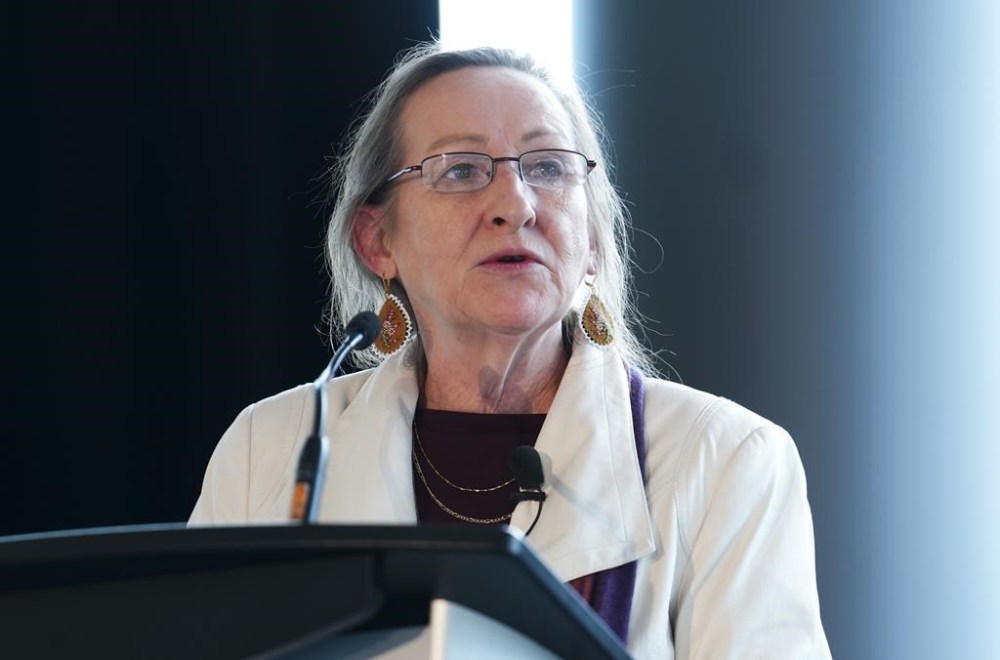
She said the first step will be to create a unit dedicated to addressing homelessness within the Department of Executive and Indigenous Affairs. She said that would help to co-ordinate work being done by several departments.
The plan details a number of goals and solutions. It focuses on working with community partners, improving access to services and increasing housing options, along with improving data collection, analysis and sharing.
The strategy aims to reduce homelessness to a level that can be effectively managed or “functional zero” in all communities. It also includes expanding integrated service delivery with a person-centred approach, training for front-line service workers, targeted programming for groups, including people transitioning from correctional centres, and reducing stigma.
Cochrane said she would like to see homeless shelters established in every region. Currently, there are only shelters in Yellowknife, Inuvik and Hay River, while other housing supports are available in several communities.
“People do better when they’re around their friends and their family,” Cochrane said. “When they want to change and get healthier and there’s no support there except for their friendship network, we’re setting them up to fail.”
The premier said she understands the challenges facing both people experiencing homelessness and front-line workers. She said she was a “street kid” sleeping on people’s couches at the age of 13 and worked as a social worker for 20 years before entering politics.
“It’s about making people understand that homeless people are people, they’re our sisters, our brothers, our uncles, our cousins, our friends,” she said of the government plan. “We need to change the public perception so that people understand that these people are people, and they’re going through a lot of pain but they still are loved.”
The previous territorial government first announced intentions to develop a homelessness strategy in September 2018. Tabling of the final document comes just months before the current government will sit for the last time ahead of the territorial election in October.
When asked in the legislature Wednesday why it took so long, Cochrane said it required the work of multiple departments waylaid by the COVID-19 pandemic.
She told reporters the dedicated homelessness unit will be created before the election.
“I’m going to need residents and (non-governmental organizations), Indigenous governments, community people to actually hold us to account in the next assembly,” she said.
Data on the number of people experiencing homelessness across the territory is limited.
A 2021 point-in-time homeless count found 312 people were experiencing homelessness in Yellowknife, more than half of whom were chronically homeless. Indigenous people accounted for nearly 92 per cent of those experiencing homelessness compared to 23 per cent of the city’s total population.
The 2021 census states that 13.2 per cent of households across the territory were in core housing need, meaning their housing did not meet at least one standard of adequacy, affordability or suitability.
Robert Tordiff, assistant deputy minister for the Department of Executive and Indigenous Affairs, said data collection will be critical for evolving programs and services going forward.
Cochrane added it will also be important for tracking progress.
This report by The Canadian Press was first published May 31, 2023.
This story was produced with the financial assistance of the Meta and Canadian Press News Fellowship.