

Wildfire forecast anticipates high risk for new wildfires in Prairies, N.W.T.
Advertisement
Read this article for free:
or
Already have an account? Log in here »
To continue reading, please subscribe:

Digital Subscription
One year of digital access for only $205*
- Enjoy unlimited reading on winnipegfreepress.com
- Read the E-Edition, our digital replica newspaper
- Access News Break, our award-winning app
- Play interactive puzzles
*First annual payment billed as $205.00 + GST for one year. This annual subscription will automatically renew at $233.00 + GST every 52 weeks (10% off the regular annual price of $259.35). Offer available to new and qualified returning subscribers only. Cancel any time.
To continue reading, please subscribe:
Add Free Press access to your Brandon Sun subscription for only an additional
$1 for the first 4 weeks*
- Enjoy unlimited reading on winnipegfreepress.com
- Read the E-Edition, our digital replica newspaper
- Access News Break, our award-winning app
- Play interactive puzzles
*Your next Brandon Sun subscription payment will increase by $1.00 and you will be charged $17.95 plus GST for four weeks. After four weeks, your payment will increase to $24.95 plus GST every four weeks.
Read unlimited articles for free today:
or
Already have an account? Log in here »
Hey there, time traveller!
This article was published 12/06/2024 (838 days ago), so information in it may no longer be current.
OTTAWA – While the wildfire season has been less dire so far this year than 2023, hot, dry weather means conditions are ripe for an above average fire season across most of Canada, the national fire forecast said Wednesday.
The Canadian Interagency Forest Fire Centre says there were 120 active fires burning on Tuesday, including 46 that were out of control.
As of this week, more than 1,480 fires have burned about 5,200 square kilometres, an area almost as large as all of Prince Edward Island. Almost two-thirds of the burned area is in British Columbia.
Comparatively, fire activity in 2024 is a fraction of what happened during the worst fire season on record last year. By this time in 2023, nearly 2,500 fires had burned more than 46,000 square kilometres of land. Alberta and Quebec accounted for almost half the fire activity in May and June 2023.
The total area burned is also below the 10-year average of 7,700 square kilometres but above the 25-year average of 4,650 square kilometres.
Natural Resources Minister Jonathan Wilkinson said the risk is still high for things to get worse this summer.
“The planet is burning up and climate change is indeed a significant factor,” Wilkinson said at a news conference.
Globally there have been 12 straight months with record-breaking average temperatures, and Environment Canada reported that this year just smashed records for the warmest winter this country has ever seen. And 2023 was the second-warmest year on record in Canada, with a national average temperature 2.8 C above average.
Wilkinson said this summer’s forecast is calling for higher than average temperatures almost everywhere and lower than average rainfall in multiple places.
One of the maps provided with the forecast is almost jaw-dropping: a deep red shade that predicts a nearly 100 per cent likelihood of above-average temperatures is painted across all of Atlantic Canada and Quebec, most of Ontario and large swaths of Manitoba and Nunavut.
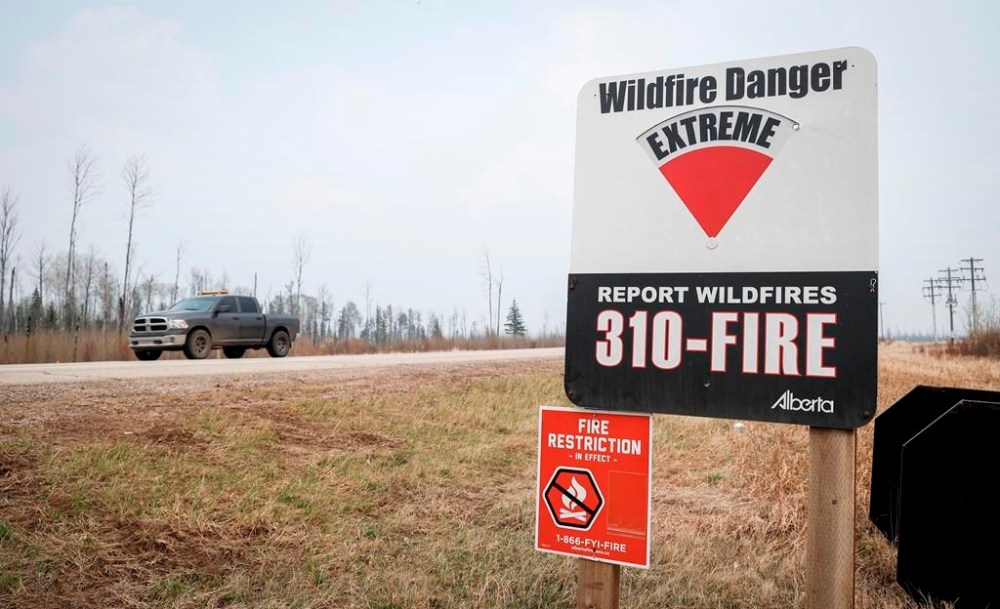
The forecast said the risk of fires in June is extreme or very high in southern and northeastern B.C., northern Alberta, southern Saskatchewan, a small pocket of northern Manitoba and most of Northwest Territories.
While the risk is lower in Ontario and Quebec, there is still a likelihood for more fires than usual in both provinces.
In July the risk of fire is well above average in all of the Prairies, southern Nunavut and almost all of Northwest Territories.
This report by The Canadian Press was first published June 12, 2024.