

Federal government extends ban on senior Iranian officials back to 2003
Advertisement
Read this article for free:
or
Already have an account? Log in here »
To continue reading, please subscribe:

Digital Subscription
One year of digital access for only $205*
- Enjoy unlimited reading on winnipegfreepress.com
- Read the E-Edition, our digital replica newspaper
- Access News Break, our award-winning app
- Play interactive puzzles
*First annual payment billed as $205.00 + GST for one year. This annual subscription will automatically renew at $233.00 + GST every 52 weeks (10% off the regular annual price of $259.35). Offer available to new and qualified returning subscribers only. Cancel any time.
To continue reading, please subscribe:
Add Free Press access to your Brandon Sun subscription for only an additional
$1 for the first 4 weeks*
- Enjoy unlimited reading on winnipegfreepress.com
- Read the E-Edition, our digital replica newspaper
- Access News Break, our award-winning app
- Play interactive puzzles
*Your next Brandon Sun subscription payment will increase by $1.00 and you will be charged $17.95 plus GST for four weeks. After four weeks, your payment will increase to $24.95 plus GST every four weeks.
Read unlimited articles for free today:
or
Already have an account? Log in here »
Hey there, time traveller!
This article was published 15/09/2024 (687 days ago), so information in it may no longer be current.
OTTAWA – The federal government is expanding a measure that bans tens of thousands of Iranian officials from entering Canada as part of an effort to hold the regime accountable for human-rights violations.
On Sunday, Public Safety Minister Dominic LeBlanc announced that any senior official who served in the Iranian government at any time since June 23, 2003 is now inadmissible to Canada. The decision extends a previous ban, announced in November 2022, that denied entry to those in the top echelons of the Iranian regime dating back to 2019.
“We are sending a strong message that those involved in terrorism, human rights violations and atrocities are not welcome here,” LeBlanc said in a statement. “Canada will always stand up for human rights and fight for justice, at home and around the world.”
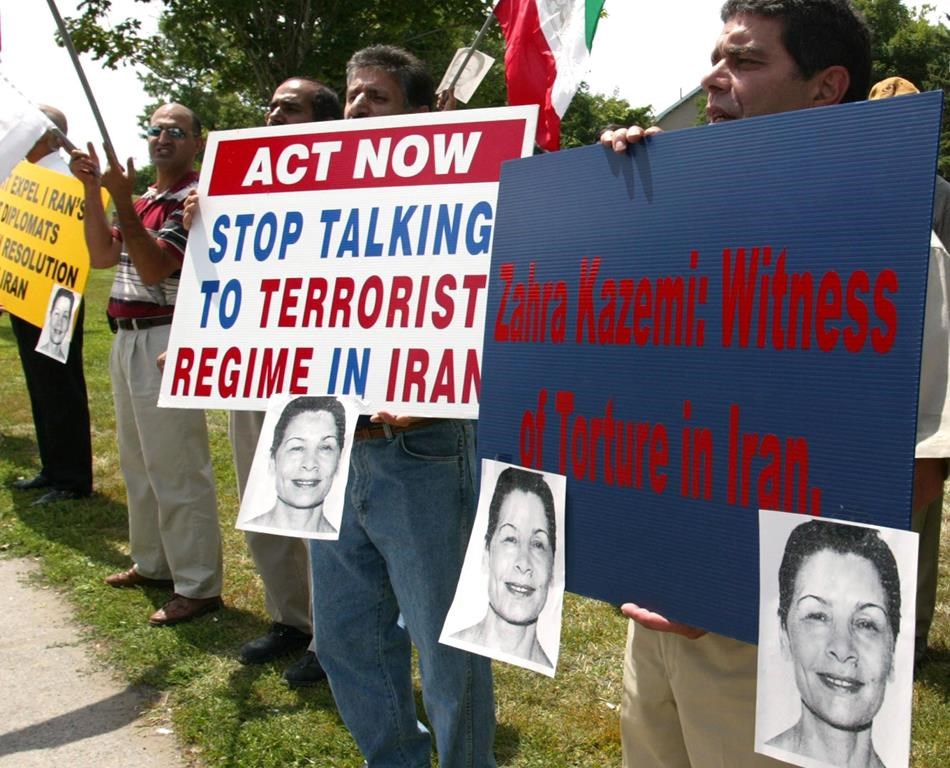
Demonstrators protest against Iran outside the Department of Foreign Affairs in Ottawa, Monday July 26, 2004. THE CANADIAN PRESS/Fred Chartrand
The new cutoff date for admissibility reflects the day on which Iranian-Canadian photojournalist Zahra Kazemi was arrested in Tehran. She died in hospital almost three weeks later, in July 2003, after being tortured and raped.
The move comes on the eve of the second anniversary of the death of 22-year-old Mahsa Amini, who died in hospital on Sept. 16, 2022 after being arrested by Iran’s morality police for allegedly wearing her hijab improperly. Her death sparked global protests.
The announcement was met with praise from Kourosh Doustshenas, spokesperson for the Association of Families of Flight PS752 Victims. The Ukraine International Airlines flight was shot down over Tehran in January 2020 by the Islamic Revolutionary Guard Corps (IRGC), a branch of the Iranian armed forces. All 176 people aboard the flight were killed, including 55 Canadian citizens and 30 permanent residents.
“Justice for Zahra Kazemi and so many others is long overdue,” Doustshenas said in a statement on social media. “This amendment is a crucial message that Canada will not be a safe haven for human rights violators. It’s a step toward accountability and justice for victims of the Iranian regime’s atrocities, including those affected by Flight PS752.”
Ottawa first labelled the Iranian government as “a regime that has engaged in terrorism and systematic and gross human rights violations” under the Immigration and Refugee Protection Act in November 2022, shortly after Amini’s death. The measure denied entry to senior officials who’d served in the government since Nov. 15, 2019. That date marked the start of nationwide protests that prompted a violent government crackdown. At the time, Reuters reported 1,500 people were killed during less than two weeks of unrest.
The designation means that current and former officials present in Canada can also lose their temporary or permanent resident status and can be removed from the country.
According to the Canada Border Services Agency, 82 visas had been cancelled as of Aug. 26, and 15 people have been reported inadmissible by the agency. Of those 15, two have been found inadmissible and were issued deportation orders following hearings at the Immigration and Refugee Board, and one person has been removed from Canada.
The tribunal ordered the deportation earlier this year of Seyed Salman Samani, Iran’s former deputy interior minister, and Majid Iranmanesh, a former director general in the regime.
The agency did not immediately respond to questions about how many more officials might now be targeted by the expanded measure.
Critics have accused Canada of providing safe haven for top-ranking Iranian officials, including after Morteza Talaei, who served as Tehran’s police chief when Kazemi was tortured in 2003, was photographed at a Toronto-area gym in 2021.
In a statement posted on social media Sunday, the Centre for Israel and Jewish Affairs called the government’s latest move “a positive step.”
“Iran’s terror extends beyond its support for violence abroad,” the group said. “The regime’s violence includes the oppression of its own people, especially women.”
In June, the Canadian government listed the IRGC as a terrorist organization under the Criminal Code, following years of pressure from Iranian Canadians and opposition parties.
This report by The Canadian Press was first published Sept. 15, 2024.
— By Maura Forrest in Montreal