

Quebec bill aims to stop people from sharing intimate images without consent
Advertisement
Read this article for free:
or
Already have an account? Log in here »
To continue reading, please subscribe:
Monthly Digital Subscription
$0 for the first 4 weeks*
- Enjoy unlimited reading on winnipegfreepress.com
- Read the E-Edition, our digital replica newspaper
- Access News Break, our award-winning app
- Play interactive puzzles
*No charge for 4 weeks then price increases to the regular rate of $19.00 plus GST every four weeks. Offer available to new and qualified returning subscribers only. Cancel any time.
Monthly Digital Subscription
$4.75/week*
- Enjoy unlimited reading on winnipegfreepress.com
- Read the E-Edition, our digital replica newspaper
- Access News Break, our award-winning app
- Play interactive puzzles
*Billed as $19 plus GST every four weeks. Cancel any time.
To continue reading, please subscribe:
Add Free Press access to your Brandon Sun subscription for only an additional
$1 for the first 4 weeks*
*Your next subscription payment will increase by $1.00 and you will be charged $16.99 plus GST for four weeks. After four weeks, your payment will increase to $23.99 plus GST every four weeks.
Read unlimited articles for free today:
or
Already have an account? Log in here »
Hey there, time traveller!
This article was published 03/10/2024 (431 days ago), so information in it may no longer be current.
QUEBEC – The Quebec government tabled a bill on Thursday that aims to give victims a simpler and faster way to stop intimate photos and videos of them from being shared without their consent.
“Sharing intimate images without consent is a scourge,” Quebec Justice Minister Simon Jolin-Barrette told reporters at the legislature after introducing the legislation. “All it takes is one text message to break a person, to break their self-esteem, to break their sense of security, to break their trust in others.”
The bill would allow people to fill out a form online or at a courthouse and quickly obtain an order from a Quebec judge. Offenders can be ordered to stop sharing the image or footage, have it destroyed, or de-index a hyperlink to the image or video. Jolin-Barrette said it should take hours or a few days for an application to be processed and an order to enter into force.
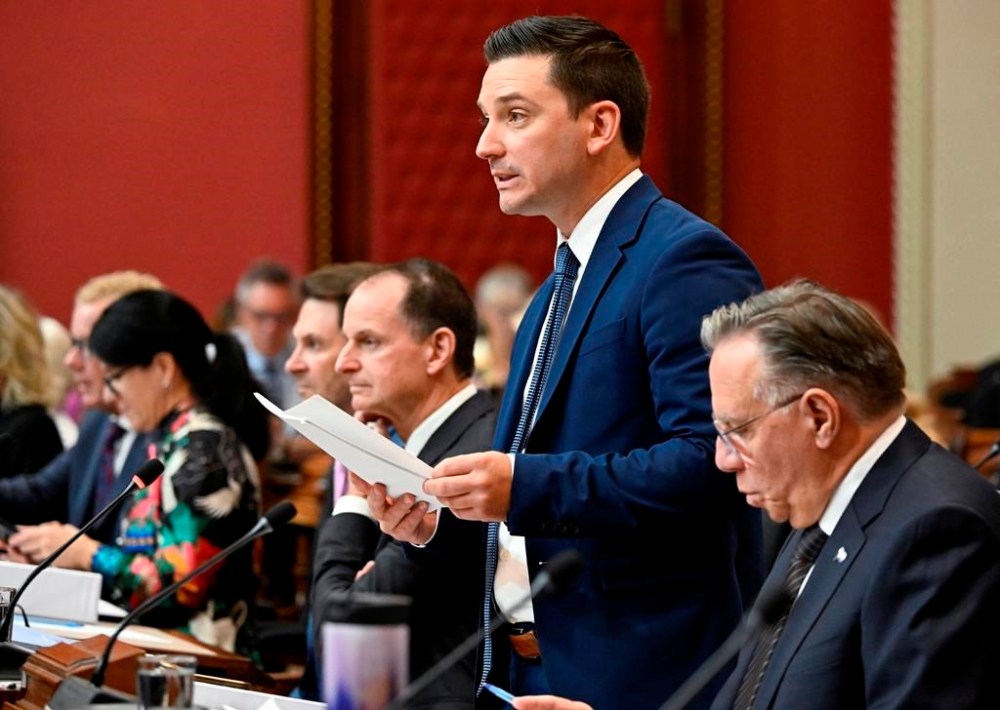
“We fill in the form. The judge receives it and processes the request as an urgent matter,” he said. “In this kind of situation, it’s a race against time. The longer it takes to destroy the image, the more likely it is to circulate, and the more devastating the consequences can be.”
Failure to comply comes with stiff penalties — with fines up to $5,000 to $50,000 per day. Those amounts are doubled for subsequent offences. A person may also be jailed for a maximum of 18 months.
“Any visual or sound recording or live broadcast is considered an image for the purposes of this act,” the bill reads, outlining that it covers content that is published, sold, communicated or advertised.
The bill also covers pornography websites on which videos are uploaded involving people who have not consented to being filmed.
If a person represented in an image is deceased, a close relative may file the application for a court order. People aged 14 or older can file the applications themselves or give their consent to another person to file on their behalf.
This report by The Canadian Press was first published Oct. 3, 2024.