

Skywatchers treated to a northern lights extravaganza from coastal B.C. to Germany
Advertisement
Read this article for free:
or
Already have an account? Log in here »
To continue reading, please subscribe:

Digital Subscription
One year of digital access for only $205*
- Enjoy unlimited reading on winnipegfreepress.com
- Read the E-Edition, our digital replica newspaper
- Access News Break, our award-winning app
- Play interactive puzzles
*First annual payment billed as $205.00 + GST for one year. This annual subscription will automatically renew at $233.00 + GST every 52 weeks (10% off the regular annual price of $259.35). Offer available to new and qualified returning subscribers only. Cancel any time.
To continue reading, please subscribe:
Add Free Press access to your Brandon Sun subscription for only an additional
$1 for the first 4 weeks*
- Enjoy unlimited reading on winnipegfreepress.com
- Read the E-Edition, our digital replica newspaper
- Access News Break, our award-winning app
- Play interactive puzzles
*Your next Brandon Sun subscription payment will increase by $1.00 and you will be charged $17.95 plus GST for four weeks. After four weeks, your payment will increase to $24.95 plus GST every four weeks.
Read unlimited articles for free today:
or
Already have an account? Log in here »
Hey there, time traveller!
This article was published 11/10/2024 (723 days ago), so information in it may no longer be current.
Many Canadians, Americans, and Europeans may have woken up with kinked necks Friday after a dazzling overnight display of the aurora borealis.
A strong solar storm had much of Earth’s northern skies dancing with pink, purple, green, and blue lights ranging from the west coast of Canada all the way to Germany.
For Becky Holvik from Meaford, Ont., about 180 kilometres northwest of Toronto, it was the most impressive display she’s ever seen.
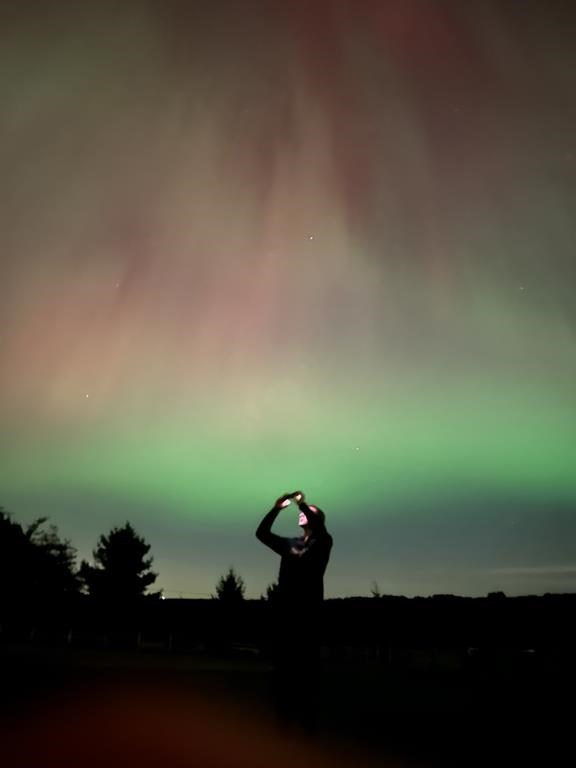
“It was like being in a natural cathedral,” she said. “It kind of makes you feel small.”
Holvik said it was the first time her two sons, and her husband, were able to take in the phenomenon, and the boys spent the evening with eyes to the sky while laying in the grass on the family farm.
She said she was glad her family was able to take in “the quintessential Canadian experience.”
“What’s the point in living in Alberta or in rural Ontario if you can’t get to see those kind of things?”
Thursday’s nights display was one in a series of recent strong solar storms, and University of Alberta physics professor Ian Mann says there could be more on the way.
“It’s very hard to predict when (it’s) going to be,” he said. “It looks to be a much more active cycle than we were expecting.”
Mann explained that the aurora borealis appears as result of “explosions” on the sun’s surface ejecting material into space. When that material comes into contact with the Earth’s atmosphere it becomes visible in the sky as visible light.
The sun, Mann said, has a roughly 11-year cycle where it shifts from minimal solar activity to maximum activity, which includes solar flares and explosions, although solar flares aren’t the cause of the northern lights. Mann said the sun is nearing the peak of another maximum activity cycle point, but just how active this point of the cycle will be remains to be seen.
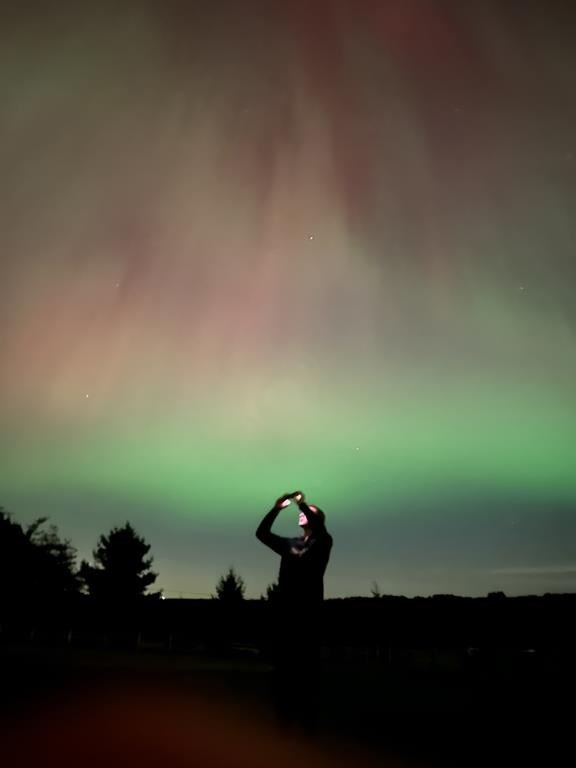
A person is shown taking images of the northern lights display in Meaford, Ontario on Thursday Oct. 10, 2024. THE CANADIAN PRESS/HO - Ian Holvik
“It may be that this winter season for aurora watching might be the best… if that’s when the solar cycle peaks,” he said, noting that as the intensity of solar activity increases, so does the vibrancy, and coverage, of the northern lights, which is why the lights were visible as far south as the midwestern United States.
At the University of Alberta, Mann is a part of a team of researchers who run AuroraWatch, an online platform that tries to forecast the likelihood of the northern lights being visible in the Edmonton area.
AuroraWatch website provides a real-time monitor of geomagnetic activity and the team also offers a free email alert service that issues notices when activity is high.
This report by The Canadian Press was first published Oct. 11, 2024.