

‘Safe and dignified place’: Fully equipped tiny homes open near Halifax for homeless
Advertisement
Read this article for free:
or
Already have an account? Log in here »
To continue reading, please subscribe:

Digital Subscription
One year of digital access for only $205*
- Enjoy unlimited reading on winnipegfreepress.com
- Read the E-Edition, our digital replica newspaper
- Access News Break, our award-winning app
- Play interactive puzzles
*First annual payment billed as $205.00 + GST for one year. This annual subscription will automatically renew at $233.00 + GST every 52 weeks (10% off the regular annual price of $259.35). Offer available to new and qualified returning subscribers only. Cancel any time.
To continue reading, please subscribe:
Add Free Press access to your Brandon Sun subscription for only an additional
$1 for the first 4 weeks*
- Enjoy unlimited reading on winnipegfreepress.com
- Read the E-Edition, our digital replica newspaper
- Access News Break, our award-winning app
- Play interactive puzzles
*Your next Brandon Sun subscription payment will increase by $1.00 and you will be charged $17.95 plus GST for four weeks. After four weeks, your payment will increase to $24.95 plus GST every four weeks.
Read unlimited articles for free today:
or
Already have an account? Log in here »
Hey there, time traveller!
This article was published 24/10/2024 (707 days ago), so information in it may no longer be current.
HALIFAX – About 20 kilometres northwest of downtown Halifax, at the corner of Hopeful and Belief, lie rows of tiny homes, each with their own brightly coloured porch chair, waiting for their first occupants.
The new neighbourhood is Nova Scotia’s latest project to address homelessness, particularly in the province’s biggest city, where as of mid-October almost 1,300 people described themselves as unhoused, according to a local community group.
On Thursday, standing in the morning fog in front of a tiny home, Suzanne Ley with Nova Scotia’s Department of Community Services said the goal of the project is to offer homeless people a temporary accommodation resembling more of a “traditional home.”
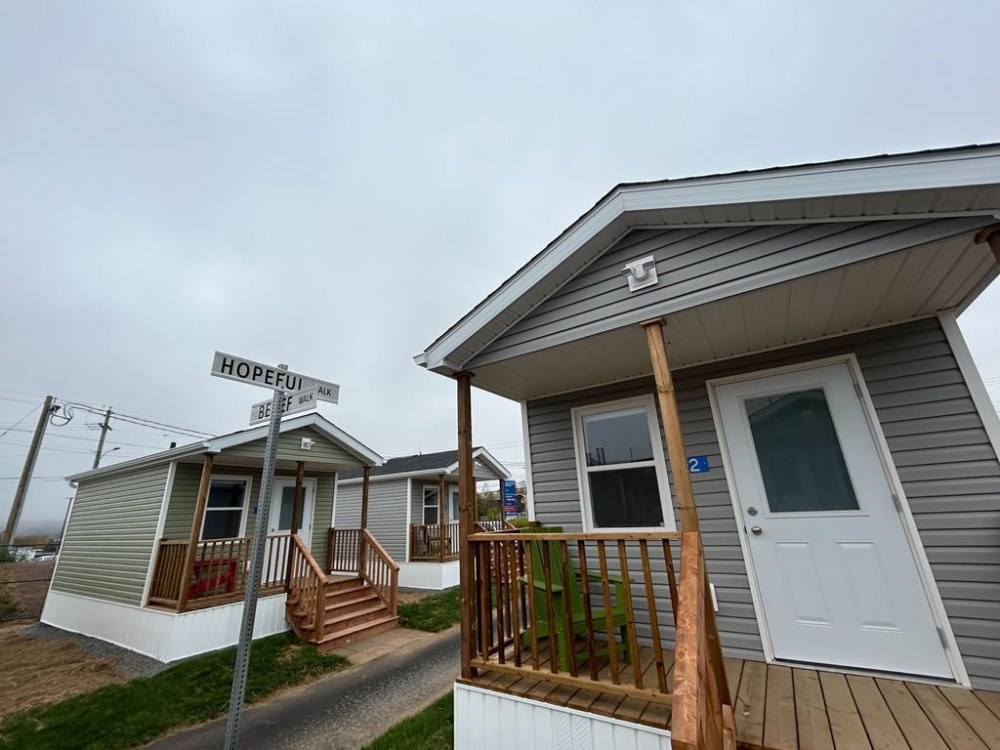
“They’re meant to be a stop along the path towards independence, a safe and dignified place for people to come inside,”Ley said after a tour of the soon-to-be-opened tiny home village in Lower Sackville N.S., a suburb of Halifax.
The homes are miniature versions of the type of house seen in suburban areas, with gable roofs and wooden porches. The narrow paths that line the community have names such as Hopeful Walk and Belief Walk, mimicking streets. The first 26 single-occupancy and four double-occupancy units will open on Nov. 4, and the expected completion date for the rest of the homes is in December. Once complete, the village will house up to 70 people in 60 single- and double-occupancy homes.
Single units are 176 square feet; double-occupancy units are 252 square feet. They come self-contained and fully furnished: each home has a kitchen equipped with a cooktop, small fridge and microwave, as well as a private bathroom and shower.
The tiny home community is a product of a partnership between the province, the Halifax Regional Municipality, United Way Halifax, The Shaw Group and Dexter Construction. The city donated the land for the village, while the United Way Halifax owns the units and will coordinate the necessary property management. The province put up $9.4 million in construction costs last fall to build the homes and has committed $935,000 annually for operational costs.
Residents of the tiny homes are chosen from a list of people experiencing homelessness that is maintained by the Affordable Housing Association of Nova Scotia. The non-profit refers people to the province’s Department of Community Services for a space in one of the homes. A spokesperson for the province said residents for the first phase have already been chosen.
Joe Rudderham, executive director of Atlantic Community Shelters Society, said the tiny homes are unlike Pallet shelters — the 70-square-foot fibreglass structures that were installed in the Halifax area and Kentville, N.S., earlier this year to offer homeless people transitional spaces that are “basically a place to sleep, to sit at a desk, and a place to store some stuff.”
In Lower Sackville’s village, he said, all utilities are included for residents, who will also get access to bedding and towels for their homes. Shared computers, office spaces and laundry facilities are also on site.
Residents living in the units will pay rent that is capped at 30 per cent of their income, whether that be through employment earnings, or support from government programs such as employment insurance, income assistance, or disability supports.
In addition to self-contained units, Rudderham’s group will also provide support to residents to help them get on the path to permanent stability. Rudderham said the supports available will depend onwhat the village residents need, but he expects his group to provide counselling and mental health supports, employment services to help residents with resumes or interview coaching, or educational services such cooking and budgeting lessons.
This report by The Canadian Press was first published Oct. 24, 2024.