

Supreme Court to hear appeal of Quebec ruling that invalidated random police stops
Advertisement
Read this article for free:
or
Already have an account? Log in here »
To continue reading, please subscribe:

Digital Subscription
One year of digital access for only $205*
- Enjoy unlimited reading on winnipegfreepress.com
- Read the E-Edition, our digital replica newspaper
- Access News Break, our award-winning app
- Play interactive puzzles
*First annual payment billed as $205.00 + GST for one year. This annual subscription will automatically renew at $233.00 + GST every 52 weeks (10% off the regular annual price of $259.35). Offer available to new and qualified returning subscribers only. Cancel any time.
To continue reading, please subscribe:
Add Free Press access to your Brandon Sun subscription for only an additional
$1 for the first 4 weeks*
- Enjoy unlimited reading on winnipegfreepress.com
- Read the E-Edition, our digital replica newspaper
- Access News Break, our award-winning app
- Play interactive puzzles
*Your next Brandon Sun subscription payment will increase by $1.00 and you will be charged $17.95 plus GST for four weeks. After four weeks, your payment will increase to $24.95 plus GST every four weeks.
Read unlimited articles for free today:
or
Already have an account? Log in here »
Hey there, time traveller!
This article was published 01/05/2025 (512 days ago), so information in it may no longer be current.
MONTREAL – The Supreme Court of Canada has agreed to hear a case about whether it’s constitutional for police to make a random traffic stop without reasonable suspicion the driver has committed an offence.
Canada’s highest court announced Thursday it has granted the Quebec government leave to appeal a lower court decision that said random stops lead to racial profiling.
The case involves Joseph-Christopher Luamba, a Montrealer of Haitian descent who said he had been stopped by police nearly a dozen times without reason, including several times when he was behind the wheel. None of the stops resulted in a ticket.
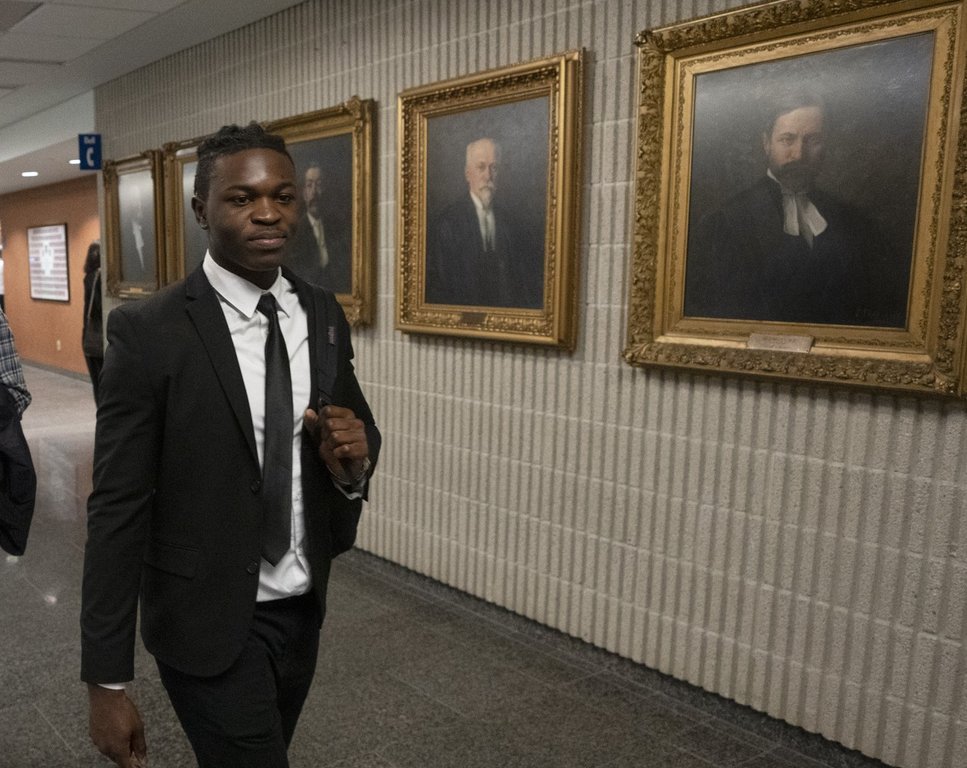
Quebec Superior Court Justice Michel Yergeau sided with Luamba in October 2022, saying that racial profiling exists and that it’s a reality that weighs heavily on Black people.
“The preponderant evidence shows that over time, the arbitrary power granted to the police to carry out roadside stops without cause has become for some of them a vector, even a safe conduit for racial profiling against the Black community,” Yergeau said.
“The rule of law thus becomes … a breach through which this sneaky form of racism rushes in.”
The Canadian Civil Liberties Association intervened on Luamba’s behalf, arguing that random stops by police violate equality rights guaranteed under the Canadian Charter of Rights and Freedoms, and create opportunities for racial profiling.
Yergeau’s decision was greeted by civil rights groups as a victory against racial profiling.
The Quebec government appealed the ruling, arguing that it deprived police of an important tool to stop crime, but the Court of Appeal upheld Yergeau’s decision last year and gave the provincial government six months to make the necessary changes to the Highway Safety Code.
The Supreme Court will be asked to weigh in on whether stopping drivers with no apparent reason violates the Charter, and whether the Quebec judges made an error when they overturned a 1990 Supreme Court decision that upheld the practice of random stops.
The high court ruled in the R. v. Ladouceur decision that random stops were the only way to determine whether drivers are properly licensed, whether a vehicle’s seatbelts work and whether a driver is impaired. But Yergeau wrote it was time for the justice system to declare that the power to stop vehicles at random violates certain constitutional rights, and is obsolete and inoperable.
The lower court rulings do not affect structured police operations, such as roadside checkpoints aimed at stopping drunk drivers.
Quebec’s Public Security Department announced last month that most random traffic stops by police had been suspended, after the Court of Appeal refused the government’s request to allow the practice to continue until the case is heard before the Supreme Court.
This report by The Canadian Press was first published May 1, 2025.